
Generative Engine Optimization for Ecommerce: The Complete 2026 Guide to Getting Cited by AI
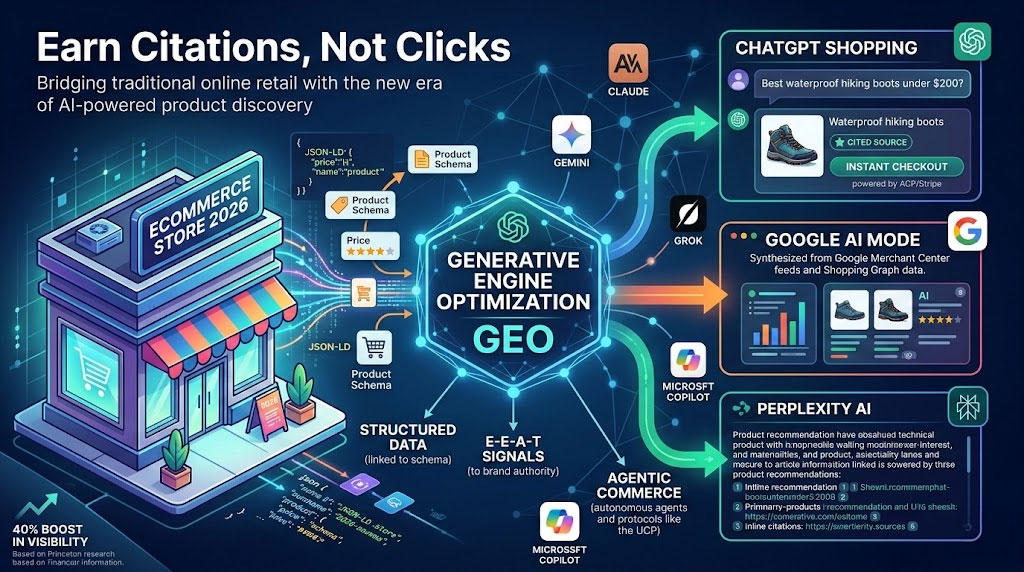
Every ecommerce brand is optimizing for Google. But in 2026, Google is no longer the only engine deciding which products shoppers see. ChatGPT now handles over 50 million shopping queries per day. Perplexity processes more than 500 million queries per month. Google’s own AI Mode synthesizes product answers instead of listing links. If your store isn’t showing up in these AI-generated responses, you’re invisible to a fast-growing segment of buyers — and generative engine optimization is how you fix that.
Generative Engine Optimization (GEO) is the practice of structuring your ecommerce content so that AI platforms — from ChatGPT and Gemini to Claude, Grok, and Perplexity — cite your products, brand, and expertise in their answers. Unlike traditional SEO, which chases clicks from ranked links, GEO is about earning citations inside AI-generated responses. The Princeton University research team that formalized the concept found that GEO strategies can boost visibility in generative engine responses by up to 40%. For online retailers, that visibility now directly translates into revenue.
This guide breaks down exactly how generative engine optimization for ecommerce works in 2026 — covering every major AI platform, the structured data and schema markup that make your products machine-readable, the content strategies that earn AI citations, and a dedicated section on what Saudi Arabia’s ecommerce market needs to do differently. Whether you manage a Shopify store, run a Salla-powered brand in Riyadh, or oversee a multi-channel enterprise operation, this is your playbook for the new era of AI-driven product discovery.

Table of Contents
What Is Generative Engine Optimization (GEO) and Why Ecommerce Stores Need It
Generative Engine Optimization (GEO) is the discipline of optimizing digital content so it gets cited, referenced, and recommended by AI-powered search and assistant platforms. The term was formalized in 2024 by researchers at Princeton University, Georgia Tech, and IIT Delhi, who published the foundational academic paper through the ACM SIGKDD conference. Their research demonstrated that specific content optimization techniques could increase visibility in generative engine responses by up to 40%.
For ecommerce specifically, generative engine optimization means ensuring your product pages, category content, buying guides, and brand information are structured in ways that AI systems can confidently extract, synthesize, and present to shoppers. When a customer asks ChatGPT “what’s the best waterproof hiking boot under $200?” or tells Google’s AI Mode “help me find a laptop for video editing,” the AI doesn’t show a list of blue links. It builds a curated, citation-backed answer — and your store either appears in that answer, or it doesn’t.
The urgency is real. Gartner has predicted a 25% decrease in traditional search engine volume by 2026 as users migrate to conversational AI assistants. Adobe reported that AI-referred traffic to U.S. retail sites grew by an astonishing 1,300% during the 2024 holiday season compared to the prior year, and that momentum continued into 2025 with AI-referred sessions jumping 527% between January and May 2025 alone. Meanwhile, ChatGPT now serves over 700 million weekly active users, many of whom use it for product research and purchasing decisions. This isn’t a future trend — it’s the current reality of how people discover and buy products online.
GEO vs. Traditional SEO: Key Differences for Ecommerce
Understanding the distinction between GEO and traditional SEO is critical for any ecommerce strategy in 2026. While they share a common foundation — quality content, technical excellence, and authority — they diverge in what they optimize for and how success is measured. If you’re already investing in traditional SEO best practices, GEO builds directly on top of that work.
| Factor | Traditional SEO | Generative Engine Optimization (GEO) |
|---|---|---|
| Goal | Rank in search results to earn clicks | Get cited in AI-generated answers |
| Success Metric | Position, CTR, organic traffic | Citation frequency, brand mentions, AI referral traffic |
| Content Format | Keyword-optimized pages | Structured, citable, fact-rich content with inline sources |
| Data Signals | Backlinks, domain authority, page speed | Schema markup, entity relationships, earned media mentions |
| User Interaction | User clicks through to your site | AI may cite your content without the user ever visiting |
| Competition | 10 organic positions per SERP | 3–6 sources cited per AI response |
| Keyword Strategy | Target search volume and difficulty | Target conversational queries and question-based intent |
| Trust Signals | Backlinks, DA/DR scores | E-E-A-T, third-party citations, brand entity recognition |
The critical takeaway is that a page can rank #1 on Google but never get cited by ChatGPT if it lacks the structural elements AI engines prioritize. The research from Princeton confirmed that AI systems heavily favor content containing specific, citable data — a statement like “AI-driven marketing campaigns deliver 20–30% higher ROI” is far more likely to be cited than a vague claim like “AI marketing improves results.” For ecommerce, this means product pages with complete specifications, verified reviews, and structured data consistently outperform thin listings in AI-generated recommendations.
The good news? You don’t have to choose between SEO and GEO. The strategies are complementary. Strong traditional SEO provides the technical foundation (indexing, performance, crawlability), while GEO adds the content structure, entity authority, and machine-readability that AI systems require. In fact, many outdated SEO myths — like keyword density being a silver bullet — are exactly the kind of thinking that GEO forces you to move beyond.
How AI Platforms Discover and Recommend Products in 2026
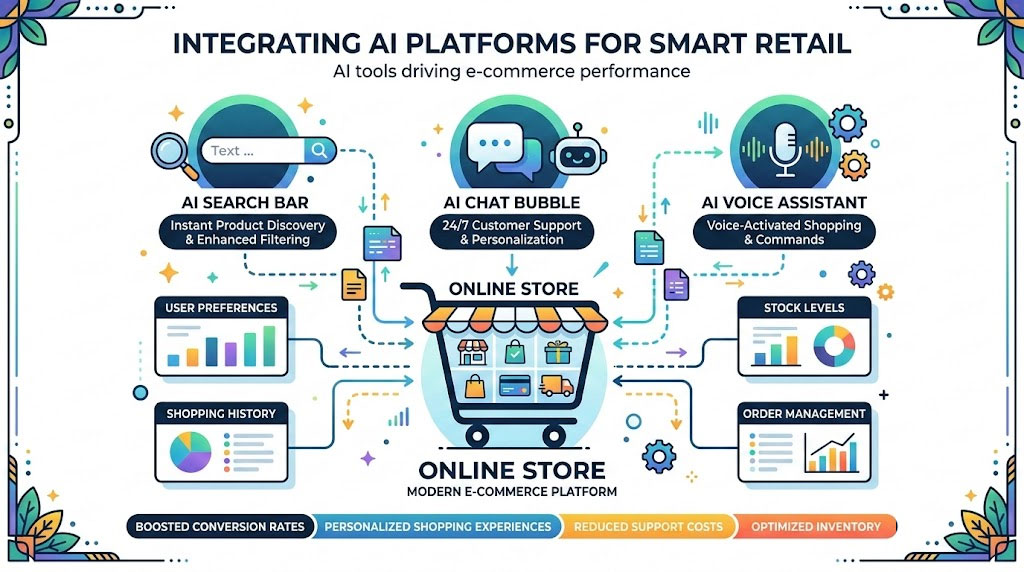
Each AI platform has its own approach to sourcing product information and making recommendations. Effective generative engine optimization requires understanding these differences so you can tailor your strategy. Here’s how the major platforms work.
Google AI Mode and AI Overviews
Google’s AI Overviews synthesize 3–5 sentence answers at the top of search results, linking to 3–6 source pages. In early 2026, Google expanded this significantly with AI Mode — a conversational interface that lets shoppers research, compare, and now purchase products without leaving Google’s ecosystem. The backbone of this shift is the Universal Commerce Protocol (UCP), launched at the National Retail Federation conference in January 2026.
Google’s AI retrieves product information in real time from Merchant Center feeds, structured data on product pages, and the broader Shopping Graph. The new Merchant Center data attributes go far beyond traditional keywords to include answers to common product questions, compatible accessories, and substitute products. For your store to be recommended, your product data must be complete, accurate, and structured using proper schema markup. Google’s system also factors in customer reviews, brand authority signals, and content freshness — pages with visible “Last Updated” signals and current-year statistics outperform outdated content for time-sensitive queries.
ChatGPT Shopping and Instant Checkout
OpenAI has aggressively moved into ecommerce. ChatGPT’s Shopping Research feature, launched in late 2025, uses a specialized variant of GPT-5 mini trained specifically for product research. It achieves 52% accuracy on multi-constraint product queries (compared to 37% for standard ChatGPT Search), making it significantly better at handling complex requests involving price ranges, specifications, and feature trade-offs.
In September 2025, OpenAI introduced Instant Checkout powered by the Agentic Commerce Protocol (ACP), built with Stripe. U.S. users can now purchase directly from Etsy sellers and over a million Shopify merchants — including brands like Glossier, SKIMS, and Vuori — without leaving the chat. Product results are organic and unsponsored, ranked purely on relevance to the user’s query. Critically, ChatGPT only surfaces products from websites that permit its browsing agents via robots.txt — Amazon, for instance, has blocked several OpenAI crawlers, meaning its products rarely appear in ChatGPT recommendations.
For ecommerce brands, this means ensuring your robots.txt allows OpenAI’s crawlers, maintaining accurate product data, and building the kind of content that ChatGPT’s models associate with authority and trustworthiness.
Perplexity AI
Perplexity processes over 500 million queries monthly and has become a go-to platform for product research, particularly among technically savvy users. Unlike ChatGPT, Perplexity always shows its sources with inline citations, making it transparent about where its information comes from. This creates a direct path for ecommerce brands: if your content is well-structured and authoritative, Perplexity will cite it with a visible link.
Perplexity tends to favor recently published content from authoritative domains, including product review sites, brand blogs with detailed specifications, and industry publications. The platform’s shopping features allow users to compare products across multiple sources, and it has begun testing sponsored results alongside organic citations. For GEO, the winning strategy with Perplexity is publishing detailed, data-rich product comparisons and buying guides that serve as citable reference material.
Microsoft Copilot
Microsoft Copilot integrates shopping capabilities across Windows, Edge, Bing, and Microsoft 365 products. In January 2026, Shopify announced a direct integration allowing customers to check out within Copilot’s conversational flow. Copilot leverages Bing’s index and Microsoft’s Shopping Graph, meaning that optimizing for Bing — through proper product feeds, structured data, and Bing Webmaster Tools — directly improves your Copilot visibility.
Copilot’s unique advantage is its integration with enterprise workflows. When a procurement manager asks Copilot to find office supplies within a budget, or a small business owner asks for inventory management tools, Copilot pulls from Bing’s commercial data and your product feeds. B2B ecommerce brands should pay particular attention to Copilot optimization.
Claude, Gemini, and Grok
Claude (by Anthropic) is increasingly used by developers, researchers, and professionals for product and technology research. Claude relies on web search to provide current product information and tends to prioritize well-structured, factual content from authoritative sources. Its focus on accuracy and source attribution means detailed product specifications, well-cited comparison guides, and expert reviews perform particularly well.
Gemini is deeply integrated into Google’s ecosystem — Search, Workspace, Android, and now shopping via UCP. Content that performs well in Google AI Overviews generally performs well in Gemini. The key differentiator is Gemini’s multimodal capability: it can process images and videos alongside text, meaning product photography quality and image alt-text optimization matter more for Gemini than for text-only platforms.
Grok (by xAI) integrates with the X (formerly Twitter) ecosystem and has a unique advantage in surfacing real-time social conversation around products. Brands with strong social proof — active community discussions, influencer mentions, and trending product reviews — tend to appear more frequently in Grok’s recommendations. For ecommerce, this underscores the value of building an active social presence alongside your website optimization.

Structured Data and Schema Markup: The Foundation of Ecommerce GEO
If there is one single action that separates AI-visible ecommerce stores from invisible ones, it’s structured data implementation. Schema markup provides the machine-readable language that AI systems use to understand your products, pricing, availability, reviews, and business entity. According to the Schema.org vocabulary — the standardized language created by Google, Microsoft, Yahoo, and Yandex — structured data transforms plain text into rich contextual information that search engines and AI systems interpret instantly. A BrightEdge study found that pages with structured data receive approximately 30% more clicks compared to standard results — and in the context of generative engine optimization, structured data directly determines whether AI can confidently recommend your products.
In 2026, structured data serves three critical functions for ecommerce. First, it powers rich results in Google Search — product snippets with price, availability, and ratings that significantly boost click-through rates. Second, Google AI Mode and AI Overviews extract structured data to build shopping answers, making schema the most reliable way for AI to parse your product information. Third, it integrates with Merchant Center and other product feed systems that power AI-driven shopping experiences across platforms.
Essential Schema Types for Ecommerce GEO
Not all schema types carry equal weight for ecommerce GEO. Here are the types you must implement, ordered by impact.
| Schema Type | Purpose | GEO Impact |
|---|---|---|
| Product + Offer | Name, description, SKU, price, availability, brand, GTIN | Critical — without this, AI cannot recommend your products |
| AggregateRating + Review | Star ratings, review count, individual reviews | High — AI systems use ratings as trust signals for recommendations |
| FAQPage | Product Q&A content | High — directly feeds conversational AI responses |
| Organization | Brand name, logo, social profiles, contact info | High — establishes brand entity in knowledge graphs |
| BreadcrumbList | Category hierarchy on every page | Medium — helps AI understand site architecture and product taxonomy |
| HowTo | Product usage guides, setup instructions | Medium — earns citations for instructional queries |
| LocalBusiness | Physical store information, service areas | Medium — essential for local and regional AI queries |
| Speakable | Content sections suitable for voice assistant readout | Growing — prepares content for voice commerce |
The key is building interconnected entity chains, not isolated markup. An Organization schema should link to Person schema (your founder/team), which links to Article schema (your content), which links to Product schema (your products). This creates a web of relationships that AI systems use to establish topical authority and trust. Basic schema plugins that generate flat, disconnected JSON-LD are no longer sufficient — Google’s Gemini model and AI Overviews reward rich, interconnected schemas.
JSON-LD Product Schema Example
Here’s what a comprehensive Product schema implementation looks like for a GEO-optimized ecommerce product page. JSON-LD is the recommended format because it keeps structured data separate from HTML, making maintenance easier and reducing the chance of data mismatches.
{
  "@context": "https://schema.org",
  "@type": "Product",
  "name": "ProTrail Waterproof Hiking Boot",
  "image": [
    "https://example.com/images/protrail-boot-front.jpg",
    "https://example.com/images/protrail-boot-side.jpg"
  ],
  "description": "Waterproof hiking boot with Gore-Tex lining, Vibram outsole, and 200g Thinsulate insulation. Ideal for cold-weather trail hiking.",
  "sku": "PT-BOOT-2026",
  "gtin13": "0123456789012",
  "brand": {
    "@type": "Brand",
    "name": "TrailMaster"
  },
  "offers": {
    "@type": "Offer",
    "url": "https://example.com/products/protrail-waterproof-boot",
    "priceCurrency": "USD",
    "price": "179.99",
    "availability": "https://schema.org/InStock",
    "itemCondition": "https://schema.org/NewCondition",
    "shippingDetails": {
      "@type": "OfferShippingDetails",
      "shippingRate": {
        "@type": "MonetaryAmount",
        "value": "0",
        "currency": "USD"
      },
      "deliveryTime": {
        "@type": "ShippingDeliveryTime",
        "handlingTime": {
          "@type": "QuantitativeValue",
          "minValue": 1,
          "maxValue": 2,
          "unitCode": "DAY"
        },
        "transitTime": {
          "@type": "QuantitativeValue",
          "minValue": 3,
          "maxValue": 5,
          "unitCode": "DAY"
        }
      }
    },
    "hasMerchantReturnPolicy": {
      "@type": "MerchantReturnPolicy",
      "returnPolicyCategory": "https://schema.org/MerchantReturnFiniteReturnWindow",
      "merchantReturnDays": 30,
      "returnMethod": "https://schema.org/ReturnByMail"
    }
  },
  "aggregateRating": {
    "@type": "AggregateRating",
    "ratingValue": "4.7",
    "reviewCount": "342"
  },
  "review": [
    {
      "@type": "Review",
      "author": {
        "@type": "Person",
        "name": "Sarah M."
      },
      "reviewRating": {
        "@type": "Rating",
        "ratingValue": "5"
      },
      "reviewBody": "Completely waterproof in heavy rain. Ankle support is excellent for rocky terrain."
    }
  ]
}
Notice the completeness: GTIN identifier for knowledge graph matching, shipping details, return policy, individual reviews tied to specific SKUs, and detailed product attributes. Every field gives AI systems more information to confidently recommend this product. If a shopper asks “what are the best waterproof hiking boots with good ankle support under $200?” — this structured data gives any AI platform enough information to include this product in its response.
Content Strategies That Earn AI Citations for Ecommerce
Structured data gets your products understood by AI. Content strategy gets your brand cited. The Princeton GEO research identified several content optimization strategies that significantly increase visibility in generative engine responses. Here’s how to apply each one to ecommerce.
1. Write for the answer, not the keyword. Traditional SEO targets keywords. GEO targets the answer AI gives when someone asks a question. Structure your product descriptions, buying guides, and category pages to directly answer specific questions. A header that reads “What Are the Best Waterproof Hiking Boots Under $200?” is more likely to be cited by an AI answering that exact query than a header like “Our Waterproof Boot Collection.” Use Google Search Console query data and tools like AlsoAsked or AnswerThePublic to identify the actual questions shoppers ask — then make those questions your H2 and H3 headers.
2. Include specific, citable statistics and data. AI systems heavily favor content with concrete numbers. Instead of writing “our boots are popular with hikers,” write “over 12,000 customers rated this boot 4.7/5 stars, with 94% recommending it for winter trail conditions.” Every factual claim should include a source, a date, or a verifiable data point. This is especially important for product comparisons, market analysis, and buying guides — the types of content most frequently cited in AI shopping responses.
3. Create comprehensive comparison content. AI-generated shopping answers almost always involve comparison. Build detailed comparison tables and guides that evaluate products across multiple criteria — price, features, pros, cons, ideal use cases. Structure these with clear headers and organized data that AI can easily extract. A well-structured “best laptops for video editing in 2026” comparison guide with a proper HTML table and specific benchmarks will earn more AI citations than a collection of individual product pages.
4. Use inline citations and link to primary sources. When you cite a statistic or make a factual claim, link directly to the original source within the text — not in a footnotes section at the bottom. AI systems are trained to recognize cited material as more trustworthy, and inline citations dramatically increase the probability of your content being referenced. This applies to blog posts, buying guides, and even product descriptions that reference certifications, lab test results, or industry standards.
5. Add expert quotes and first-person experience. Content featuring direct quotes from industry experts or first-hand product experience receives significantly more AI citations than generic content. Quotes serve as credibility markers that AI engines prioritize. If you’re reviewing a product, include specific personal observations. If you’re writing a buying guide, include quotes from relevant experts or verified customer testimonials. This aligns directly with what an effective AI content strategy looks like in practice.
6. Maintain content freshness. AI retrieval systems weight recent content for time-sensitive queries. Articles with visible publication and update dates, current-year statistics, and fresh examples outperform evergreen but outdated content. Add a “What Changed in 2026” section to existing articles and regularly update product specifications and pricing. This signals freshness to both AI systems and human readers.
E-E-A-T Signals and Brand Authority for GEO
Google’s E-E-A-T framework (Experience, Expertise, Authoritativeness, Trustworthiness) has always mattered for SEO. In the era of generative engine optimization, it matters even more because AI systems use these signals to determine which sources to trust and cite. A recent large-scale study of AI search systems found a systematic and overwhelming bias toward earned media — third-party, authoritative sources — over brand-owned content. This means the reputation you build across the web directly influences whether AI recommends your products.
To strengthen your E-E-A-T for GEO, start with your own site. Create detailed author bio pages for your team, linking them from every blog post and content page using the person’s name as anchor text. Implement Person schema on these bio pages and Organization schema on your homepage. Use SameAs markup to connect your brand to verified social profiles, industry directories, and platforms like Crunchbase or Wikidata. This helps AI systems build a reliable entity profile for your brand.
Beyond your site, invest in earned media. Guest posts on authoritative industry publications, podcast appearances, expert commentary in news articles, and mentions in independent product reviews all feed the knowledge graphs that AI systems rely on. Encourage customer reviews on platforms like Google, Trustpilot, and niche review sites. User-generated content is frequently used as input for AI summaries — active community discussions and reviews increase your chance of being referenced. The strategies for building free backlinks translate directly into GEO authority signals.
Technical GEO Checklist: Cloud, Security, and Performance
GEO isn’t just about content and schema — the technical infrastructure of your ecommerce store directly affects AI discoverability. AI crawlers and shopping agents require fast, secure, and accessible websites. Here’s your technical checklist.
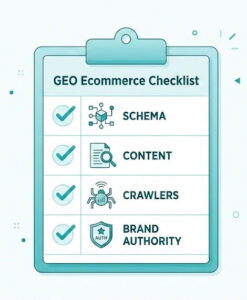
Crawlability and robots.txt. This is non-negotiable. Ensure your robots.txt file allows crawling by major AI platforms. ChatGPT’s shopping feature only surfaces products from sites that permit OpenAI’s browsing agents. Check for: GPTBot, ChatGPT-User, Google-Extended (for Gemini), PerplexityBot, ClaudeBot, and Applebot-Extended. Block any of these, and you’re invisible to that platform’s shopping features.
Site speed and Core Web Vitals. AI systems factor in page load times and user experience signals. A slow-loading product page with poor Largest Contentful Paint (LCP) or Cumulative Layout Shift (CLS) scores is less likely to be recommended. Use a CDN (like Cloudflare), optimize images, and ensure your hosting infrastructure — whether on AWS or another cloud provider — delivers sub-2-second load times globally.
HTTPS and security headers. Every ecommerce page must be served over HTTPS with a valid SSL certificate. Beyond that, implement security headers (Content-Security-Policy, X-Content-Type-Options, Strict-Transport-Security) that signal a well-maintained, trustworthy site. AI systems evaluating source reliability consider security posture as part of their trust assessment.
Mobile-first architecture. With smartphones delivering nearly 78% of ecommerce revenue in markets like Saudi Arabia, mobile optimization is table stakes. AI shopping assistants on mobile devices prioritize mobile-friendly content, and Google’s AI Mode is increasingly used on mobile via the Gemini app. Ensure your product pages are responsive, fast on mobile networks, and free of intrusive interstitials that degrade the user experience.
XML sitemaps and product feed hygiene. Submit a comprehensive XML sitemap that includes all product pages, category pages, and content pages. Keep your Google Merchant Center feed synchronized with your website data — price mismatches, availability errors, or missing GTINs reduce AI confidence in your product data. For platforms like Shopify, WooCommerce, and Salla, use native integrations or dedicated feed management tools to maintain accuracy.
Agentic Commerce: Google’s Universal Commerce Protocol and OpenAI’s Agentic Commerce Protocol
The most significant ecommerce infrastructure shift of 2026 is the emergence of agentic commerce — where AI agents don’t just recommend products but complete the entire purchase on the shopper’s behalf. Two open protocols are leading this transformation, and every serious ecommerce brand needs to understand them.
Google’s Universal Commerce Protocol (UCP) was announced on January 11, 2026, at the National Retail Federation conference. Co-developed with Shopify, Etsy, Wayfair, Target, and Walmart, and endorsed by over 20 partners including Visa, Mastercard, Stripe, and American Express, UCP creates a standardized language for AI agents to handle the full commerce journey — from product discovery through checkout to post-purchase support. As of March 2026, UCP-powered checkout is operational for U.S. shoppers purchasing from Etsy and Wayfair directly within AI Mode in Google Search and the Gemini app, with Shopify, Target, and Walmart integrations launching soon. Google has committed to expanding globally and adding features like loyalty rewards and personalized shopping experiences.
OpenAI’s Agentic Commerce Protocol (ACP), built with Stripe, powers Instant Checkout within ChatGPT. It’s already live for Etsy sellers and over a million Shopify merchants. OpenAI has open-sourced the protocol, inviting developers and merchants to build integrations. Product results are organic and unsponsored — merchants only pay a small fee on completed purchases.
For ecommerce brands, the action items are clear. If you’re on Shopify or Etsy, you’re already eligible for both protocols — no custom integration required. For custom platforms, explore UCP’s GitHub repository and OpenAI’s merchant documentation. If you’re building on WooCommerce, Magento, or regional platforms like Salla and Zid, watch for plugin integrations and prepare your product data now. The retailers who integrate first will capture a disproportionate share of AI-driven purchases as these protocols scale globally through 2026 and 2027. This shift toward autonomous AI agents handling commerce is accelerating faster than most brands realize.

GEO for Ecommerce in Saudi Arabia: What Local Brands Must Do Differently
Saudi Arabia’s ecommerce market is projected to reach $31.29 billion in 2026, growing to $54.87 billion by 2031 at an 11.92% CAGR, according to ResearchAndMarkets. With 99% internet penetration, 78% 5G coverage, and one of the most digitally connected populations in the world, the Kingdom offers massive opportunity — but also unique requirements for generative engine optimization.
Arabic-language content optimization. Most GEO guides focus exclusively on English-language optimization. Saudi brands must optimize for Arabic conversational queries because that’s how the majority of Saudi consumers interact with AI assistants. The recent research on AI search behavior found significant cross-language variation in how different AI platforms source information. Create product descriptions, FAQ sections, and buying guides in both Arabic and English, with proper schema markup for each language version. Ensure your hreflang tags are correctly implemented so AI systems serve the right language version to the right audience.
Local platform integration. While Shopify and WooCommerce dominate globally, Saudi Arabia’s homegrown platforms Salla (serving over 80,000 merchants) and Zid play a pivotal role in the local ecommerce ecosystem. These platforms are actively building their own AI capabilities and will likely integrate with UCP and similar protocols as they expand globally. If you’re on Salla or Zid, ensure your product feeds are complete, your structured data is properly implemented, and your content strategy addresses both local and international AI platforms. The fundamentals of building an ecommerce store in Saudi Arabia now include AI discoverability as a launch requirement, not an afterthought.
PDPL compliance and data governance. Saudi Arabia’s Personal Data Protection Law (PDPL) has implications for how you collect, store, and use the customer data that powers AI-driven personalization. AI shopping platforms are increasingly factoring in regulatory compliance as part of their trust assessment. Ensure your privacy policy, data collection practices, and cookie consent mechanisms are PDPL-compliant. The cybersecurity market in Saudi Arabia is projected to grow from $4.98 billion in 2026 to $7.81 billion by 2031, reflecting the Kingdom’s intense focus on data protection — and AI platforms will increasingly favor stores that meet these standards.
Payment and fulfillment signals. Saudi Arabia’s shift toward cashless payments is accelerating, with 96% of all POS transactions now contactless according to the Saudi central bank data reported by the World Economic Forum. Digital wallets — led by STC Pay — are recording the fastest growth in the ecommerce payment landscape. Include payment method schema (supporting Mada, Apple Pay, STC Pay) and local fulfillment details (same-day delivery in Riyadh, Jeddah, Dammam) in your structured data. When an AI recommends products, it increasingly considers whether the purchase can be completed smoothly in the shopper’s local context. Buy Now Pay Later (BNPL) services and digital wallets are increasingly important signals in the Saudi context.
Vision 2030 and sovereign AI context. Saudi Arabia’s digital economy transformation under Vision 2030 includes massive investments in sovereign AI infrastructure, local data centers, and Arabic-first large language models. As these local AI models develop, Saudi ecommerce brands that have already built comprehensive structured data and Arabic-language GEO content will be first in line for visibility. The investments in sovereign AI mean that local content authority will matter even more as Saudi-specific AI platforms emerge.
Measuring GEO Performance: Metrics and Tools
You can’t improve what you don’t measure. GEO introduces new metrics that complement traditional SEO KPIs. Here’s how to track your generative engine optimization performance.
AI referral traffic in GA4. Google Analytics 4 can segment traffic from AI sources. Look for referral traffic from domains like chat.openai.com, perplexity.ai, bing.com/chat, and gemini.google.com. Create a custom channel grouping for “AI Referrals” to track this traffic separately from organic search. While AI referral traffic is still a fraction of traditional organic traffic for most sites, it’s growing exponentially — tracking it now gives you baseline data to measure improvements.
Citation audits. Manually test how your brand and products appear across AI platforms. Ask ChatGPT, Perplexity, Claude, Gemini, and Grok questions relevant to your product categories and track whether your brand gets cited. Do this weekly for your core product queries. Document which platforms cite you, what content they reference, and how your competitors appear. This manual process is time-consuming but currently the most reliable way to assess GEO visibility.
Brand mention monitoring. Use tools like BrandMentions, Semrush, or Ahrefs to track how often your brand is mentioned across the web — including in AI-generated content, review sites, and forum discussions. AI systems that use RAG (Retrieval-Augmented Generation) pull from live web sources, so the more frequently your brand appears in authoritative contexts, the more likely AI will cite you.
Schema validation. Regularly test your structured data using Google’s Rich Results Test and the Schema.org validator. Check Google Search Console’s “Enhancements” section for errors, warnings, and valid items across all your schema types. A broken schema that goes unnoticed for weeks can silently tank your AI visibility.
Common GEO Mistakes Ecommerce Stores Make
Even stores that are aware of GEO frequently make avoidable mistakes. Here are the most damaging ones.
Blocking AI crawlers in robots.txt. This is the single most common and most damaging mistake. If your robots.txt blocks GPTBot, PerplexityBot, or ClaudeBot, those platforms literally cannot see your products. Audit your robots.txt today and ensure all major AI crawlers are allowed access to your product and content pages.
Relying on a basic schema plugin and calling it done. Most “all-in-one” SEO plugins generate flat, disconnected JSON-LD that covers the bare minimum. In 2026, this level of implementation makes you invisible in AI contexts. You need interconnected entity chains — Organization to Person to Article to Product — with complete attributes including shipping, returns, and verified reviews tied to individual SKUs.
Writing product descriptions for humans only. Product descriptions must serve both human readers and AI extraction. This doesn’t mean keyword stuffing — it means including specific, structured product attributes (materials, dimensions, use cases, compatibility) in clear, parseable formats. A product description that says “great jacket for winter” gives AI nothing to work with. A description that says “800-fill-down insulated jacket rated to -20°C, weighing 450g, with YKK zippers and adjustable cuffs” gives AI everything it needs.
Ignoring earned media and third-party citations. The research is clear: AI systems exhibit an overwhelming bias toward earned media over brand-owned content. If the only place your brand exists online is your own website, AI has limited signals to trust you. Invest in PR, expert contributions, customer reviews on third-party platforms, and partnerships with content creators who cover your product category.
Treating GEO as separate from SEO. GEO is not a replacement for SEO. It’s an extension. The technical SEO foundation — fast load times, clean architecture, proper indexing, mobile optimization — remains essential. GEO builds on top of that foundation with structured data, entity authority, and AI-specific content optimization. Stores that try to do GEO without strong SEO fundamentals will struggle with both.
FAQ: Generative Engine Optimization for Ecommerce
What is generative engine optimization for ecommerce?
Generative engine optimization (GEO) for ecommerce is the practice of structuring your product data, website content, and brand presence so that AI-powered platforms like ChatGPT, Google AI Mode, Perplexity, Claude, Gemini, and Grok cite and recommend your products in their AI-generated shopping answers. Unlike traditional SEO that focuses on ranking in search results, GEO focuses on being included as a trusted source in AI responses.
How is GEO different from traditional SEO for online stores?
Traditional SEO optimizes for ranking positions in a list of search results to earn clicks. GEO optimizes for citations within AI-generated answers. The key differences include: GEO prioritizes structured data and schema markup over keyword density, earned media and third-party citations over backlink volume, conversational question-based content over keyword-targeted pages, and brand entity recognition over domain authority. However, GEO builds on strong SEO foundations — you need both.
What schema markup do ecommerce sites need for GEO?
At minimum, ecommerce sites need Product schema (with complete Offer details including price, availability, shipping, and returns), AggregateRating and Review schema, Organization schema, FAQPage schema, and BreadcrumbList schema. For maximum GEO impact, implement interconnected entity chains linking your Organization to Person (team/founders), Article (content), and Product entities using JSON-LD format.
How do I get my products recommended by ChatGPT?
First, ensure your robots.txt file allows OpenAI’s crawlers (GPTBot and ChatGPT-User). Second, maintain complete, accurate product data on your website with proper schema markup. Third, build your brand presence across authoritative third-party sources — review sites, industry publications, and social platforms. ChatGPT’s Shopping Research feature surfaces products from permitted websites based on relevance, and its Instant Checkout feature (via the Agentic Commerce Protocol) currently supports Shopify and Etsy merchants with plans to expand.
What is Google’s Universal Commerce Protocol and how does it affect ecommerce?
The Universal Commerce Protocol (UCP) is an open standard launched by Google in January 2026 that enables AI agents to discover, evaluate, recommend, and complete purchases across the web. Co-developed with Shopify, Target, Walmart, Etsy, and Wayfair, UCP powers checkout directly within Google AI Mode and the Gemini app. Merchants on supported platforms can enable UCP-powered checkout through their Merchant Center account, allowing shoppers to buy products without leaving Google’s AI interface.
Does generative engine optimization work for Saudi Arabia ecommerce?
Absolutely. Saudi Arabia’s ecommerce market is projected to reach $31.29 billion in 2026, with 99% internet penetration and rapidly growing AI adoption. However, Saudi brands need additional considerations: Arabic-language content optimization for AI queries, proper hreflang implementation, PDPL-compliant data practices, local payment schema (Mada, STC Pay, BNPL), and optimization for both global platforms and emerging Saudi-specific AI models. Brands on local platforms like Salla and Zid should also prepare for upcoming agentic commerce protocol integrations.
How do I measure whether my GEO strategy is working?
Track AI referral traffic in GA4 by creating a custom channel grouping for visits from AI platforms (chat.openai.com, perplexity.ai, gemini.google.com, etc.). Conduct weekly citation audits by asking major AI platforms product-related questions and documenting whether your brand appears. Monitor brand mentions across the web using tools like Semrush or BrandMentions. Validate your schema markup regularly through Google’s Rich Results Test and Search Console. Over time, you should see increasing AI referral traffic, more frequent brand citations, and growing share of voice in AI-generated shopping responses.
Start Optimizing for Generative Engines Today
Generative engine optimization is not a niche technical discipline — it’s the next evolution of how ecommerce brands earn organic visibility. The GEO Conference — the official industry event dedicated to generative engine optimization — now attracts leaders from companies like OpenAI, Google, Etsy, and Adobe, signaling just how seriously the industry is taking this shift. The brands that invest in GEO now, while most competitors haven’t started, will build compounding citation authority that becomes increasingly difficult to displace. Just as domain authority compounds over time in traditional SEO, citation authority in AI systems follows the same trajectory.
Start with the highest-impact actions. Audit your robots.txt to ensure AI crawlers can access your site. Implement comprehensive Product schema with JSON-LD on every product page. Rewrite your top product descriptions and buying guides to include specific, citable data with inline sources. Build your Organization and Person schema to establish entity authority. Then expand outward — earn media coverage, encourage third-party reviews, and create the kind of detailed, expert content that AI systems trust enough to cite.
The era of AI-mediated shopping is here. Whether customers find your products through Google AI Mode, ChatGPT’s Shopping Research, Perplexity, Claude, Copilot, Gemini, or Grok, the fundamentals are the same: make your products machine-readable, your content citation-worthy, and your brand impossible for AI to ignore.
Related reading:
- AI Content Strategy: Proven Playbook to Skyrocket Rankings
- Ecommerce Trends 2026: 10 Technologies Reshaping Online Shopping
- AI Agents for eCommerce: Automate Inventory, Customer Service, and Pricing
- Sovereign AI Saudi Arabia & The Saudi-First Customer Experience
- 15 SEO Myths You Should Ignore in 2026
- Google Discover: Your Comprehensive Guide to Success
Sources: Princeton University GEO Research (KDD 2024), Google Developers Blog — Universal Commerce Protocol (January 2026), OpenAI — Instant Checkout and Agentic Commerce Protocol (September 2025), ResearchAndMarkets — Saudi Arabia Ecommerce Market Report (January 2026), MarketsandMarkets — KSA Cybersecurity Market Forecast (2026), Adobe — AI Traffic Report (2025), Gartner — Search Volume Predictions (2026), Frase.io — GEO Guide (2025), World Economic Forum — Saudi Arabia Digital Economy (January 2026).

Husain Alhaboubi is Director of Digital Channels at Mobily, where he leads platform optimization, AI-powered customer engagement, and UI/UX strategy. With 20+ years of experience spanning eCommerce, IT infrastructure, and digital marketing, he previously drove a 225% revenue increase and 69% organic traffic growth as eCommerce Senior Manager at flyadeal, and managed enterprise IT operations — including data centers, ERP systems, and network security — as Group IT Manager at IPD Group.
Husain holds a BS in Information Systems from the University of Texas at Arlington and is certified in Google Ads, Google Analytics, and Semrush SEO. He writes from hands-on experience across both sides of digital business: the strategic (eCommerce, SEO, AI, digital transformation) and the technical (server administration, cloud computing, web development, networking, and security) — with a particular focus on the Saudi market and Vision 2030. Read his full resume →