
AI Agents for eCommerce: Automate Inventory, Customer Service, and Pricing in 2026
The global eCommerce market is becoming more complex every year, and managing inventory, customer service, and pricing manually is no longer sustainable. AI agents for eCommerce are changing the game by automating these critical operations with minimal human oversight. Unlike basic automation tools that follow rigid rules, AI agents for eCommerce can analyze data in real time, make autonomous decisions, and continuously learn from outcomes.

With the AI-enabled eCommerce market projected to grow from $8.65 billion in 2025 to $22.6 billion by 2032, businesses that adopt these intelligent systems now will gain a serious competitive edge. In this guide, I will break down exactly how AI agents automate inventory management, customer service, and dynamic pricing, and how you can implement them in your own eCommerce business.
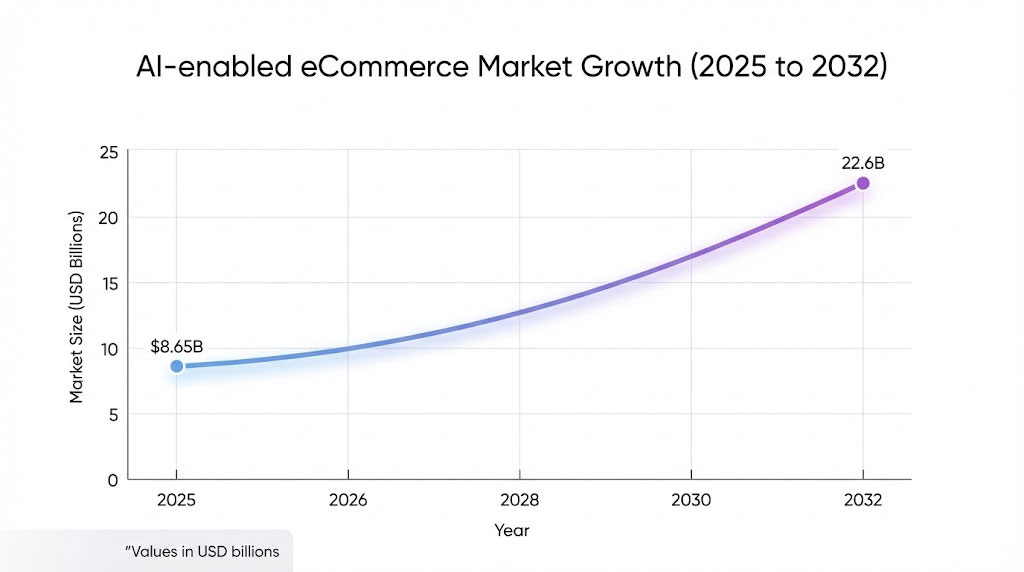
Table of Contents
What Are AI Agents for eCommerce?
AI agents for eCommerce are autonomous software systems that go far beyond traditional rule-based automation. While a conventional automation tool follows predefined “if-then” logic, an AI agent can perceive its environment, make decisions, take actions, and learn from the results — all without requiring constant human input. In the context of online retail, these agents operate across inventory systems, customer support channels, and pricing engines to execute complex workflows independently.
Think of it this way: a traditional automation script might trigger a restock alert when inventory drops below 50 units. An AI agent, on the other hand, analyzes historical sales velocity, upcoming promotions, seasonal demand patterns, and supplier lead times to determine the optimal reorder point for each individual SKU — and then places the purchase order automatically. According to Gartner, approximately 33% of enterprise software applications will include agent-based AI by 2028, up from less than 1% in 2024. That is the scale of the shift we are witnessing, and it explains why AI agents for eCommerce have moved from experimental pilots to core operational tools.
Why eCommerce Businesses Need AI Automation in 2026
The case for eCommerce automation powered by AI has never been stronger. Several converging factors are making it not just advantageous but essential for online retailers to adopt AI agents for eCommerce in 2026.
First, the market is growing at an extraordinary pace. The agentic AI in retail and eCommerce market was valued at $46.74 billion in 2025 and is estimated to reach $60.43 billion in 2026, with projections of $218.37 billion by 2031 at a 29.29% CAGR (Mordor Intelligence, 2026). Second, consumer expectations have shifted permanently. Shoppers now expect instant responses, personalized recommendations, and competitive pricing — 24 hours a day. Meeting those expectations manually is cost-prohibitive at scale.
Third, the data is clear: businesses using agentic AI report measurable results. According to industry research, 69% of AI adopters report measurable revenue increases, while 72% see meaningful cost reductions. Companies that excel at AI-driven personalization generate 40% more revenue than those that do not. For eCommerce businesses competing on tight margins, those numbers represent the difference between growth and stagnation. If you are interested in how AI is reshaping broader business strategies, my guide on autonomous AI agents covers the technology foundations in detail.
AI Agents vs. Traditional Automation: What’s the Difference?
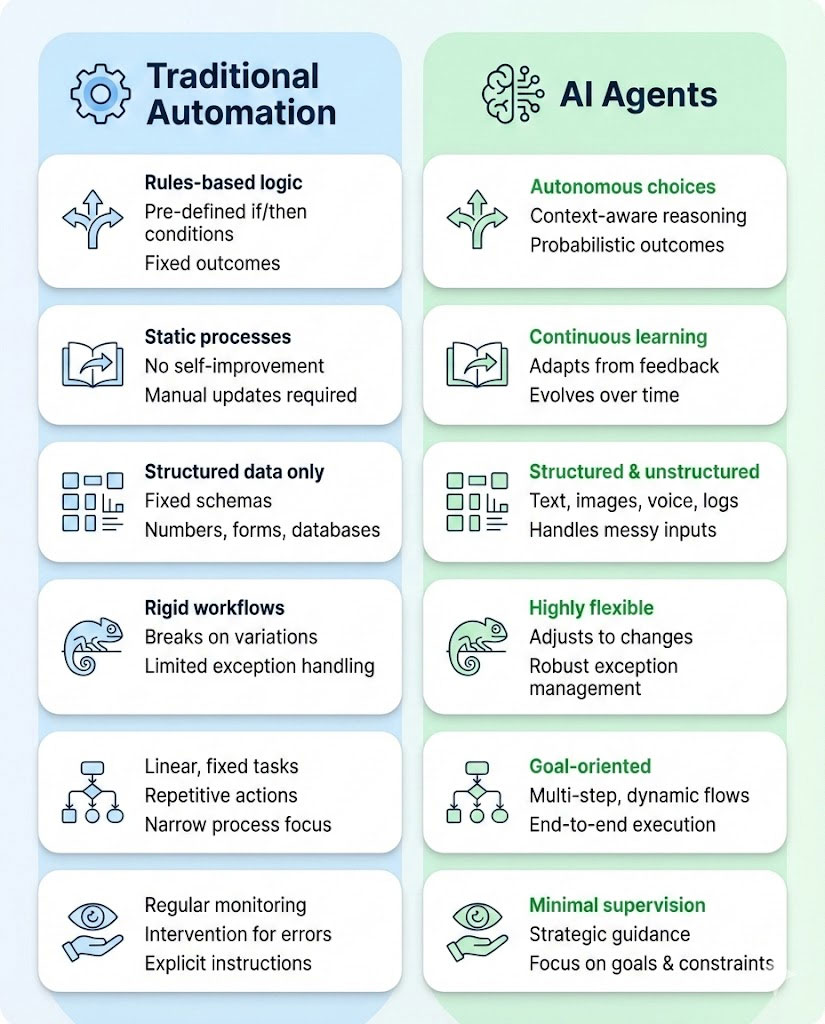
Understanding the distinction between AI agents for eCommerce and traditional automation is critical before investing in either approach. Here is a clear comparison:
| Feature | Traditional Automation | AI Agents |
|---|---|---|
| Decision Making | Follows predefined rules (if-then logic) | Analyzes data and makes autonomous decisions |
| Learning Capability | Static — requires manual updates | Continuously learns and improves from outcomes |
| Data Processing | Handles structured data only | Processes structured and unstructured data in real time |
| Adaptability | Breaks when conditions change | Adapts to new patterns and market shifts |
| Scope of Tasks | Single-step task execution | Multi-step workflow orchestration |
| Human Oversight | Requires frequent monitoring | Operates autonomously with escalation protocols |
| Best For | Repetitive, predictable processes | Complex, variable, multi-factor operations |
AI Agents for Inventory Management
AI inventory management is one of the most impactful applications of AI agents for eCommerce. Traditional inventory systems rely on static reorder points and historical averages, which often lead to either stockouts that cost sales or overstock that ties up working capital. AI inventory management agents solve this by processing multiple data streams simultaneously and making intelligent, real-time stocking decisions.
The numbers back this up: AI-driven inventory management reduces stockouts by up to 65% and cuts forecast errors by 20–50% compared to traditional statistical methods. According to McKinsey, AI-driven supply chain systems cut inventory levels by 20–30% while reducing logistics costs by 5–20%. The global AI inventory management market grew from $7.38 billion in 2023 to $9.6 billion in 2025, with projections to reach $27.23 billion by the end of the decade.
Demand Forecasting and Stock Optimization
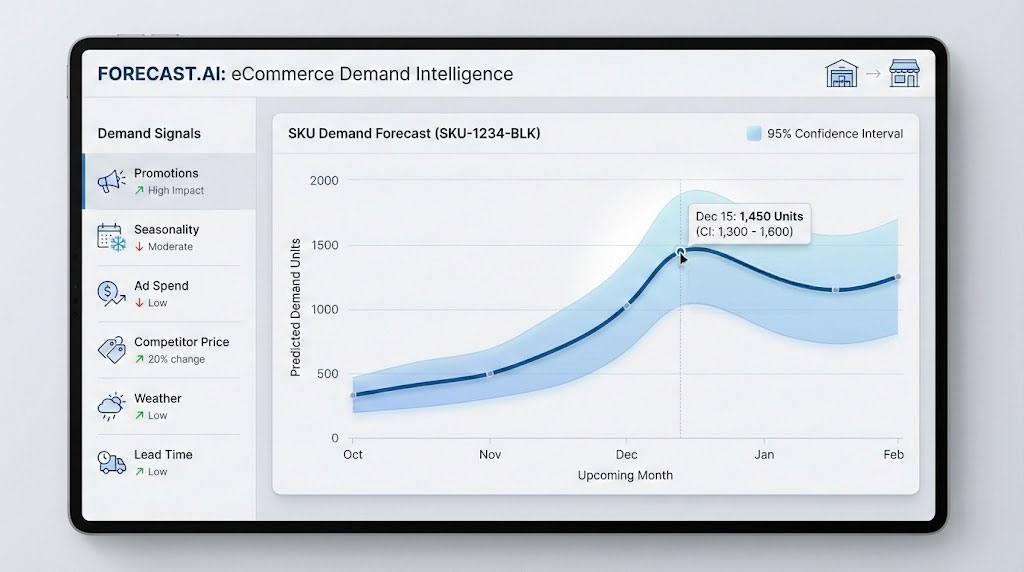
The core advantage of AI inventory management is demand forecasting that goes far beyond what spreadsheets or basic ERP systems can deliver. Machine learning forecasting models ingest multiple data streams: historical order data, sales velocity by SKU and channel, seasonal patterns, promotional calendars, marketing spend, competitor pricing, and even external factors like weather data and economic indicators. The models identify non-obvious correlations and generate demand predictions at the SKU-location level, with confidence intervals that help purchasing teams make better stocking decisions.
For example, an AI agent monitoring a fashion retailer’s inventory might detect that a specific product category sees a 40% demand spike whenever a particular influencer posts about it on social media. The agent factors this into its forecast model, pre-positions inventory at fulfillment centers closest to the expected demand, and adjusts safety stock levels accordingly — all before the spike actually occurs. This kind of proactive intelligence is impossible with traditional rule-based systems, and it is a core reason why AI agents for eCommerce are replacing static inventory tools across the industry.
Automated Replenishment and Supplier Coordination
Beyond forecasting, these intelligent agents can automate the entire replenishment cycle — a critical component of intelligent automation. When an agent determines that a product needs restocking, it calculates the optimal order quantity based on lead times, minimum order quantities (MOQs), sell-through velocity, and desired safety stock levels. It then generates and sends purchase orders to suppliers automatically.
Some advanced systems take this further by negotiating with suppliers through agent-to-agent communication. B2B-focused agents can handle price discussions and contract renewals by analyzing market rates, supplier performance metrics, and negotiation history to secure optimal terms. Amazon, for instance, makes approximately 2.5 million repricing and restocking decisions daily using its AI systems, and analysts estimate that the company’s AI and robotics advancements will generate annual cost savings of up to $16 billion by 2032. Walmart’s automated fulfillment centers have already cut unit costs by 20% compared to manual operations. If you are running an eCommerce operation that involves complex logistics, you might also find value in understanding how digital transformation is reshaping supply chains across markets.
AI Agents for Customer Service
AI customer service has evolved dramatically from the basic chatbots of a few years ago. Modern AI agents for eCommerce can handle complex, multi-turn conversations, understand context and sentiment, and resolve issues autonomously. The financial impact is significant: the average cost of a chatbot interaction is $0.50, compared to $6.00 for a human customer service interaction — a 12x difference. Gartner projects that conversational AI will save $80 billion in contact center labor costs by 2026.
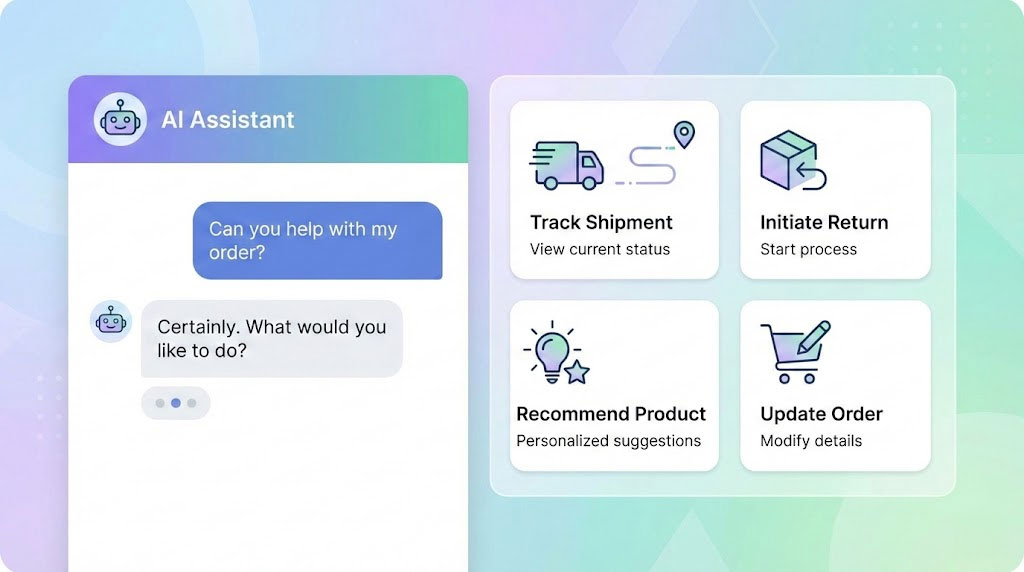
For eCommerce specifically, AI agents for eCommerce customer service are proving particularly effective at driving revenue, not just cutting costs. Research from Rep AI’s 2025 Ecommerce Shopper Behavior Report, which analyzed over 17 million shopping sessions, found that 93% of customer questions are resolved without human intervention when handled through conversational AI. Even more compelling, 64% of AI-powered sales come from first-time shoppers, demonstrating that conversational AI builds trust with new customers effectively.
Conversational AI and Autonomous Resolution
Today’s AI customer service agents can handle a wide range of eCommerce tasks autonomously. These include answering product questions, providing shipping updates, processing returns and exchanges, recommending products based on browsing history, recovering abandoned carts, and even completing purchases on behalf of customers. Amazon’s Rufus AI shopping assistant now includes an “Auto Buy” feature that authorizes the chatbot to complete purchases when products reach a target price.
The performance data shows that AI agents excel at transactional and logistics-based tasks. Chatbot-assisted return or cancellation requests achieve success rates of up to 58%, while proactive approach conversations result in 35% cart recovery rates. When shoppers are greeted proactively by an AI assistant rather than having to initiate the chat, nearly 45% engage with the bot. These engagement rates translate directly into revenue: eCommerce stores using AI agents for eCommerce customer service report a 67% increase in sales, and conversion rate improvements of up to 30%.
The Hybrid Support Model: AI and Human Collaboration
Despite impressive AI agents for eCommerce automation capabilities, the most effective approach combines AI efficiency with human empathy. According to a Cisco survey, 89% of consumers believe the best support experience combines human empathy with AI efficiency. While 51% of consumers prefer interacting with bots for instant assistance, 86% say empathy and emotional connection matter more than speed alone.
The practical implementation of AI customer service looks like this: AI agents handle the high volume of routine inquiries — order status, product information, return processing — automatically and instantly. When they detect emotionally complex situations, billing disputes, or cases requiring nuanced judgment, they escalate seamlessly to human agents, complete with full conversation context. This AI customer service approach achieves the best of both worlds: speed and availability for simple queries, and human understanding for sensitive ones. If you want to explore how businesses are creating seamless experiences across multiple touchpoints, my article on omnichannel customer experience provides a deeper look.
AI Agents for Dynamic Pricing
AI dynamic pricing is rapidly becoming essential for eCommerce competitiveness. Static pricing strategies — where you set a price and leave it — leave significant revenue on the table. AI agents for eCommerce pricing continuously analyze demand signals, competitor prices, inventory levels, and customer behavior to optimize prices in real time. Gartner predicts that 90% of eCommerce businesses will implement some form of AI dynamic pricing by 2026.
The results are compelling. McKinsey research shows that AI dynamic pricing generates 2–5% sales growth, with 5–10% margin increases. During peak sales periods, businesses using dynamic pricing have reported average order value lifts of up to 13%. One Asian retailer achieved a 10% gross margin rise within months of deploying AI pricing, alongside a 3% increase in gross merchandise value. A European retailer saw 4.7% EBITDA improvement in pilot categories alone.
How AI Pricing Algorithms Work
Modern AI dynamic pricing systems use several algorithmic approaches depending on the business context. The most common include reinforcement learning, which optimizes pricing by learning from environmental data about demand elasticity, seasonality, and market uncertainty; decision trees, which identify the price ranges that predict the highest revenue; and multi-factor elasticity models that determine the impact of price changes on demand while accounting for cannibalization and competitive effects.
A sophisticated pricing AI system typically consists of multiple specialized modules working together. These include a long-tail module for new products without historical data, a competitive response module that uses real-time competitor pricing data, a key-value item (KVI) module that manages consumer price perception for products whose prices shoppers tend to remember, and time-based pricing modules that adjust for seasonality, peak shopping hours, and product lifecycle. The key differentiator from traditional rule-based pricing is that AI agents for eCommerce pricing use ML algorithms that can consider up to sixty variables simultaneously, compared to the three variables that earlier systems could handle.
Real-World Dynamic Pricing Results
Several major retailers have demonstrated the power of AI dynamic pricing at scale. Amazon makes approximately 2.5 million repricing decisions daily, resulting in an estimated 25% increase in profits. Wendy’s is investing $20 million in AI-powered digital menu boards that dynamically adjust offerings based on real-time factors including time of day, weather, and customer traffic.
The adoption curve is accelerating rapidly. While 61% of European retailers have adopted some form of dynamic pricing, a survey by Valcon found that 55% of those who have not yet adopted are actively planning to pilot dynamic pricing with generative AI in 2026. Among companies that have pursued AI-driven pricing transformations, large firms have seen over $100 million in revenue improvement — a success rate 70% higher than AI applications in other business areas. For eCommerce businesses looking to stay competitive, understanding the broader eCommerce technology trends helps put pricing automation in the right strategic context.
How AI Agents Work Together: The Unified Automation Stack
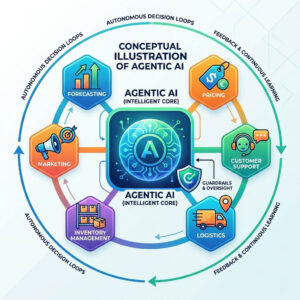
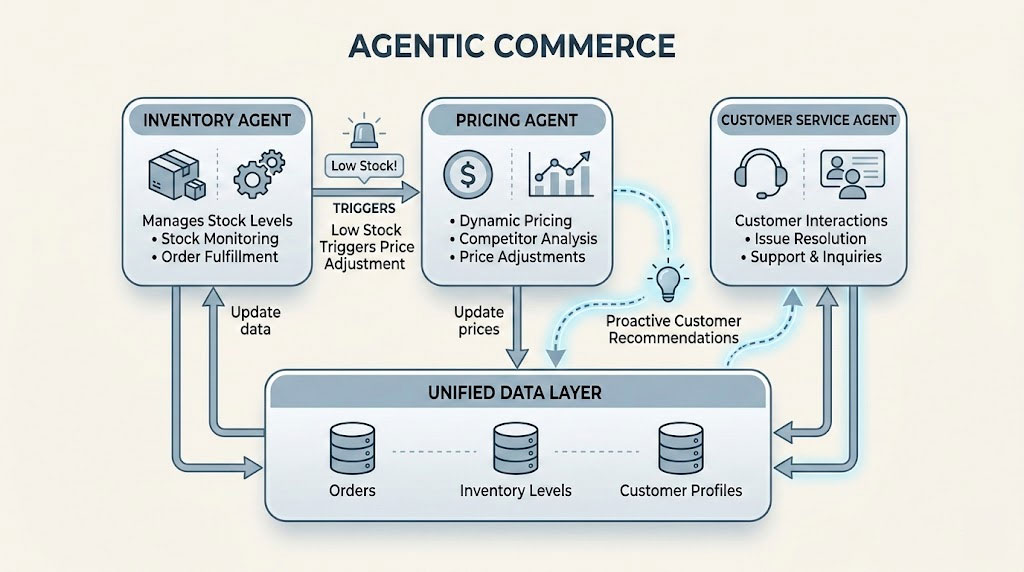
The real power of AI agents for eCommerce emerges when they operate as a unified system rather than isolated tools. In a connected automation stack, the inventory agent, customer service agent, and pricing agent share data and coordinate actions in real time.
Consider this practical scenario: an inventory agent notices that a popular product is running low on stock and that the next supplier shipment will not arrive for two weeks. It communicates this to the pricing agent, which gradually increases the price to slow demand and maximize margin on remaining units. Simultaneously, the customer service agent begins proactively suggesting alternative products to shoppers who inquire about the low-stock item. When the new shipment arrives, the pricing agent adjusts back to competitive levels, the inventory agent redistributes stock across fulfillment centers, and the customer service agent starts recommending the restocked product to customers who previously showed interest.
This kind of orchestration is what industry analysts refer to as “agentic commerce,” and it represents the next major evolution in eCommerce automation. As TechRadar noted, Gartner predicts that up to 40% of enterprise applications will include task-specific agentic AI by 2026, up from under 5% in 2025. The retailers that build unified data foundations today will be the ones who capture the most value from this shift. The critical prerequisite is unified data: when inventory, orders, pricing, and customer context live in disconnected systems, even the smartest AI agents for eCommerce cannot deliver consistent results.
AI Agents for eCommerce in Saudi Arabia and the Middle East
The Saudi Arabian market represents one of the most exciting opportunities for AI agents for eCommerce adoption globally. The Kingdom’s eCommerce market is projected to reach $31.29 billion in 2026, growing from $27.96 billion in 2025, with an anticipated 11.92% CAGR through 2031 (Research and Markets, January 2026). This growth is underpinned by Vision 2030’s massive digital infrastructure investments, including 99% internet penetration and 78% 5G coverage.
Saudi Arabia’s AI ambitions are substantial. The Saudi AI market is estimated at $2.14 billion in 2025 and is projected to reach $16.90 billion by 2032, growing at a 34.3% CAGR (MarketsandMarkets). A 2025 SAP-YouGov survey found that 81% of Saudi enterprises are already deploying AI solutions tailored to their industries, with 52% identifying improved customer satisfaction as their most important success measure. PwC Middle East estimates that AI could contribute $135 billion to Saudi Arabia’s GDP by 2030, equivalent to 12.4% of GDP.
For eCommerce businesses operating in the Saudi market, AI agents for eCommerce are particularly relevant given the Kingdom’s young, tech-savvy population and rapid shift toward cashless transactions. A Checkout report found that 53% of MENA shoppers have already used AI-powered visual search tools for online shopping. The Saudi Data and AI Authority (SDAIA) continues to drive the National Strategy for Data and AI, while the Public Investment Fund’s HUMAIN initiative — launched in May 2025 — is investing across the entire AI value chain from data centers to applications. For more on how Vision 2030 is driving digital transformation across the Saudi economy, read my in-depth analysis of Saudi Arabia’s digital transformation journey.
How to Implement AI Agents in Your eCommerce Business
Implementing AI agents for eCommerce successfully requires a structured approach. Based on what is working for retailers across different scales, here is a practical implementation roadmap:
Step 1: Audit your data foundation. AI agents are only as good as the data they can access. Start by ensuring your sales, inventory, customer, and supplier data are clean, connected, and flowing in real time. If your systems are siloed, the first investment should be in data integration, not AI tools.
Step 2: Identify your highest-ROI automation category. For most eCommerce businesses, AI inventory management or AI customer service automation delivers the fastest return. Audit where you are losing the most money — stockouts, overstocking, slow customer responses, or uncompetitive pricing — and start there.
Step 3: Choose platform-native AI features first. If you are on Shopify, WooCommerce, BigCommerce, or another major platform, explore the AI agents for eCommerce capabilities built into your existing stack before adding specialized third-party tools. The integration overhead of managing six to eight separate AI systems is becoming the primary bottleneck for mid-market retailers.
Step 4: Deploy with guardrails. Human oversight remains essential when launching AI agents for eCommerce, particularly for critical decisions. Set up review processes for pricing recommendations, inventory adjustments, and customer escalation rules. Monitor your AI systems for bias, drift, and performance changes, especially in the first 90 days.
Step 5: Measure and expand. Track specific KPIs for each automation category — stockout rate, forecast accuracy, first-contact resolution rate, average order value, and margin improvement. Once you have proven results in one area, expand methodically to the next. Industry data shows that businesses deploying AI agents for eCommerce automation achieve 170–219% ROI over three years with payback periods under 18 months.
Common Mistakes to Avoid with AI eCommerce Automation
Having observed how businesses approach eCommerce automation, there are several pitfalls that can undermine your investment in AI agents for eCommerce:
Deploying AI on top of dirty data. This is the most common and most costly mistake with AI agents for eCommerce. If your product catalogs have inconsistent SKUs, your inventory counts are inaccurate, or your sales data is incomplete, AI will amplify those errors rather than fix them. Clean your data before deploying any AI solution.
Removing human oversight too quickly. While AI agents can operate autonomously, removing human review entirely from the start is risky. Start with human-in-the-loop models where AI makes recommendations that humans approve, then gradually increase autonomy as confidence builds.
Ignoring the customer trust gap. When deploying AI agents for eCommerce customer interactions, transparency is critical. Only 34% of US customers currently express comfort in letting AI shop for them, and 46% of shoppers are unlikely to let a digital assistant manage their entire shopping trip. Transparency matters — customers should always know when they are interacting with AI, and escalation to human support should be easy and immediate.
Over-investing in tools without a data strategy. Successful AI agents for eCommerce deployment depends on data quality first. According to a 2025 SAP survey, 96% of companies plan to invest in data consolidation and quality improvement programs, recognizing that robust data foundations are a prerequisite for AI success. Only 28% of manufacturers maintain formal digital strategies, creating a significant gap between AI investment and actual results.
Treating AI as a one-time implementation. AI agents for eCommerce require ongoing monitoring, retraining, and optimization. Market conditions change, consumer behavior shifts, and competitors adjust their strategies. Your AI systems need to evolve continuously. Set up regular performance reviews and dedicate resources to model maintenance.
FAQ: AI Agents for eCommerce Automation
What are AI agents for eCommerce and how do they differ from chatbots?
AI agents in eCommerce are autonomous systems that can perceive data, make decisions, and take actions across multiple business functions like inventory, pricing, and customer service. Unlike basic chatbots that follow scripted responses, AI agents learn from outcomes, handle multi-step workflows, and operate across different systems simultaneously. They represent a significant upgrade from both traditional automation and simple chatbot technology.
How much does it cost to implement AI agents for an eCommerce store?
Costs vary significantly based on scale and complexity. For small to mid-size businesses using AI agents for eCommerce, comprehensive AI customer service platforms range from $2,000 to $8,000 per month, plus 20–40 hours of setup time. Enterprise solutions start around $10,000 or more per month. However, the ROI is typically strong: businesses report an average 250% ROI on AI investments, with payback periods under 18 months. Starting with platform-native AI features (like those built into Shopify or BigCommerce) is the most cost-effective entry point.
Which eCommerce function benefits most from AI agents — inventory, customer service, or pricing?
It depends on where your biggest operational pain points are. For most eCommerce businesses, AI inventory management delivers the fastest measurable ROI because stockouts and overstock have direct, quantifiable financial impact. AI customer service automation provides the highest volume cost savings (12x reduction per interaction). AI dynamic pricing typically has the biggest impact on margins (5–10% increases). The ideal approach is to start with one area, prove the ROI, and then expand to the others.
Can small eCommerce businesses benefit from AI agents, or is this only for large retailers?
Small businesses can absolutely benefit. AI tools have become significantly more accessible, with platforms like Prediko, Netstock, and Cin7 offering plug-and-play AI inventory management for brands with as few as 500 SKUs. For customer service, tools like Rep AI and Tidio offer AI chatbots starting at free or low-cost tiers. The key is to start with one focused AI agents for eCommerce use case rather than trying to automate everything at once. As of 2025, roughly 89% of retailers are already using or piloting AI, including many small and mid-size businesses.
Do customers trust AI agents for customer service in eCommerce?
Consumer trust in AI is growing but still nuanced. About 51% of consumers prefer bots when seeking immediate assistance, and 48% say it is harder to tell the difference between AI and human service reps. However, 87% of consumers prefer a hybrid model that combines AI speed with human empathy. The key to building trust with AI agents for eCommerce is transparency (making it clear when customers are interacting with AI), easy escalation paths to human agents, and consistently high-quality responses. Businesses that get this balance right see significant customer satisfaction improvements.
What are the security and privacy concerns with AI agents in eCommerce?
Data security and privacy are top concerns — 74% of CEOs cite them as their biggest AI implementation challenge, and 53% of managers report data security concerns affecting deployment. Key considerations for AI agents for eCommerce include ensuring AI systems comply with relevant data protection regulations (like Saudi Arabia’s PDPL or GDPR), implementing proper data encryption, limiting AI access to only necessary data, and maintaining audit trails for all AI-driven decisions. Choose AI vendors with strong security certifications and clear data handling policies.
How long does it take to see results from AI eCommerce automation?
Most businesses see initial results within 30–90 days of deployment, with full ROI realized within 12–18 months. AI customer service typically shows the fastest results because the baseline metrics (response time, resolution rate) are immediately measurable. AI inventory management forecasting improvements compound over time as the AI learns from more data. AI dynamic pricing results can appear within weeks for businesses with sufficient transaction volume. The key factor is data quality — businesses with clean, connected data see results faster than those that need extensive data cleanup first.
Will AI agents replace human workers in eCommerce?
AI agents are transforming roles rather than eliminating them entirely. By 2030, AI is expected to manage 80% of customer interactions, but this frees human agents to focus on complex problem-solving, relationship building, and strategic work. The most successful AI agents for eCommerce implementations use AI to handle routine, high-volume tasks while humans tackle creative, emotional, and high-stakes situations. According to industry surveys, 47% of leaders see upskilling existing employees as a top priority, and 28% are already considering hiring AI trainers to help teams work effectively alongside AI systems.
Start Automating Your eCommerce Operations with AI Agents
AI agents for eCommerce are no longer experimental technology. With 89% of retailers already using or piloting AI, and the market projected to grow at nearly 30% annually, the question is not whether to adopt AI automation — it is how quickly you can implement it effectively. The three pillars covered in this guide — inventory management, customer service, and dynamic pricing — represent the highest-impact areas where AI agents deliver measurable ROI.
Start with your data foundation. Identify your biggest operational bottleneck. Deploy AI in that area with proper guardrails and human oversight. Measure results. Then expand. The businesses that take this methodical approach to AI agents for eCommerce in 2026 will be the ones that dominate their categories in the years ahead. Whether you are operating in the Saudi market, the broader MENA region, or globally, the fundamentals of agentic AI adoption are the same: clean data, focused implementation, and continuous optimization.
Related reading:
- The Ultimate Guide to Autonomous AI Agents
- Ecommerce Trends 2026: 10 Technologies Reshaping Online Shopping
- Saudi Arabia’s Digital Economy in 2025: Vision 2030’s Tech-Driven Transformation
- Digital Consumer Behavior in Middle East E-commerce
- AI Content Strategy: Proven Playbook to Skyrocket Ranking
- A Beginner’s Guide to Opening an E-commerce Website in Saudi Arabia
Sources: Gartner (2025–2026), McKinsey & Company, Mordor Intelligence (2026), Rep AI 2025 Ecommerce Shopper Behavior Report, MarketsandMarkets Saudi Arabia AI Market Report, SAP-YouGov Survey (November 2025), Research and Markets Saudi Arabia Ecommerce Report (January 2026), Shopify AI Statistics (2026), Zendesk AI Customer Service Report, PwC Middle East AI Impact Study, Valcon European Retail Pricing Survey.

Husain Alhaboubi is Director of Digital Channels at Mobily, where he leads platform optimization, AI-powered customer engagement, and UI/UX strategy. With 20+ years of experience spanning eCommerce, IT infrastructure, and digital marketing, he previously drove a 225% revenue increase and 69% organic traffic growth as eCommerce Senior Manager at flyadeal, and managed enterprise IT operations — including data centers, ERP systems, and network security — as Group IT Manager at IPD Group.
Husain holds a BS in Information Systems from the University of Texas at Arlington and is certified in Google Ads, Google Analytics, and Semrush SEO. He writes from hands-on experience across both sides of digital business: the strategic (eCommerce, SEO, AI, digital transformation) and the technical (server administration, cloud computing, web development, networking, and security) — with a particular focus on the Saudi market and Vision 2030. Read his full resume →