
Start an Ecommerce Business in Saudi Arabia: The Complete 2026 Guide
Want to start an ecommerce business in Saudi Arabia? You are entering one of the fastest-growing digital markets in the Middle East. With a market size of $31.29 billion in 2026 and projections reaching $54.87 billion by 2031 (Mordor Intelligence, January 2026), the Kingdom offers exceptional opportunities for entrepreneurs willing to navigate its regulatory landscape and tap into a population where 91% of residents shop online regularly. This comprehensive guide walks you through every step—from business registration to launch—so you can build a compliant, profitable online store in Saudi Arabia that consumers trust and return to.
Table of Contents
Why Start an Ecommerce Business in Saudi Arabia?
Before diving into the how, let me share why the Saudi ecommerce market represents such a compelling opportunity for online entrepreneurs.
The numbers tell a powerful story:
| Metric | Figure | Source |
|---|---|---|
| Ecommerce Market Size (2026) | $31.29 billion | Mordor Intelligence, January 2026 |
| Projected Market Size (2031) | $54.87 billion | Mordor Intelligence, January 2026 |
| Annual Growth Rate (CAGR) | 11.92% | Mordor Intelligence, January 2026 |
| Internet Penetration | 99% | DataReportal, January 2025 |
| 5G Coverage | 78% nationwide | Mordor Intelligence, January 2026 |
| Population | 34.3 million | DataReportal, January 2025 |
| Online Shoppers | 91% shop regularly | Setup in Saudi, 2025 |
| Electronic Payment Adoption | 79% of retail transactions | Saudi Central Bank (SAMA), April 2025 |
| Licensed Ecommerce Stores | 40,953 (Q4 2024) | Monsha\u0027at, 2024 |
Several factors make this market particularly attractive for new entrants:
- Young, tech-savvy population: 65% of Saudi Arabia\u0027s population is under 40, with 25% falling in the highly engaged 18–24 age bracket
- Mobile-first consumers: 78% of ecommerce transactions occur on smartphones, with median mobile internet speeds of 124.61 Mbps (DataReportal, January 2025)
- Government support: Vision 2030 prioritizes ecommerce growth, allowing 100% foreign ownership for licensed businesses
- Cashless transition: Electronic payments exceeded the government\u0027s 70% target, reaching 79% of all retail transactions in 2024, with 12.6 billion non-cash transactions processed (SAMA, April 2025)
- Infrastructure investment: Over $24.8 billion invested in digital infrastructure over the past six years, including nationwide 5G coverage
The Kingdom\u0027s digital transformation under Vision 2030 has created an environment where starting an online business is more accessible than ever—provided you understand the requirements. Emerging ecommerce trends like AI-driven logistics and social commerce are further accelerating growth opportunities in the Kingdom.
Step 1: Define Your Business Model and Niche
Before you start an ecommerce business in Saudi Arabia, you need clarity on what you are selling and to whom. This foundational step determines everything from your platform choice to your marketing strategy.
Choosing Products That Sell
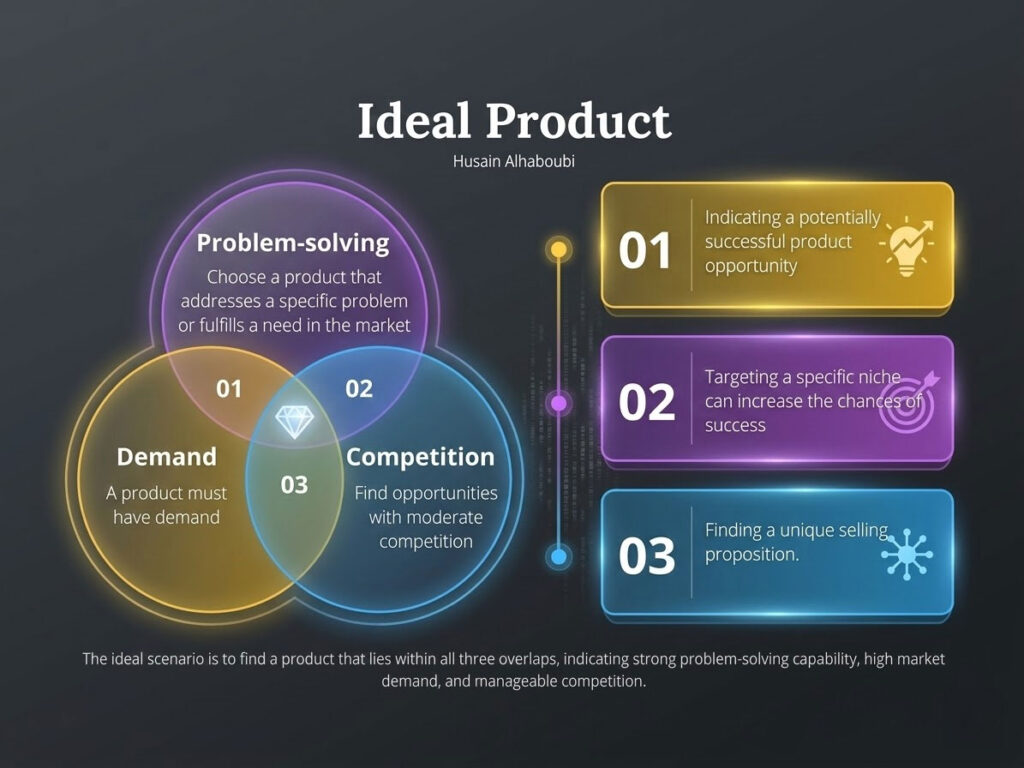
An ideal product sits at the intersection of three factors:
- Problem-solving: Does it address a genuine need or pain point?
- Demand: Is there proven market interest? Use Google Trends (filtered to Saudi Arabia) and Amazon.sa bestseller lists to validate
- Manageable competition: Can you differentiate, or is the market saturated with established players?
I recommend choosing products you are familiar with. If you understand the customer\u0027s perspective, you\u0027ll make better decisions about sourcing, marketing, and customer service.
Top-Performing Ecommerce Categories in Saudi Arabia
Based on current market data, these categories show the strongest performance in the Saudi ecommerce market:
| Category | Market Share/Notes | Growth Trend |
|---|---|---|
| Electronics & Consumer Tech | 30% of ecommerce market | Moderate (longer replacement cycles) |
| Fashion & Apparel | Strong, especially modest fashion | High growth |
| Beauty & Personal Care | Growing rapidly | High growth |
| Food & Grocery | 13.72% CAGR (fastest growing) | Very high growth |
| Home & Furniture | Steady demand | Moderate growth |
The grocery delivery segment is particularly compelling, with dark-store models enabling 15-minute delivery in major cities. However, this requires significant logistics investment. Understanding digital consumer behavior in the Middle East can help you identify which categories align best with your target audience. AI-powered agents are also transforming inventory management and pricing in these fast-moving categories.
Choosing Your Business Structure
Saudi Arabia offers several structures for ecommerce businesses:
- Limited Liability Company (LLC): Most common choice for ecommerce. Protects personal assets and provides better access to banking and contracts.
- One-Person Company (OPC): Ideal for solo entrepreneurs wanting liability protection with full ownership control.
- Freelance License: Available through freelance.sa for individuals starting small. Lower barrier to entry but limited scalability.
- Branch of Foreign Company: For international brands entering the Saudi market with full control over operations.
For most new entrepreneurs, I recommend starting with a Freelance License to test your concept, then transitioning to an LLC as you scale.
Step 2: Register Your Business Legally
To legally operate an online store in Saudi Arabia that regulators recognize, you must complete several registration steps. The regulatory framework has evolved significantly, and compliance is actively enforced.
Obtaining Your Commercial Registration (CR)
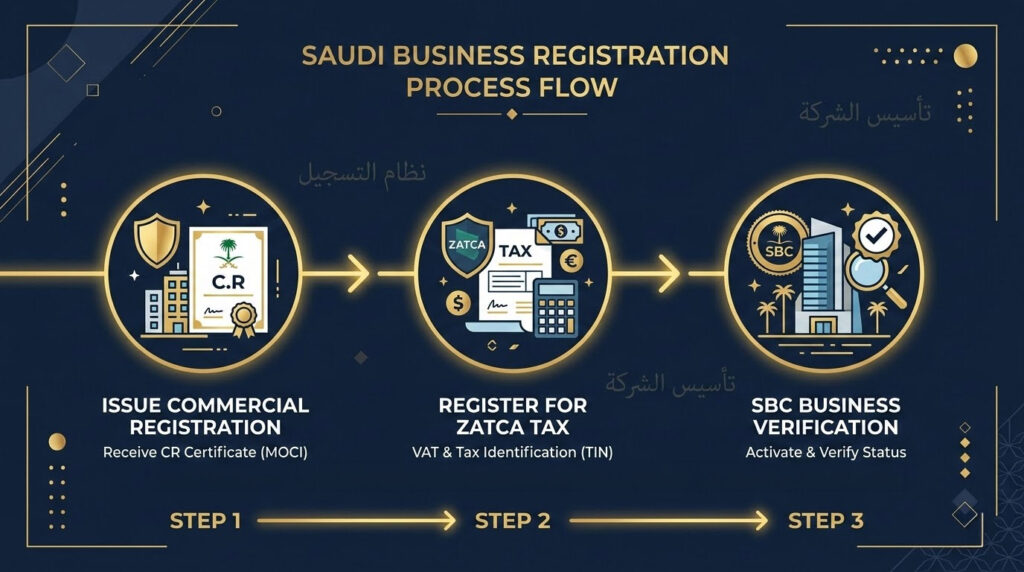
The Commercial Registration certificate from the Ministry of Commerce is mandatory for all businesses. Here\u0027s the process:
- Visit cr.sa and create an account
- Select your business activity (ensure ecommerce is specified)
- Choose and register your business name
- Submit required documents (ID, address proof)
- Pay the registration fees online
- Receive your CR certificate (typically within days)
Important: Your CR must explicitly list ecommerce as a business activity. This is essential for payment gateway onboarding and bank account setup.
Saudi Business Center Verification
After obtaining your CR, you must verify your online store through the Saudi Business Center platform (business.sa). This replaced the previous Maroof verification system for business registration purposes.
The Ministry of Commerce now evaluates online stores against 10 essential compliance standards. In January 2025, they announced results from evaluating the top 100 online stores, with a second phase of evaluations underway.
ZATCA Registration and VAT Compliance
Registration with the Zakat, Tax, and Customs Authority (ZATCA) is required for VAT compliance. Saudi Arabia applies a 15% VAT on most goods and services.
Key requirements:
- VAT registration threshold: Mandatory if annual taxable supplies exceed SAR 375,000
- E-invoicing (Fatoora): Phase 2 integration requirements are now in effect—your system must generate compliant electronic invoices that map SKUs, taxes, and buyer details correctly
- Display requirements: Your VAT registration number must be visible on your website
Non-compliance can result in significant penalties. I strongly recommend working with a local accountant familiar with Saudi tax requirements.
Additional Licenses by Category
Certain product categories require additional approvals:
- Food, supplements, cosmetics: Saudi Food and Drug Authority (SFDA) approval
- Telecom or tech services: Communications, Space & Technology Commission (CITC) clearance
- Medical devices: SFDA registration
For Foreign Investors
If you are a foreign entrepreneur looking to launch an online store in the Kingdom, you\u0027ll need:
- MISA License: Obtain a foreign investment license from the Ministry of Investment Saudi Arabia (MISA). This allows 100% foreign ownership.
- Commercial Registration: After MISA approval, proceed with CR registration
- Chamber of Commerce membership: Required for business operations
- National Address: Register through Saudi Post
- Local bank account: Required for transactions and payment gateway integration
The process is more complex for foreign investors, and I recommend working with a local business setup consultant to navigate the requirements efficiently.
Step 3: Choose Your Domain Name
Your domain name is your digital identity. Choose wisely:
- Keep it short and memorable: Avoid complex spellings or hyphens
- Include relevant keywords: If natural, incorporate your niche or location
- Consider a .sa domain: Local domains enhance credibility with Saudi consumers and signal authenticity
- Check availability across platforms: Ensure matching social media handles are available
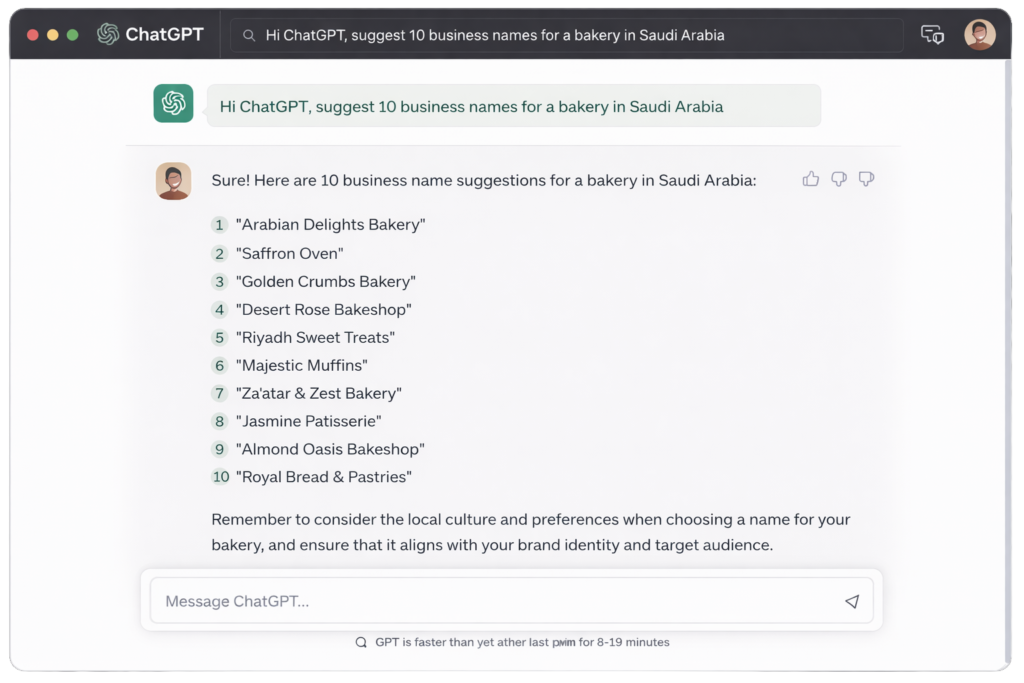
You can use AI tools like ChatGPT to brainstorm business name ideas. For example, asking “Suggest 10 business names for an online bakery in Saudi Arabia” can generate creative options that you can then check for domain availability.
Step 4: Select Your Ecommerce Platform
Choosing the right ecommerce platform Saudi Arabia merchants rely on is one of the most consequential decisions when you start an ecommerce business in Saudi Arabia. The right choice depends on your technical skills, budget, and growth plans.
Saudi-Based Platforms: Salla vs Zid
When comparing Salla vs Zid, the two homegrown platforms that dominate the Saudi ecommerce enablement space, both offer compelling advantages for local merchants.
Salla
Salla has emerged as a powerhouse, serving over 68,000 active merchants and processing more than $13.3 billion in transactions (Salla, 2025). In 2024, the company secured $130 million in pre-IPO funding and integrated STC Bank as a payment option across its network.
- Best for: Beginners and Arabic-first businesses
- Strengths: Full Arabic support, seamless local payment integration (Mada, STC Bank), built-in shipping solutions with 1,000+ logistics partners, free starter plan available
- Limitations: Less customization flexibility than open-source solutions
- Pricing: Free plan available; paid plans for advanced features
Zid
Zid positions itself as a “Total Commerce” solution, enabling merchants to manage ecommerce, social media sales, and physical outlets from a single dashboard. The company has raised $59 million to date and offers omnichannel capabilities that unify the retail experience across every touchpoint.
- Best for: Businesses needing advanced inventory management and multi-channel capabilities
- Strengths: Robust inventory control, marketplace integrations (Amazon, Noon, Trendyol), advanced analytics, Zid Financing with over SAR 50 million deployed to merchants
- Limitations: Steeper learning curve, higher cost for advanced features
- Pricing: Free plan for beginners; paid plans from $613 to $3,679 annually
The Salla vs Zid decision ultimately comes down to your priorities: Salla excels at simplicity and speed-to-launch, while Zid offers deeper inventory and multi-channel tools for merchants ready to scale.
International Platforms
WooCommerce (WordPress)
My personal preference for businesses needing maximum flexibility. WooCommerce is free and open-source, with thousands of plugins available.
- Best for: Technically comfortable users wanting full control
- Strengths: Unlimited customization, large developer community, extensive plugin ecosystem
- Limitations: Requires hosting, security management, and some technical knowledge
- Cost: Free core; hosting and premium plugins add cost
Shopify
- Best for: Fast setup with minimal technical requirements
- Strengths: Reliable hosting, professional templates, Arabic language support
- Limitations: Monthly fees, transaction fees on non-Shopify payments, less flexibility
- Cost: Starts at $29/month; scales with features
Ecommerce Platform Saudi Arabia Comparison
Here\u0027s how each ecommerce platform Saudi Arabia entrepreneurs commonly choose stacks up:
| Feature | Salla | Zid | WooCommerce | Shopify |
|---|---|---|---|---|
| Arabic Support | Native | Native | Via plugins | Good |
| Local Payment Integration | Excellent | Excellent | Requires setup | Good |
| Ease of Use | Very Easy | Moderate | Technical | Easy |
| Customization | Limited | Good | Unlimited | Moderate |
| Free Plan | Yes | Yes (limited) | Yes (self-hosted) | No |
| Best For | Beginners | Growing businesses | Technical users | Quick launch |
My recommendation: If you’re new to ecommerce and targeting Saudi consumers specifically, start with Salla\u0027s free plan to test your concept. If you need advanced inventory management or plan to sell across multiple channels, consider Zid. For maximum customization and international ambitions, WooCommerce remains powerful—just be prepared for the technical learning curve.
Step 5: Design and Develop Your Website
Your website\u0027s design directly impacts conversion rates. Saudi consumers expect professional, mobile-optimized experiences.
Design Priorities for Saudi Ecommerce
- Mobile-first design: With 78% of transactions on mobile, your site must perform flawlessly on smartphones
- Arabic language support: Right-to-left (RTL) layout, proper Arabic typography, and culturally relevant imagery
- Fast loading: Target under 3 seconds load time. Use compressed images and efficient code
- Trust signals: Display your CR number, VAT number, and Saudi Business Center verification prominently
- Clear policies: Return policy, privacy policy, and terms of service must be easily accessible
If you are using WooCommerce, platforms like ThemeForest offer professional themes optimized for RTL languages. Ensure any theme you select supports WooCommerce and receives regular updates from the developer. For performance optimization, caching your WordPress site with Cloudflare can dramatically improve load times. Protecting your store from threats is equally important—review these essential website security tips before going live.
Required Pages and Disclosures
Saudi ecommerce law requires specific disclosures. Your website must include:
- Clear pricing: All-inclusive prices with VAT displayed, using the new Saudi Riyal symbol where appropriate
- Return and refund policy: The Ecommerce Law mandates a 7-day return window for most products (with exceptions for perishables and customized items)
- Privacy policy: Compliance with the Personal Data Protection Law (PDPL)
- Contact information: Including a Saudi-based address or agent
- Delivery information: Clear shipping timeframes and costs
- Warranty information: Where applicable
Step 6: Set Up Payment Gateways
Payment integration can make or break your ecommerce venture. Saudi consumers have specific payment preferences, and offering the right options significantly impacts conversion rates.
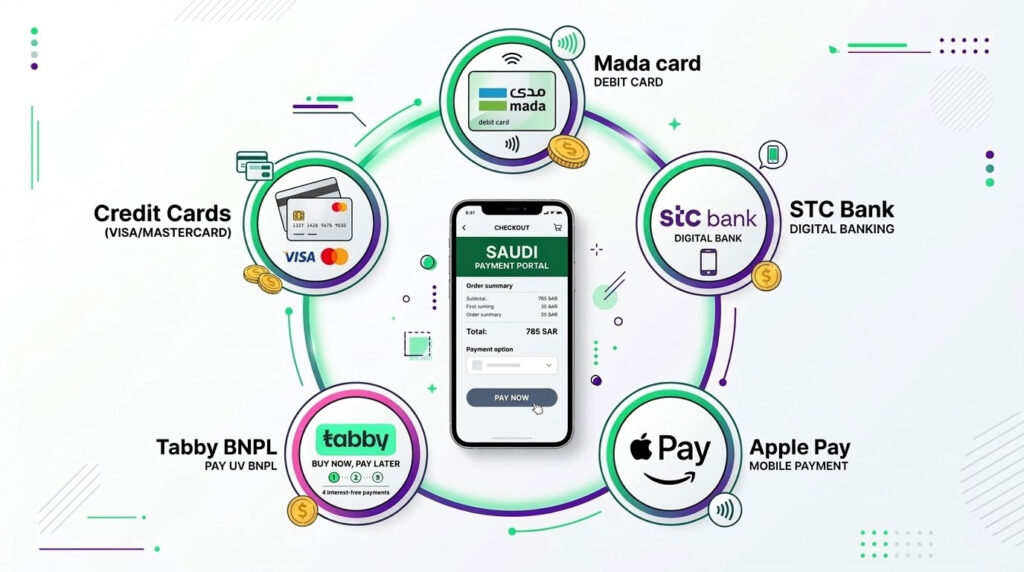
Essential Payment Methods
| Payment Method | Type | Why It Matters |
|---|---|---|
| Mada | Domestic debit network | Most widely used card network in Saudi Arabia—essential for local transactions |
| Credit/Debit Cards | Visa, Mastercard | 42.62% market share; required for international customers |
| STC Bank | Digital Bank | Popular digital bank and wallet with QR-based payments; strong among younger demographics |
| Apple Pay / Google Pay | Mobile wallets | Growing rapidly; SAMA signed a deal with Google in April 2025 to launch Google Pay via Mada infrastructure |
| Tabby | Buy Now Pay Later | Critical for conversion—allows customers to split payments |
| Tamara | Buy Now Pay Later | Another major BNPL provider in the Kingdom |
| Cash on Delivery (COD) | Traditional | Still preferred by some segments; expect higher return rates |
Buy Now Pay Later (BNPL) has become particularly important in Saudi Arabia. Services like Tabby and Tamara allow customers to split purchases into installments, significantly reducing cart abandonment for higher-value items. BNPL adoption is transforming how Saudis shop online, and digital wallets are growing at a 14.71% CAGR, outpacing card growth according to Mordor Intelligence.
Recommended Payment Gateway Providers
- Amazon Payment Services (formerly PayFort): My personal favorite—comprehensive, reliable, and widely trusted
- HyperPay: Strong regional presence with excellent Mada integration
- PayTabs: User-friendly setup with good local support
- Tap Payments: Growing player with solid features
- Moyasar: Saudi-based provider with straightforward integration
Ensure your chosen gateway supports SAMA (Saudi Central Bank) approved payment processing and integrates with your ecommerce platform. In April 2025, SAMA also signed agreements to bring Google Pay and Alipay+ acceptance to Saudi Arabia via the Mada infrastructure, which may further simplify cross-border payment acceptance.
Step 7: Configure Shipping and Logistics
Logistics represent one of the most significant operational challenges when launching an online store in the Kingdom. Saudi Arabia\u0027s geography—with vast distances between population centers—requires strategic planning.
Major Shipping Providers
- Aramex: Regional leader with extensive Saudi network
- Saudi Post (SPL): National postal service with improving capabilities
- SMSA Express: Strong domestic coverage
- DHL: Excellent for international shipping
- J&T Express: Growing presence with competitive pricing
- Fetchr: Technology-driven logistics solution
AI-powered logistics and robotics are also beginning to reshape Saudi ecommerce fulfillment, particularly in last-mile delivery for major urban centers.
Key Logistics Considerations
- Price shipping by region: A flat rate that seems simple can destroy margins in remote areas. Consider tiered pricing based on destination.
- Offer multiple options: Standard, express, and same-day (where available) give customers choice
- Set realistic expectations: Clear delivery timeframes build trust. Under-promise and over-deliver.
- Consider COD logistics: If offering cash on delivery, factor in collection services and higher return rates (COD orders typically see 20–30% return rates)
- National Address system: Saudi Arabia\u0027s National Address system improves delivery accuracy—encourage customers to use their registered addresses
For Riyadh, Jeddah, and Dammam, same-day and next-day delivery are increasingly expected. Noon.com operates a 45,000 m² fulfillment center in Riyadh specifically to meet these expectations.
Step 8: Create Compelling Product Listings
Your product listings are your salespeople. Invest time in making them convert.
Product Listing Essentials
- High-quality images: Multiple angles, zoom capability, lifestyle shots showing products in use
- Detailed descriptions: Features, benefits, specifications, and use cases—in Arabic and English if targeting both audiences
- Accurate pricing: Include VAT, clearly display any discounts
- Stock status: Real-time inventory visibility reduces customer frustration
- Customer reviews: Social proof significantly impacts purchase decisions
SEO for Product Pages
Optimize each product page for search visibility:
- Include relevant keywords in titles and descriptions
- Write unique meta descriptions for each product
- Use descriptive alt text for images
- Create clean, keyword-rich URLs
- Add structured data (schema markup) for rich search results
AI tools can now assist with product content generation, helping you create descriptions at scale. An effective AI content strategy can accelerate how quickly you build out your product catalog while maintaining quality and SEO best practices. To make sure your content reaches AI-powered search engines as well, consider applying generative engine optimization principles from the start.
Step 9: Implement Localization
Localization goes beyond translation. To effectively serve Saudi consumers, you need to resonate with local culture and preferences.
Localization Checklist
- Language: Full Arabic language support with professional translation—not just Google Translate
- Currency: Display prices in Saudi Riyals (SAR)
- Cultural imagery: Use visuals that reflect Saudi culture, modest dress codes, and local aesthetics
- Local holidays: Plan campaigns around Ramadan, Eid al-Fitr, Eid al-Adha, and Saudi National Day
- Customer service hours: Align with Saudi business hours (Sunday–Thursday)
- Local phone number: A Saudi contact number builds trust
Step 10: Develop Your Marketing Strategy
With your store built, it\u0027s time to drive traffic and sales. Saudi Arabia\u0027s unique social media landscape requires a tailored approach.
Priority Marketing Channels
Social Media: With 99.6% social media penetration and 34.1 million user identities (DataReportal, January 2025), platforms are essential. Prioritize:
- TikTok: 138.2% adult ad reach—the highest in the world among all countries
- Snapchat: 24.7 million users, reaching 87.7% of Saudi adults aged 18+
- Instagram: 16.9 million users; strong for fashion, beauty, and lifestyle products
- YouTube: 27.2 million users, reaching 79.4% of the total population
Influencer Marketing: Saudi influencers carry significant purchasing influence. Ad spending in influencer marketing is projected at $95.69 million in 2025 (Statista). Note that influencers must hold a Mawthooq license from GCAM to advertise products legally.
Search Engine Optimization (SEO): Invest in Arabic SEO from day one. Product-led content, how-to guides, and localized category pages drive free organic traffic. Avoid common pitfalls by learning which SEO myths to ignore and focus on building quality backlinks to strengthen your domain authority.
Paid Advertising: Google Ads and Meta Ads (Facebook/Instagram) with Arabic creative and local targeting.
WhatsApp Business: With 87% penetration, WhatsApp is the preferred customer service channel. Use WhatsApp Business for order updates, customer inquiries, and personalized communications.
Key Seasonal Campaigns
Plan your marketing calendar around:
- Ramadan: The biggest shopping season—start campaigns 2–3 weeks before
- Eid al-Fitr and Eid al-Adha: Major gifting occasions
- Saudi National Day (September 23): Patriotic promotions perform well
- Back to School (August–September): Strong for relevant categories
- White Friday (November): Saudi\u0027s version of Black Friday
Step 11: Implement Analytics and Tracking
You can\u0027t improve what you don\u0027t measure. Set up comprehensive tracking from day one.
Essential Analytics Tools
- Google Analytics 4: Proper ecommerce tracking setup reveals customer behavior, conversion paths, and revenue attribution
- Google Search Console: Monitor search visibility and technical issues
- Platform analytics: Salla, Zid, and Shopify all offer built-in analytics
- Social media insights: Track engagement and conversion from social channels
Key Metrics to Track
- Contribution margin per order: Revenue minus variable costs
- Customer acquisition cost (CAC): Total marketing spend divided by new customers
- Customer lifetime value (LTV): Average revenue per customer over their relationship
- Conversion rate: Visitors who complete purchases
- Cart abandonment rate: Critical for identifying checkout friction
- Return rate: Particularly important for COD orders
- COD failure rate: Orders not collected on delivery
Step 12: Ecommerce Regulations Saudi Arabia — Ongoing Compliance
Understanding ecommerce regulations Saudi Arabia enforces is critical. Non-compliance can result in fines up to SAR 1 million (~$270,000) or business suspension.
Ecommerce Law Requirements (2019)
The Saudi Ecommerce Law establishes requirements for:
- Clear product information and terms of service
- Consumer data protection and privacy
- Mechanisms for addressing complaints and disputes
- 7-day return policy (with specified exceptions)
- Transparency in pricing and delivery terms
- Reporting requirements if your platform is hacked (within 3 days)
Personal Data Protection Law (PDPL)
The PDPL governs how you collect, process, and store customer data:
- Obtain explicit consent before collecting personal data
- Publish a clear privacy policy
- Implement cookie consent mechanisms
- Limit cross-border data transfers unless permitted
- Provide customers with data access and deletion rights
The regulatory framework continues to evolve, so I recommend reviewing the Ministry of Commerce\u0027s online compliance standards regularly and subscribing to ZATCA updates.
Step 13: Test and Launch
Before going live, thoroughly test every aspect of your store:
- Complete purchase flow: Test orders from browsing to delivery
- Payment processing: Verify all payment methods work correctly
- Mobile experience: Test on multiple devices and screen sizes
- Page speed: Use Google PageSpeed Insights to identify issues
- Forms and checkout: Ensure all fields work, error messages are clear
- Email notifications: Verify order confirmations and shipping updates send correctly
- Arabic display: Check RTL layout renders properly throughout
Consider a soft launch with limited marketing to identify issues before scaling.
Step 14: Establish Customer Support
Saudi consumers expect responsive support. Fast replies convert better than discount codes.
Support Channels to Offer
- WhatsApp Business: Primary channel—respond within minutes during business hours
- Live chat: On-site chat for immediate assistance
- Email: For detailed inquiries and documentation
- Phone support: Saudi phone number for voice communication
- Social media: Monitor and respond to comments and DMs
Train your team to handle inquiries in Arabic, process returns efficiently, and escalate issues appropriately. Customer service quality directly impacts reviews, repeat purchases, and word-of-mouth referrals.
Common Mistakes to Avoid
Based on observing businesses entering the Saudi market, these are the most frequent pitfalls:
- Launching without proper registration: Operating without CR and VAT registration invites penalties and prevents payment gateway access
- Ignoring e-invoicing requirements: ZATCA\u0027s Phase 2 e-invoicing integration is mandatory—get it right from the start
- Underestimating logistics costs: A flat shipping rate that looks simple can destroy margins on distant deliveries
- Poor Arabic localization: Machine translation damages credibility. Invest in professional localization.
- Missing BNPL options: Not offering Tabby or Tamara costs you conversions, especially for higher-value items
- Neglecting mobile optimization: With 78%+ of transactions on mobile, a poor mobile experience is fatal
- Ignoring return policy requirements: The 7-day return window is law—build it into your operations
- Slow customer response: Saudi consumers expect quick responses. Delays lose sales.

FAQ: Starting an Ecommerce Business in Saudi Arabia
How much does it cost to start an ecommerce business in Saudi Arabia?
Costs vary significantly based on your approach. A minimal setup using Salla\u0027s free plan could start under SAR 5,000 including CR registration and basic inventory. A more comprehensive launch with custom website development, professional photography, and initial marketing budget typically ranges from SAR 30,000–100,000. Foreign investors face higher setup costs due to MISA licensing requirements and minimum capital obligations.
Do I need a commercial registration to sell online in Saudi Arabia?
Yes. A Commercial Registration (CR) or Freelance License is mandatory to legally operate an online business. Without proper registration, you cannot integrate payment gateways, open business bank accounts, or operate legally. The Ministry of Commerce actively monitors and penalizes unregistered ecommerce activities.
Can foreigners own 100% of an ecommerce business in Saudi Arabia?
Yes. Under Vision 2030 reforms, 100% foreign ownership is permitted for ecommerce businesses that obtain a MISA (Ministry of Investment) license and meet minimum capital requirements. You don\u0027t need a local partner. However, the licensing process is more complex and time-consuming than for Saudi nationals.
What is the best ecommerce platform for Saudi Arabia?
For beginners targeting the local market, Salla offers the easiest entry with Arabic-first design and built-in local payment/shipping integrations. For businesses needing advanced inventory management and omnichannel capabilities, Zid provides more robust features. WooCommerce suits technically proficient users wanting maximum customization, while Shopify works well for quick launches with less technical overhead. The best platform depends on your technical comfort and growth ambitions.
What is the VAT rate for ecommerce in Saudi Arabia?
Saudi Arabia applies a 15% Value Added Tax (VAT) on most goods and services. Ecommerce businesses must register with ZATCA for VAT if annual taxable supplies exceed SAR 375,000, display VAT-inclusive prices, and issue compliant e-invoices under the Fatoora system.
What payment methods should I offer?
At minimum, offer Mada (essential for local debit cards), credit/debit cards (Visa/Mastercard), and at least one BNPL option (Tabby or Tamara). Adding mobile wallets like STC Bank, Apple Pay, and Google Pay improves conversion among younger demographics. Cash on delivery remains relevant for some segments but comes with higher return rates.
How long does it take to launch an ecommerce store in Saudi Arabia?
With all documentation ready, Saudi nationals can complete CR registration within days and launch a basic store on Salla or Zid within 1–2 weeks. Foreign investors should expect 2–4 months for the full MISA licensing and setup process. Building a custom WooCommerce or Shopify store with proper localization typically takes 4–8 weeks.
Conclusion: Your Ecommerce Journey Starts Now
The Saudi ecommerce market offers exceptional opportunities for entrepreneurs ready to navigate its requirements and serve its digitally connected population. The $31.29 billion market is growing at nearly 12% annually, supported by near-universal internet access, strong government backing, and consumers who increasingly expect to shop online.
To successfully start an ecommerce business in Saudi Arabia, focus on:
- Compliance first: Complete proper registration before launching. Missing e-invoicing or operating unlicensed costs more than any delayed campaign.
- Platform selection: Choose based on your technical comfort and growth plans. Salla and Zid serve local needs exceptionally well.
- Payment optimization: Mada and BNPL options are non-negotiable for conversion.
- Mobile-first everything: With 78%+ of transactions on smartphones, mobile experience is paramount.
- Arabic localization: Professional localization builds trust and drives conversions.
- Customer experience: Fast support, clear policies, and reliable delivery create repeat customers.
Start with compliance and payments, not just marketing. Build your foundation correctly, and you\u0027ll be positioned to scale as the market continues its remarkable growth trajectory.
Good luck on your ecommerce journey in the Kingdom!
Related reading:
- Saudi Arabia\u0027s Digital Economy in 2025: Vision 2030\u0027s Tech-Driven Transformation
- The Rise of Buy Now Pay Later in Saudi Arabia
- GA4 Ecommerce Tracking Saudi Arabia
- Digital Consumer Behavior in Middle East Ecommerce: The 2026 Guide
- Ecommerce Trends 2026: 10 Technologies Reshaping Online Shopping
- The Evolution and Impact of Social Media Marketing in Saudi Arabia
Sources: Mordor Intelligence Saudi Arabia Ecommerce Market (January 2026); DataReportal Digital 2025: Saudi Arabia; Saudi Central Bank (SAMA) E-Payments Report (April 2025); Monsha\u0027at Ecommerce Statistics Q4 2024; Ministry of Commerce Saudi Arabia; ZATCA; Salla Official Information (2025); Zid; Statista; Setup in Saudi; Arab News.

Husain Alhaboubi is Director of Digital Channels at Mobily, where he leads platform optimization, AI-powered customer engagement, and UI/UX strategy. With 20+ years of experience spanning eCommerce, IT infrastructure, and digital marketing, he previously drove a 225% revenue increase and 69% organic traffic growth as eCommerce Senior Manager at flyadeal, and managed enterprise IT operations — including data centers, ERP systems, and network security — as Group IT Manager at IPD Group.
Husain holds a BS in Information Systems from the University of Texas at Arlington and is certified in Google Ads, Google Analytics, and Semrush SEO. He writes from hands-on experience across both sides of digital business: the strategic (eCommerce, SEO, AI, digital transformation) and the technical (server administration, cloud computing, web development, networking, and security) — with a particular focus on the Saudi market and Vision 2030. Read his full resume →