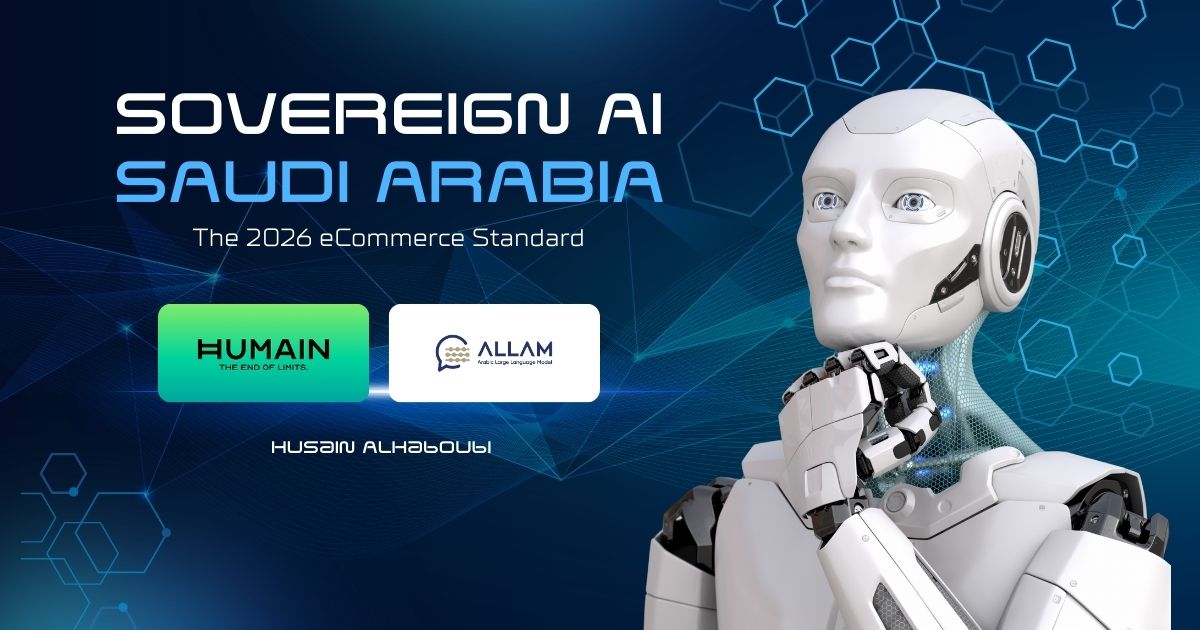
Sovereign AI Saudi Arabia & The “Saudi-First” Customer Experience: The 2026 eCommerce Standard
If you are running an eCommerce business in Saudi Arabia and still relying on generic, Western-built AI tools for customer interactions, you are already falling behind. Sovereign AI Saudi Arabia is no longer a government-only concept — it is rapidly becoming the standard for brands that want to deliver a truly Saudi-first customer experience.
With the Kingdom ranking first globally in public sector AI adoption, a newly announced $40 billion dedicated AI investment fund through HUMAIN Saudi Arabia, and total sovereign AI commitments exceeding $100 billion, the playing field has fundamentally shifted. In 2026, the brands winning in the Saudi market are the ones using Arabic AI model infrastructure hosted inside the Kingdom, trained on local data, and fluent in the cultural nuances that global models simply cannot grasp.

Table of Contents
What Is Sovereign AI and Why Should Saudi eCommerce Brands Care?
At its core, sovereign AI refers to a nation building and controlling its own artificial intelligence infrastructure — from the data centers and GPU clusters to the language models and governance frameworks. Rather than depending entirely on foreign cloud providers and AI tools, a country with sovereign AI capabilities can process sensitive data within its own borders, train models on culturally relevant datasets, and enforce local regulations over how AI operates.
For eCommerce managers and brand owners, this matters far more than it sounds. When your AI-powered chatbot, product recommendation engine, or dynamic pricing tool runs on a global model hosted overseas, your Saudi customer data is leaving the Kingdom. Your AI does not understand local dialects. It does not know the difference between Ramadan browsing behavior and Saudi National Day gifting patterns. And it certainly does not comply natively with the Personal Data Protection Law (PDPL) that became fully enforceable in September 2024 — a law now backed by active enforcement, with 48 penalty decisions issued in its first year alone.
Sovereign AI Saudi Arabia changes this equation entirely. It means using AI systems hosted inside the Kingdom, trained on Arabic-first datasets that capture Saudi dialects and cultural nuances, and designed to comply with PDPL data residency requirements from day one. For eCommerce brands, this translates into more accurate personalization, stronger regulatory compliance, and a Saudi-first customer experience that feels authentically local — not a translated version of an American or European shopping journey.
Saudi Arabia’s Sovereign AI Infrastructure: The 2026 Landscape
Saudi Arabia is not just talking about sovereign AI — it is building the infrastructure at a scale that few countries can match. From the $600 billion US-Saudi investment agreements announced during President Trump’s May 2025 visit to the newly unveiled $40 billion HUMAIN AI investment fund managed in partnership with Andreessen Horowitz, the Kingdom’s commitment to sovereign AI leadership has only accelerated. The results are already visible across multiple pillars of the AI stack.
HUMAIN Saudi Arabia and the ALLaM Ecosystem
Launched in May 2025 under the Public Investment Fund (PIF), HUMAIN represents Saudi Arabia’s most ambitious AI initiative and the central engine of HUMAIN Saudi Arabia‘s sovereign AI strategy. Unlike companies that focus narrowly on a single model or service, HUMAIN delivers full-stack AI capabilities: sovereign data centers with a projected capacity of up to 500 megawatts in the first phase — powered by 18,000 NVIDIA GB300 Grace Blackwell supercomputer chips with several hundred thousand more planned over five years — cloud infrastructure, and the Arabic-first ALLaM large language model, all hosted within Saudi borders.
HUMAIN’s ambitions are staggering. The company is targeting 1.9 gigawatts of data center capacity by 2030, scaling to 6.6 gigawatts by 2034, with a goal of processing 7% of the world’s AI training and inference workloads. Partnerships with NVIDIA, AMD ($10 billion collaboration), Qualcomm, Cisco, and xAI (a $3 billion investment announced in February 2026) ensure that international AI training and inference workloads can run on Saudi infrastructure. In January 2026, HUMAIN Saudi Arabia secured a $1.2 billion financing agreement with the National Infrastructure Fund to expand AI data center capacity by an additional 250 megawatts.
The ALLaM model family is the centerpiece for eCommerce applications. The ALLaM-2-7B and ALLaM-1-13B models were developed by SDAIA’s National Center for Artificial Intelligence, with the 13B model pre-trained on over 3 trillion tokens in Arabic and English and fine-tuned with 10 million prompt-and-response pairs. ALLaM was not adapted from an English model — it was built from the ground up for Arabic, handling classical Arabic, regional dialects (including Najdi and Hejazi), religious references, and cultural context at a level that global models cannot replicate. ALLaM is now available across IBM watsonx, Microsoft Azure AI, and Qualcomm AI Cloud, while the 7B parameter version was listed open-source on Hugging Face in March 2025, making it accessible for custom development.
For businesses, HUMAIN is building a marketplace where developers and eCommerce platforms can access ALLaM and deploy ready-made use cases — from AI-powered customer service agents to automated product descriptions and culturally aware chatbots — without starting from scratch.
HUMAIN OS: The Agentic AI Operating System
In February 2026, HUMAIN CEO Tareq Amin unveiled HUMAIN OS at the PIF Private Sector Forum in Riyadh — an agentic AI operating system designed to transform how humans interact with machines. Unlike traditional operating systems like Windows or macOS, HUMAIN OS is built around intent-driven interactions: users state objectives in natural language, and AI agents orchestrate tasks across systems automatically.
For sovereign AI ecommerce, HUMAIN OS represents a shift from proof-of-concept AI deployments to production-grade environments. More than 150 AI agents already manage corporate functions within HUMAIN through a single interface called HUMAIN One, where employees simply declare intent in natural language. For eCommerce brands, this kind of agentic infrastructure could mean AI agents that autonomously manage inventory, adjust pricing, handle customer service, and coordinate marketing campaigns — all running on sovereign Saudi infrastructure that keeps your data within the Kingdom.
PDPL Data Residency and the Compliance Connection
The PDPL, enforced by SDAIA since September 2024, applies to any entity — local or foreign — that processes personal data of individuals in Saudi Arabia. It requires explicit consent for data processing, mandates transparent privacy notices, and imposes restrictions on transferring personal data outside the Kingdom. Controllers processing sensitive data must register on the National Data Governance Platform, and violations can result in fines of up to SAR 5 million, with doubled penalties for repeat offenses. As of January 2026, the PDPL enforcement committees have issued 48 decisions confirming violations and imposing penalties, confirming that PDPL data residency requirements are now actively enforced.
This is where sovereign AI Saudi Arabia becomes a practical business requirement, not just a nice-to-have. If your eCommerce AI tools are sending customer data to servers in the United States or Europe for processing, you need to demonstrate PDPL compliance through formal risk assessments, Saudi Standard Contractual Clauses, and potentially SDAIA approval. But if you use a sovereign AI solution hosted inside the Kingdom — such as one built on HUMAIN’s infrastructure or Microsoft’s Saudi cloud datacenter region — you sidestep cross-border data transfer headaches entirely. With PDPL data residency enforcement ramping up, choosing a sovereign AI path is increasingly the simplest compliance strategy.
The Kingdom is also pioneering the “data embassy” concept through the draft Global AI Hub Law, which would make Saudi Arabia the first G20 nation with a comprehensive legal framework for sovereign data centers. This signals that data residency will only become more important — not less — for businesses operating in the Saudi market.
The Dialect Differentiator: Beyond Basic Arabic Translation
Here is a truth that most global AI providers would rather you not think about — and it is a core reason why sovereign AI Saudi Arabia matters for eCommerce: Arabic is one of the most challenging languages for AI to master. With over 30 distinct dialects, complex grammar, frequent code-switching between Arabic and English, and the fact that only about 15% of Arabic text online is clean enough for LLM training (compared to over 50% for English), generic multilingual models deliver a mediocre Arabic experience at best.
For Saudi eCommerce, this is not an abstract linguistic problem. It directly impacts your conversion rates, customer satisfaction scores, and brand perception. An Arabic AI model built specifically for the region addresses these challenges at a fundamental level.
How ALLaM and Kawn Handle Saudi Dialects
HUMAIN’s ALLaM model was specifically designed to handle dialectal variation. It can switch between Modern Standard Arabic and regional Saudi dialects — so when a customer from Riyadh types a query in Najdi dialect and another from Jeddah writes in Hejazi, the AI responds naturally in each dialect rather than forcing everyone into formal Arabic that feels robotic and impersonal. The HUMAIN Chat consumer app, powered by ALLaM, already supports over 30 Arabic dialects and is available for free on iOS, Android, and web.
Alongside ALLaM, Saudi AI startup Misraj AI launched the Kawn ecosystem at AWS re:Invent 2025 — the most comprehensive Arabic-first AI stack to date. Kawn includes Lahjawi, a groundbreaking dialect engine that recognizes and responds to more than a dozen Arabic dialects with native fluency, plus Mutarjim for bidirectional Arabic-English translation and Baseer for Arabic document OCR. The platform was trained on over 2 trillion Arabic tokens from diverse domains and regions, using a technique called “layer injection” that allows it to learn dialectal variations without retraining the entire model. Misraj also launched Workforces, the first Arabic AI employee suite — enterprise-ready AI agents capable of automating customer communication, processing claims, and supporting teams in native Arabic.
For eCommerce brands, the practical application is straightforward: a customer in Dammam asking about a product return in Gulf Arabic gets a response that mirrors their own speech patterns, while a customer in Mecca browsing fashion products in Hejazi Arabic receives an equally native-feeling interaction. This level of dialect-awareness from a purpose-built Arabic AI model was simply not possible with autonomous AI agents built on English-first models just two years ago.
Why Generic Arabic AI Models Fall Short in Saudi eCommerce
When you deploy a global AI model for your Saudi eCommerce store, you encounter several critical gaps. The model may technically “support Arabic,” but it was not trained to understand that “يا حلوه” (ya helwa) is a casual compliment in Gulf dialect, or that a customer saying “ابي اشوف” (abi ashoof) in Najdi means “I want to see” — not the formal Arabic equivalent. These misunderstandings create friction in customer interactions that erodes trust.
Beyond language, generic models lack cultural context. They do not know that Saudi consumers are more likely to browse and purchase late at night (eCommerce activity peaks between 12 AM and 3 AM during Ramadan), that family-oriented group purchases are culturally significant, or that trust signals differ — Saudi shoppers may value a personal recommendation from a friend or influencer over an algorithmic suggestion. A sovereign Arabic AI model trained on local data captures these patterns natively, delivering a Saudi-first customer experience that generic tools cannot match.
Hyper-Localization Strategies for Culturally Intelligent eCommerce
Sovereign AI Saudi Arabia provides the infrastructure layer. What you build on top of it — the culturally intelligent experiences — is where the competitive advantage lives. Here is how leading Saudi eCommerce brands are using locally trained AI and sovereign AI ecommerce tools to outperform competitors stuck on global platforms.
Ramadan, National Day, and Salary-Day Campaigns
A culturally intelligent AI agent does not just know that Ramadan exists — it understands the rhythm of the entire season. Research shows that Ramadan spending peaks at two distinct points: two weeks before Ramadan begins and one week before Eid. In Saudi Arabia, 54% of consumers report a significant shift in spending behavior during the holy month, with 64% calling it the perfect time to shop. Transaction volumes surge 35–40% during Ramadan, and eCommerce activity spikes dramatically between Iftar and Suhoor.
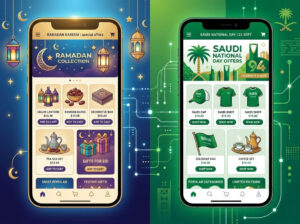
An AI system trained on sovereign Saudi data can automatically adjust your entire eCommerce experience around these patterns. It shifts product recommendations toward gifting, food, and family essentials in the weeks before Ramadan. It adjusts marketing tone to reflect generosity and community — values deeply tied to the holy month. It schedules push notifications and promotional campaigns for post-Iftar hours when engagement is highest. And critically, it knows that the end-of-month salary cycle (often around the 27th) creates purchasing power spikes that should trigger different promotions than mid-month campaigns.
Saudi National Day (September 23) requires an entirely different approach — patriotic messaging, green-themed campaigns, and product bundles that celebrate Saudi identity. A sovereign AI with local training data handles this transition automatically, while a generic model treats it as just another date on the calendar. This is the kind of granular cultural intelligence that separates sovereign AI ecommerce from off-the-shelf global tools.
Building a Saudi-First Customer Journey with Sovereign AI eCommerce
Building a Saudi-first customer experience means designing every touchpoint with local expectations in mind. Saudi Arabia’s eCommerce market reached an estimated $27.96 billion in 2025 and is projected to grow to $31.29 billion in 2026, expanding at an 11.92% CAGR through 2031 to reach $54.87 billion (Mordor Intelligence, January 2026). Within this market, smartphones account for nearly 78% of revenue, credit and debit cards hold 42.62% payment share — with the Mada network processing $52.6 billion in eCommerce sales in 2024 alone — and digital wallets led by STC Pay are the fastest-growing payment method at 14.71% CAGR.
A sovereign AI-powered customer journey accounts for all of this. It serves a mobile-first, Arabic-first experience. It recognizes that Saudi shoppers frequently switch between Arabic and English mid-conversation (code-switching) and handles this seamlessly. It integrates with local payment gateways like Mada, STC Pay, Tabby, and Tamara natively. And it tailors the entire discovery-to-checkout flow based on patterns observed in Saudi consumer data — not aggregated global averages.
Consider this practical example: a Saudi customer browsing evening wear on your store in the last week of Sha’ban (the month before Ramadan). A sovereign AI agent trained on local patterns recognizes the intent — this shopper is likely preparing for Ramadan gatherings. It surfaces modest, elegant options first, suggests matching accessories for Iftar hosting, and offers a “Ramadan bundle” with a BNPL option through Tamara. A global AI model would surface generic evening wear with no cultural context. The difference in conversion rates is measurable — and it is exactly why sovereign AI ecommerce tools are gaining rapid adoption among brands competing in the Saudi market.
Phygital Retail Saudi Arabia: Bridging Online and In-Store with Local AI
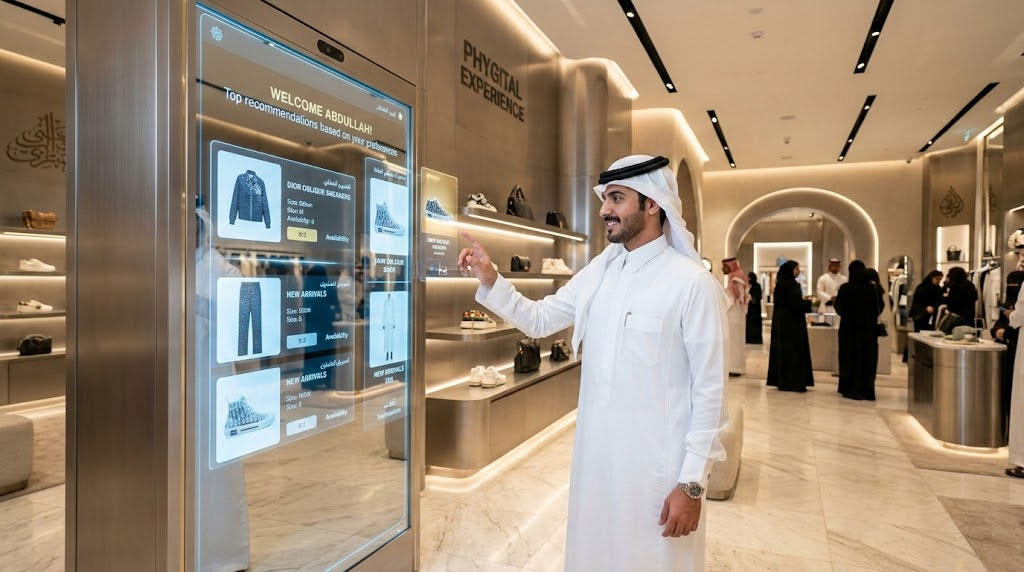
Saudi Arabia’s retail landscape is increasingly “phygital” — blending physical and digital experiences into a seamless customer journey. As sovereign AI Saudi Arabia infrastructure matures, this convergence is accelerating. With approximately 4,549 shopping malls nationwide and one of the world’s most connected populations (99% internet penetration, 78% 5G coverage), the Kingdom is a natural testing ground for phygital retail Saudi Arabia experiences powered by AI.
In Riyadh and Jeddah, forward-thinking retailers are deploying sovereign AI in physical stores to create experiences that global technology alone could not enable. Think of AI-powered kiosks that greet customers in their regional dialect, recommend products based on their online browsing history (with PDPL-compliant consent), and enable instant checkout through Mada contactless payments. Footfall heatmaps analyzed by local AI can trigger real-time price adjustments on specific aisles, turning a standard Riyadh mall into a precision-targeted revenue engine.
The phygital retail Saudi Arabia model particularly thrives during Ramadan, when Saudi shoppers exhibit a distinctive pattern: they browse in malls and local retail areas during evening hours, then place orders for home delivery from the same stores they visited in person. Sovereign AI trained on this behavior can unify the online and offline journey — ensuring that a product a customer examined in-store appears as a top recommendation in their app that same evening, complete with a delivery option timed for post-Taraweeh.
This omnichannel approach is not just about convenience — it is about meeting Saudi consumers exactly where they are, with AI that understands both their digital footprint and their physical shopping patterns in a way that respects local data sovereignty. As HUMAIN OS matures and its agentic capabilities expand, expect phygital retail Saudi Arabia use cases to become even more sophisticated, with AI agents coordinating inventory, pricing, and customer interactions across both channels simultaneously.
How to Implement Sovereign AI Saudi Arabia in Your eCommerce Stack
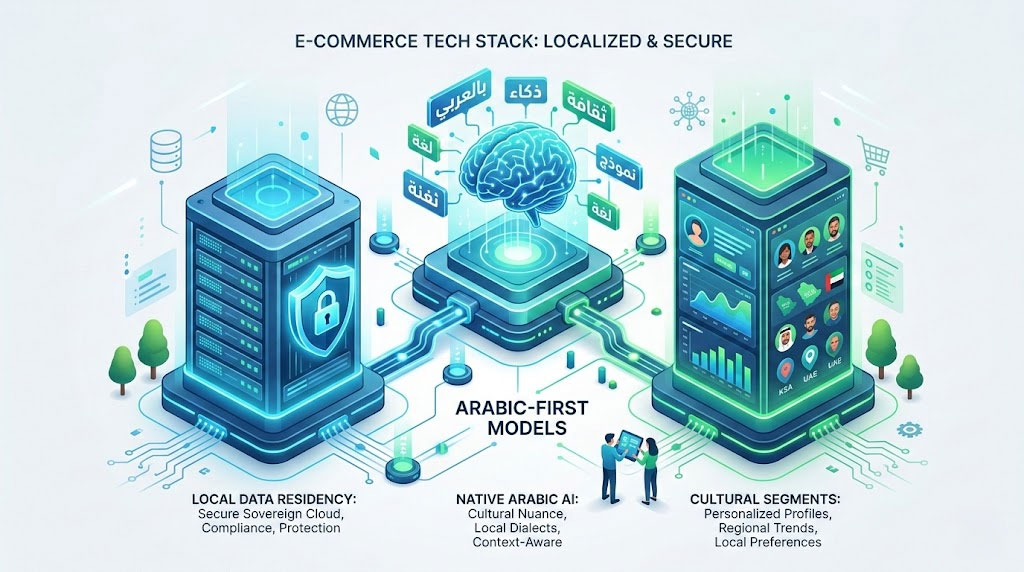
Moving from generic AI to a sovereign AI-powered eCommerce stack does not require ripping out everything you have built. Here is a practical three-step implementation path designed for eCommerce managers and brand owners operating in the Saudi market.
Step 1: Audit Your Current AI Tools for PDPL Data Residency
Start by mapping every AI-powered tool in your eCommerce stack that touches customer data. This includes chatbots, recommendation engines, email personalization platforms, dynamic pricing tools, and analytics dashboards. For each tool, answer three questions: Where is the data processed? Where is it stored? Does the provider offer a Saudi-based deployment option?
Under the PDPL, any tool processing personal data of Saudi residents must comply with cross-border transfer regulations. If a tool cannot offer in-Kingdom processing, you need to conduct a formal risk assessment (SDAIA issued the Transfer Regulations and guidelines in August 2024), implement Saudi Standard Contractual Clauses, and potentially obtain SDAIA approval. With 48 enforcement decisions already issued, the regulatory risk is no longer theoretical. The simpler path is increasingly to choose providers that offer Saudi-hosted infrastructure — and with Microsoft’s Saudi cloud datacenter region operational alongside HUMAIN and the AWS $5+ billion AI Zone, PDPL data residency compliance options are expanding rapidly.
Step 2: Integrate Arabic-First Language Models
Replace or supplement your English-first AI with Arabic-native models. For customer-facing chatbots and voice assistants, explore HUMAIN’s ALLaM model through their upcoming developer marketplace, or evaluate Misraj’s Kawn ecosystem with its dialect-specific Lahjawi engine and Workforces AI employee suite. SDAIA has also listed the ALLaM-2-7B model on Hugging Face, and it is available on IBM watsonx, Microsoft Azure AI, and Qualcomm AI Cloud — giving developers multiple platforms for custom applications.
The key distinction: do not simply add an Arabic translation layer on top of an English model. An Arabic AI model built natively understands sentence structure, cultural idioms, and regional variations from the ground up. These models produce more accurate product descriptions, more natural chatbot conversations, and more relevant search results. If you are already using AI for content creation, switching to an Arabic-first model for your Saudi-market content will noticeably improve engagement and SEO performance.
Step 3: Build Culturally Aware Customer Segments
Standard eCommerce segmentation — by demographics, purchase history, or browsing behavior — misses the cultural layer that drives Saudi consumer decisions. This is where sovereign AI Saudi Arabia solutions truly differentiate. Build segments that account for regional dialect preferences (Gulf vs. Hejazi customers respond to different linguistic styles), seasonal behavior patterns (Ramadan browsers vs. National Day shoppers vs. salary-day purchasers), and cultural values (family-oriented group purchases, modesty considerations in fashion, halal compliance in food and beauty products).
A sovereign AI model trained on Saudi data can identify these segments automatically, surfacing patterns that would be invisible to a global analytics tool. When you combine this segmentation with personalized AI agents that interact in the customer’s own dialect and understand their cultural context, you create a shopping experience that feels fundamentally different from — and superior to — what generic AI delivers. Tracking these segments through proper GA4 eCommerce tracking ensures you can measure the impact of your sovereign AI investment on actual conversion and revenue metrics.
Common Mistakes When Adopting Sovereign AI eCommerce
While the benefits of adopting sovereign AI Saudi Arabia tools for eCommerce are clear, brands frequently stumble during implementation. Avoiding these pitfalls will save you time, budget, and compliance headaches.
Treating Arabic as a translation problem. The most common mistake is layering an Arabic translation module on top of an English-first AI model and calling it “Arabic support.” This approach produces stilted, formal Arabic that no Saudi consumer actually speaks. It misses dialectal variations, cultural idioms, and code-switching patterns. Always choose models like ALLaM or Kawn that were trained natively on Arabic data.
Ignoring PDPL compliance until enforcement arrives. With 48 enforcement decisions issued in the first year, waiting to address PDPL data residency is no longer a viable strategy. Brands that have not audited their AI tool data flows risk fines of up to SAR 5 million per violation — and the scope of violations already includes consent failures, inadequate security measures, and non-compliant marketing practices.
Applying global consumer behavior models to the Saudi market. Saudi shopping patterns — late-night Ramadan browsing, salary-day purchase spikes, group-buying behavior, influencer-driven trust signals — do not map to Western consumer models. Building AI agents on global data produces recommendations that miss the cultural context driving Saudi purchasing decisions.
Underestimating the phygital dimension. Saudi Arabia’s retail market is not purely online. The interplay between mall visits and subsequent online purchases is a major revenue driver, especially during Ramadan. Brands that treat online and offline as separate channels miss the unified customer journey that sovereign AI can enable.
Going enterprise-scale too early. Most successful sovereign AI ecommerce adopters start with a single use case — a customer service chatbot or a product recommendation engine — and expand from there. Trying to overhaul your entire stack at once introduces unnecessary risk and delays measurable ROI.
Sovereign AI vs. Global AI for Saudi eCommerce: A Comparison
To help you evaluate whether sovereign AI is worth the investment for your Saudi eCommerce operation, here is a direct comparison across the factors that matter most to brand owners and eCommerce managers.
| Factor | Sovereign AI (Saudi-Hosted) | Global AI (Foreign-Hosted) |
|---|---|---|
| Data Residency | Customer data stays within Saudi borders; natively PDPL-compliant | Requires cross-border transfer risk assessments, Saudi SCCs, and potential SDAIA approval |
| Arabic Dialect Support | Handles 15–30+ dialects natively, including Najdi, Hejazi, and Gulf Arabic | Basic Arabic support; weak on dialects, cultural idioms, and code-switching |
| Cultural Context | Trained on local datasets; understands Ramadan cycles, salary-day patterns, and Saudi consumer behavior | Generic global patterns; no awareness of local seasonal or cultural nuances |
| Latency | Low latency from in-Kingdom data centers; faster response times for Saudi users | Higher latency from overseas servers; slower real-time interactions |
| Regulatory Risk | Minimal; designed for Saudi compliance from the ground up (48 enforcement decisions already issued) | Higher; active PDPL enforcement with fines of up to SAR 5 million per violation |
| Cost | Growing ecosystem with competitive pricing (HUMAIN offers lower inference costs via Groq LPUs); ALLaM 7B available open-source | Established pricing; may incur additional costs for compliance and localization layers |
| eCommerce Integration | Developer marketplace for ready-made use cases; local payment gateway compatibility; agentic AI via HUMAIN OS | Broad integrations available; may require custom work for Saudi payment methods |
| Infrastructure Scale | 500MW first phase, 1.9GW by 2030, 6.6GW by 2034 with NVIDIA GB300 and AMD chips | Dependent on provider’s global data center allocation; no Saudi-specific roadmap |
FAQ: Sovereign AI Saudi Arabia for eCommerce
What does sovereign AI mean for an eCommerce business in Saudi Arabia?
For an eCommerce business, sovereign AI means using AI models and infrastructure that are hosted within Saudi Arabia, trained on local Arabic-language data, and compliant with the Kingdom’s PDPL data protection law. It enables more accurate personalization, better Arabic dialect support through models like ALLaM, and reduced regulatory risk compared to using foreign-hosted AI tools that process customer data outside the Kingdom.
Is sovereign AI mandatory for eCommerce in Saudi Arabia?
Sovereign AI is not legally mandatory, but the PDPL’s data residency requirements and cross-border data transfer restrictions make it the most practical compliance path. With 48 enforcement decisions issued in the PDPL’s first year, any eCommerce platform processing Saudi customer data using foreign AI tools faces real regulatory risk. Using sovereign AI solutions avoids these complexities while delivering significantly better Arabic-language performance and cultural awareness.
What is the ALLaM model and how can eCommerce brands use it?
ALLaM is Saudi Arabia’s flagship Arabic large language model, developed by SDAIA’s National Center for AI. The ALLaM-1-13B model was pre-trained on over 3 trillion Arabic and English tokens and fine-tuned with 10 million prompt-and-response pairs. It supports classical Arabic and 30+ regional dialects. eCommerce brands can access ALLaM through IBM watsonx, Microsoft Azure AI, Qualcomm AI Cloud, or HUMAIN’s developer marketplace for customer service chatbots, product recommendations, automated Arabic content generation, and culturally aware shopping assistants. The 7B parameter version is also available open-source on Hugging Face for custom development.
How does Arabic dialect support improve eCommerce conversion rates?
When a chatbot or recommendation engine communicates in a customer’s regional dialect rather than formal Modern Standard Arabic, it builds trust and reduces friction. Saudi consumers are more likely to engage with, and purchase from, a brand that speaks to them naturally. Dialect-aware AI also improves search accuracy — a customer typing a product query in Najdi Arabic gets better results from an Arabic AI model that understands dialectal vocabulary and phrasing rather than one that forces formal Arabic interpretation.
How much does it cost to implement sovereign AI for a Saudi eCommerce store?
Costs vary based on implementation scope. HUMAIN Chat is available for free as a consumer app, and SDAIA’s ALLaM 7B is open-source. For enterprise-grade deployments, HUMAIN’s Groq-powered infrastructure offers competitive inference costs, and ALLaM is accessible through multiple cloud platforms (watsonx, Azure, Qualcomm AI Cloud). Microsoft’s Saudi cloud region and the AWS $5+ billion AI Zone provide additional infrastructure options. Most eCommerce brands start with a chatbot or recommendation engine pilot before scaling — a pragmatic approach that delivers measurable ROI within months.
Can small and mid-size eCommerce businesses benefit from sovereign AI Saudi Arabia?
Yes. The ecosystem is designed to be accessible beyond large enterprises. SDAIA’s open-source models lower the entry barrier for developers, and HUMAIN’s marketplace will offer pre-built use cases that smaller businesses can deploy without deep AI expertise. Saudi eCommerce platforms like Salla and Zid are also increasingly integrating Arabic-first AI capabilities, making sovereign AI Saudi Arabia accessible to the thousands of SME-run online stores in the Kingdom. Misraj AI’s Workforces suite specifically targets organizations that need enterprise-grade Arabic AI agents without building from scratch.
What does phygital retail Saudi Arabia mean for eCommerce?
Phygital retail Saudi Arabia is the convergence of physical retail and digital commerce into a seamless customer experience. In Saudi Arabia, this means AI-powered kiosks in malls that recognize returning customers, in-store product recommendations synced with a shopper’s online browsing history, and unified checkout across physical and digital channels. Sovereign AI enables this by keeping all customer data within Saudi borders while powering both the online and offline touchpoints of the shopping journey — a model that is especially effective during Ramadan when shoppers frequently browse in-store and then purchase online the same evening.
Build Saudi-First or Fall Behind
The shift toward sovereign AI Saudi Arabia is not a theoretical future — it is the present reality for eCommerce in the Kingdom. Saudi Arabia ranks first globally in public sector AI adoption, first in MENA for government AI readiness, and first globally for government AI strategy. The infrastructure is being built at historic scale: HUMAIN’s gigawatt-class AI factories powered by NVIDIA GB300 chips, the $40 billion dedicated AI fund, AMD and Qualcomm partnerships, Microsoft’s in-Kingdom cloud datacenter, the $3 billion xAI investment, and Arabic AI model ecosystems like ALLaM and Kawn that already outperform global alternatives for local use cases.
For eCommerce brands operating in a market projected to reach $31.29 billion in 2026, the message is clear: the brands that will dominate are the ones embracing sovereign AI Saudi Arabia to deliver a genuinely Saudi-first customer experience. This means AI that speaks the customer’s dialect, understands their cultural calendar, respects their data rights under active PDPL data residency enforcement, and bridges the gap between their phone screen and their favorite mall in Riyadh or Jeddah through intelligent phygital retail Saudi Arabia experiences.
The Saudi digital economy is evolving at a pace that rewards early movers and penalizes hesitation. Whether you run a large marketplace or a growing D2C brand, the three steps outlined above — audit your data residency, integrate Arabic-first models, and build culturally aware segments — provide a practical starting point. The sovereign AI ecommerce ecosystem is ready. The question is whether your brand is ready to use it.
Related reading:
- AI Agents for eCommerce: Automate Inventory, Customer Service, and Pricing in 2026
- Ecommerce Trends 2026: 10 Technologies Reshaping Online Shopping
- Digital Consumer Behavior in Middle East E-commerce: The 2026 Guide
- Saudi Arabia’s Digital Economy in 2025: Vision 2030’s Tech-Driven Transformation
- The Ultimate Guide to Autonomous AI Agents
- AI Robotics Saudi E-commerce: The Ultimate Guide to Revolutionizing Logistics and Retail in 2026
Sources: Oxford Insights Government AI Readiness Index 2025; Public Sector AI Adoption Index 2026 (Public First/Center for Data Innovation); Mordor Intelligence Saudi Arabia Ecommerce Market Report (January 2026); SDAIA official publications; HUMAIN official announcements (May 2025–February 2026); NVIDIA Newsroom — Saudi Arabia AI Factory Announcement (2026); HUMAIN $3B xAI Investment (Bloomberg, February 2026); HUMAIN OS Unveiling at PIF Private Sector Forum (AI Magazine, February 2026); HUMAIN $1.2B NIF Financing Agreement (Al Arabiya, January 2026); A&O Shearman PDPL Enforcement Analysis — 48 Decisions (January 2026); Arab News reporting on ALLaM launch (August 2025); AI Business reporting on Misraj Kawn model (December 2025); CMS Law analysis of Global AI Hub Law (April 2025); IAPP analysis of PDPL first anniversary (September 2025); MEmob+ Ramadan 2026 Consumer Behavior Report; Steady Pace Consultancy Saudi Consumer Behavior Study (2025); Microsoft Azure AI Foundry — ALLaM-2-7B on Azure (September 2024); SPA — ALLaM 7B on Hugging Face (March 2025).
Husain Alhaboubi is Director of Digital Channels at Mobily, where he leads platform optimization, AI-powered customer engagement, and UI/UX strategy. With 20+ years of experience spanning eCommerce, IT infrastructure, and digital marketing, he previously drove a 225% revenue increase and 69% organic traffic growth as eCommerce Senior Manager at flyadeal, and managed enterprise IT operations — including data centers, ERP systems, and network security — as Group IT Manager at IPD Group.
Husain holds a BS in Information Systems from the University of Texas at Arlington and is certified in Google Ads, Google Analytics, and Semrush SEO. He writes from hands-on experience across both sides of digital business: the strategic (eCommerce, SEO, AI, digital transformation) and the technical (server administration, cloud computing, web development, networking, and security) — with a particular focus on the Saudi market and Vision 2030. Read his full resume →