

Quick Commerce Saudi Arabia: The Complete 2026 Guide to Dark Stores, 15-Minute Delivery, and the Logistics Revolution
Saudi Arabia is witnessing a logistics revolution that is fundamentally changing how consumers shop for everyday essentials. Quick commerce Saudi Arabia — the model of delivering groceries, pharmacy items, and daily necessities in under 30 minutes — has exploded from a pandemic-era convenience into a $517 million industry in 2025, with projections pushing past $1 billion by 2032. For ecommerce managers, brand owners, and entrepreneurs operating in the Kingdom, understanding this shift is not optional. The quick commerce Saudi Arabia opportunity is the difference between leading the next wave of Saudi retail or watching competitors capture the most loyal, high-frequency customers in the market.
In this guide, I break down how quick commerce Saudi Arabia actually works on the ground — from the dark store Saudi Arabia networks powering 15-minute delivery windows to the AI-driven inventory systems that keep shelves stocked and waste low. I will walk you through the key players reshaping the landscape, the Vision 2030 policies fueling growth, and the practical steps you need to take whether you are launching a q-commerce Saudi Arabia operation or partnering with an existing platform.
Table of Contents
What Is Quick Commerce and Why It Matters in Saudi Arabia
Quick commerce — often shortened to q-commerce — is a segment of ecommerce focused on ultra-fast delivery of goods, typically within 10 to 30 minutes. Unlike traditional online shopping where you might wait one to three days for a package, q-commerce Saudi Arabia targets high-frequency, low-involvement purchases: groceries, snacks, pharmacy items, personal care products, and household essentials. The model relies on a network of small, strategically placed warehouses called dark stores that sit within a few kilometers of dense residential neighborhoods, enabling that speed.
Why does quick commerce Saudi Arabia matter specifically? Several factors make the Kingdom one of the most fertile markets in the world for this model. First, 85% of the Saudi population lives in urban areas — primarily Riyadh, Jeddah, and Dammam — creating the dense consumer clusters that q-commerce thrives on. Second, smartphone penetration sits at 96%, and internet coverage is at 99%, meaning virtually every consumer is one tap away from placing an order. Third, Saudi Arabia’s hot climate naturally encourages indoor shopping habits, making grocery delivery Saudi Arabia not just convenient but genuinely preferable for many households. And fourth, the young, tech-savvy population — with a median age of around 30 — has already normalized digital-first purchasing behavior through platforms like food delivery and ride-hailing apps.
The result? Saudi consumers now treat 30-minute delivery as a baseline expectation, not a premium feature. For brands and retailers, quick commerce Saudi Arabia creates both an enormous opportunity and an urgent competitive pressure to participate in the ecosystem before your competitors lock in customer loyalty.
Quick Commerce Saudi Arabia: Market Size and Growth Projections
The numbers tell a compelling story about the scale of quick commerce Saudi Arabia. According to Mordor Intelligence, the Saudi Arabia quick commerce market reached $517.3 million in 2025 and is projected to grow to $887.2 million by 2030, reflecting an 11.39% CAGR. Meanwhile, MarkNtel Advisors projects even more aggressive growth, estimating the quick commerce Saudi Arabia market could hit $1.029 billion by 2032 at a 19.66% CAGR. The variance in projections reflects different methodologies, but the consensus is clear: quick commerce Saudi Arabia is on a steep upward trajectory.
| Metric | 2025 Value | Projected Value | CAGR | Source |
|---|---|---|---|---|
| Quick Commerce Saudi Arabia Market (Mordor) | $517.3 million | $887.2M by 2030 | 11.39% | Mordor Intelligence, 2025 |
| Quick Commerce Saudi Arabia Market (MarkNtel) | $293 million | $1,029M by 2032 | 19.66% | MarkNtel Advisors, 2025 |
| Q-Commerce Saudi Arabia Market (IMARC) | $448.13 million (2024) | $2,349M by 2033 | 20.21% | IMARC Group, 2025 |
| Grocery & Staples Share | 54.61% of market | — | — | Mordor Intelligence, 2024 |
| Sub-10 Minute Delivery Share | 58.66% of orders | — | — | Mordor Intelligence, 2024 |
| Riyadh Revenue Share | 39.83% | — | — | Mordor Intelligence, 2024 |
To put this in context, the broader Saudi ecommerce market is valued at $31.29 billion in 2026, growing toward $54.87 billion by 2031. Quick commerce Saudi Arabia currently represents a small but rapidly expanding slice of that pie. Critically, online grocery penetration in Saudi Arabia is still only around 1.3% of the total $60 billion food and grocery market — meaning the ceiling for grocery delivery Saudi Arabia growth is enormous. As platforms like Nana, Ninja, and Rabbit expand their dark store Saudi Arabia networks, that penetration rate is set to climb significantly. The Eastern Province is the fastest-growing region at 13.17% CAGR, while Riyadh remains the dominant revenue hub with nearly 40% market share.
How Dark Stores Power 15-Minute Delivery in Saudi Arabia
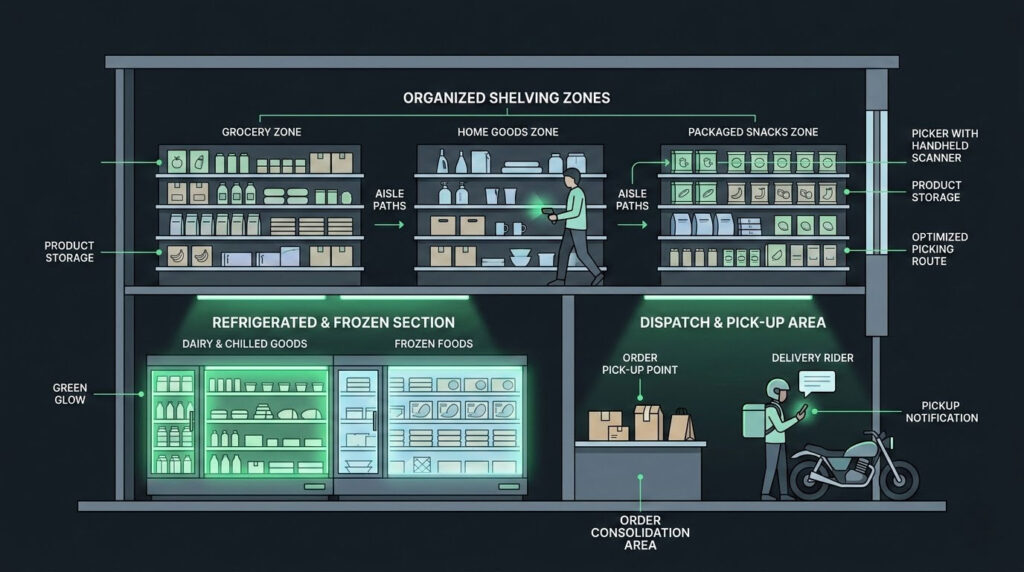
The engine behind quick commerce Saudi Arabia is the dark store — a small warehouse (typically 200-500 square meters) that is not open to the public and exists solely to fulfill online orders. Unlike a traditional supermarket that must allocate space for aisles, checkout counters, and customer flow, a dark store facility dedicates 100% of its layout to efficient picking and packing. This design enables a single order to be assembled in under three minutes from the moment it hits the system.
Dark stores in Saudi Arabia typically stock between 1,500 and 3,000 SKUs — a curated selection of the items consumers order most frequently. The selection is data-driven: platforms analyze order patterns by neighborhood, time of day, and even season (demand for dates and juices spikes during Ramadan, for example) to optimize what each dark store carries. This hyper-local inventory approach means a dark store in a family-heavy neighborhood in Riyadh will stock differently from one serving a business district in Jeddah. The entire dark store model is built around this principle of hyper-local relevance.
The placement strategy is equally critical for 15-minute delivery Saudi Arabia operations. Most q-commerce operators position their dark stores within a two to three-kilometer radius of their target delivery zones, ensuring that the last-mile delivery journey — the most expensive and time-consuming part of any delivery — stays under 15 minutes. Nana, one of the leading players, has stated that its NanaExpress network covers 90% of Riyadh’s daily grocery delivery Saudi Arabia needs through this approach. Rabbit, the Egyptian-origin q-commerce firm, built a dark store network covering 50% of Riyadh within its first year of operations. As more dark stores come online across Jeddah, Dammam, and Tier-2 cities, the delivery radius for quick commerce Saudi Arabia will continue to tighten.
Key Players Driving Quick Commerce Saudi Arabia in 2026
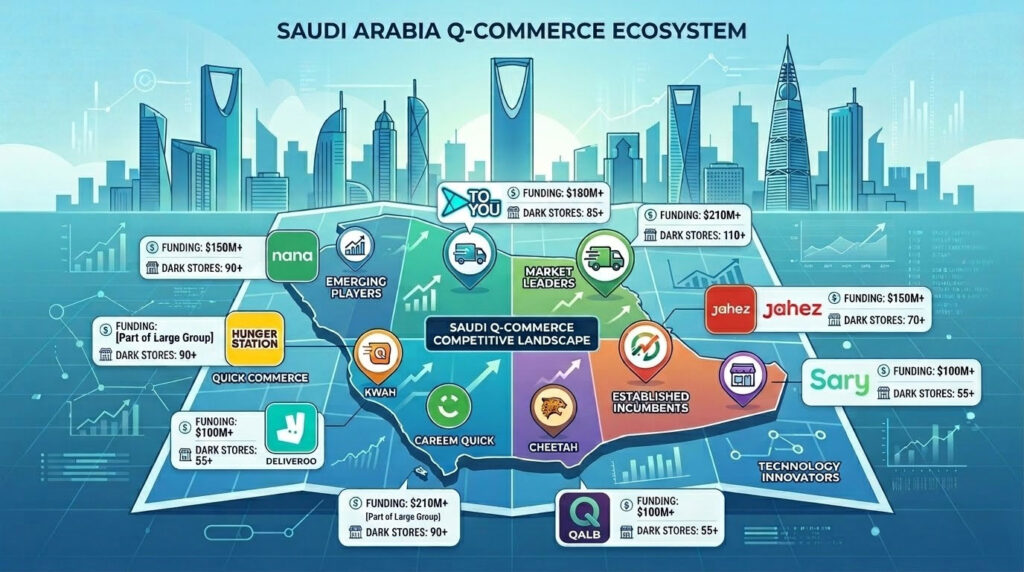
The quick commerce Saudi Arabia landscape is intensely competitive, with both homegrown startups and regional expansions vying for market share. Here are the platforms that matter most in q-commerce Saudi Arabia:
Ninja: The Fastest Saudi Unicorn
Founded in 2022, Ninja achieved unicorn status in July 2025 after raising $250 million led by Riyad Capital at a $1.5 billion valuation — making it the fastest Saudi tech startup to reach that milestone. Ninja operates over 100 dark stores across 28 cities in Saudi Arabia, Bahrain, Qatar, and Kuwait. The company is already profitable in its core quick commerce Saudi Arabia operations and projects to exceed $1 billion in revenue by the end of 2025. Ninja is expanding beyond groceries into pharmacy, cosmetics, perfumes, and even telemedicine, with plans to grow its dark store network to 200+ locations. An IPO on Tadawul is targeted for 2027.
Nana Direct: The Dark Store Pioneer
Founded in 2016 by Sami Al-Helwah and Ahmed Al Samaani, Nana was among the first to bring the dark store Saudi Arabia model to the Kingdom. The platform has delivered over 45 million orders through more than 600,000 delivery drivers. Through NanaExpress (15-minute delivery Saudi Arabia from dark stores with 2,000 SKUs) and NanaHyper (weekly shopping with 22,000+ SKUs), Nana covers the full spectrum of grocery needs. The company raised $133 million in Series C funding and is targeting 40% market share by the end of 2026. Nana also expanded into Egypt and recently acquired the Rasseed gift card app to digitize additional consumer touchpoints.
Rabbit: The Egyptian Challenger
Rabbit launched its q-commerce Saudi Arabia operations in early 2024, bringing its proven Egyptian model — where it has delivered over 40 million items to 1.4 million users — to Riyadh. The company has built a dark store network covering 50% of the capital and targets 20 million item deliveries in Saudi Arabia by 2026. Rabbit’s differentiator is its “House of Brands” approach, supporting local products and using AI-powered inventory management to predict demand and minimize stockouts. Early reorder rates among Saudi users of this quick commerce Saudi Arabia platform are already matching Egypt’s mature customer base at roughly one order per week.
Jahez, HungerStation, and Talabat
These established delivery platforms are expanding aggressively into quick commerce Saudi Arabia. Jahez made headlines in July 2025 by launching Saudi Arabia’s first autonomous delivery robot service in partnership with ROSHN Group. In a major consolidation move, Jahez also completed a $320 million acquisition of Qatar-based Snoonu to expand cross-border scale. HungerStation, now fully owned by Delivery Hero, brings significant negotiating power with suppliers. Talabat acquired Instashop for $32 million to scale grocery fulfillment across the MENA region, strengthening its quick commerce Saudi Arabia capabilities.
Sary (SILQ Group): B2B Quick Commerce
While most q-commerce platforms focus on consumers, Sary addresses the B2B side — connecting restaurants, cafes, hotels, and mini-supermarkets with wholesale suppliers for next-day delivery. In April 2025, Sary merged with Bangladesh’s ShopUp to form SILQ Group, backed by $110 million in funding led by Sanabil Investments (PIF-owned) and Peter Thiel’s Valar Ventures. Together, the combined entity has served over 600,000 retailers and processed more than $5 billion in transactions. For brands targeting the Saudi SME ecosystem, Sary represents a critical quick commerce Saudi Arabia distribution channel.
The AI and Technology Behind Saudi Q-Commerce Operations
Speed is the product in quick commerce Saudi Arabia, and AI is the technology that makes it possible. Across every major quick commerce Saudi Arabia platform, artificial intelligence powers four critical operational layers:
Demand forecasting and inventory management. Machine learning models analyze historical order patterns, weather data, cultural events (Ramadan, National Day, salary-day cycles around the 27th of each month), and real-time demand signals to predict what each dark store facility needs to stock and when. This reduces two of the biggest cost killers in q-commerce: stockouts that lose sales, and overstocking that leads to waste — particularly for perishable goods. Platforms like Rabbit have stated they use proprietary machine learning solutions to provide tailored product recommendations while minimizing inventory gaps. AI algorithms also automate discounting for items approaching expiration, helping dark stores minimize food waste.
Route optimization and fleet management. AI-driven fleet systems dynamically adjust delivery routes based on real-time traffic conditions, weather disruptions, and order clustering. According to industry data, these systems have reduced last-mile delivery times and operational costs by 30-40% compared to static routing. For AI agent-powered ecommerce operations, the fleet management layer is often the highest-ROI AI investment in any quick commerce Saudi Arabia business.
Dynamic pricing. AI continuously adjusts product prices and delivery fees based on inventory levels, demand fluctuations, competitor pricing, and time-of-day patterns. This protects thin margins — one of the biggest challenges in q-commerce — without deterring price-sensitive customers. During peak hours or high-demand events, dynamic delivery fees help balance order volume against fleet capacity.
Personalization. Using behavioral data, AI tailors the in-app experience for each quick commerce Saudi Arabia user: product recommendations, personalized promotions, and even app layout. Nana uses Google Cloud’s BigQuery to segment users by behavior, frequency, and spending patterns, then sends automated personalized campaigns to increase engagement. This level of personalization is what transforms a one-time buyer into a weekly subscriber — a critical distinction in a market where customer lifetime value depends on repeat orders.
Autonomous Delivery: Saudi Arabia’s Robotic Last-Mile Revolution

One of the most exciting developments in quick commerce Saudi Arabia is the arrival of autonomous delivery. In July 2025, Jahez and ROSHN Group launched the Kingdom’s first commercial autonomous food delivery service at the ROSHN Front Business District in Riyadh. Five Level 4 self-driving robots — equipped with over 20 sensors, six cameras, GPS navigation, and climate-adapted cooling systems — now operate during business hours, delivering meals from nearby restaurants without human intervention.
This initiative was licensed through the Transport General Authority’s regulatory sandbox program, making Jahez the first company to receive such a license for last-mile delivery Saudi Arabia automation. The robots can communicate with pedestrians by displaying messages like “I need help” and “Hello,” and feature suspension systems designed for varied terrain. While currently limited to the ROSHN Front business district, ROSHN Group has announced plans to expand the service to all ROSHN-backed communities. For context, this connects to the broader Saudi autonomous mobility strategy — the Transport General Authority has set a target of 25% of all goods transport vehicles being fully autonomous by 2030, and the autonomous vehicle market in the Kingdom is projected to reach $6.07 billion by 2033.
Beyond Jahez’s robots, Saudi Arabia also launched its largest autonomous vehicle trial in 2025 — a Robotaxi pilot between King Khalid International Airport and central Riyadh, run in partnership with WeRide, Uber, and local partner AiDriver. These parallel developments in passenger and goods transport signal that autonomous last-mile delivery Saudi Arabia is not a distant experiment but an active infrastructure buildout that will reshape quick commerce Saudi Arabia cost structures within the next few years.
How Vision 2030 Is Accelerating Quick Commerce Saudi Arabia Growth
Saudi Arabia’s government is not just watching the q-commerce boom unfold — it is actively engineering the conditions for its success. Under Vision 2030, several policy levers directly benefit quick commerce Saudi Arabia operators:
Digital infrastructure investment. The Kingdom’s 99% internet coverage and 78% 5G penetration create the connectivity backbone that q-commerce apps rely on. Government fiber rollouts and Fixed Wireless Access in rural areas are closing the urban-rural digital gap, expanding the addressable market for quick commerce Saudi Arabia beyond Tier-1 cities.
24/7 business operations. In a move that directly supports q-commerce, the Saudi Cabinet approved businesses to operate around the clock. This regulatory change allows dark stores and delivery fleets to run 24-hour operations, capturing late-night and early-morning demand windows that were previously unreachable for grocery delivery services.
Cashless economy push. The shift from cash to digital payments — facilitated by the Mada network, STC Pay, Apple Pay, and the “sarie” real-time payment rail — removes friction from the checkout process. Digital wallet penetration reached 26% of consumers in 2025, and Buy Now Pay Later services now account for 10% of basket checkouts. For quick commerce Saudi Arabia operators, seamless payments translate directly to lower cart abandonment and higher conversion rates. The digital wallet ecosystem continues to expand rapidly.
Logistics infrastructure buildout. The National Transport and Logistics Strategy includes a 59-center logistics blueprint with 21 hubs already underway. These investments reduce inter-city delivery costs and support dark store expansion into secondary cities. Cold-chain grants from the government are also improving fresh-food availability, which directly benefits the grocery segment that dominates quick commerce.
Regulatory framework. The Communication, Space, and Technology Commission (CST) is collaborating with the Ministry of Commerce to develop q-commerce-specific regulatory guidelines covering transparency, consumer protection, and data handling. The Ministry of Human Resources gig-economy framework standardizes delivery rider rights, raising cost floors but creating a level competitive playing field. These regulatory structures build consumer trust — an essential ingredient for sustained quick commerce Saudi Arabia adoption.
Quick Commerce vs Traditional Ecommerce: A Saudi Market Comparison
Understanding where quick commerce Saudi Arabia fits within the broader Saudi ecommerce ecosystem requires a clear comparison. Here is how the two models differ across the dimensions that matter most to business operators:
| Dimension | Quick Commerce Saudi Arabia (Q-Commerce) | Traditional Ecommerce |
|---|---|---|
| Delivery Speed | 10–30 minutes (15-minute delivery Saudi Arabia standard) | 1–5 days |
| Order Frequency | Multiple times per week (daily essentials) | Weekly to monthly |
| Average Order Value | SAR 50–150 (lower per order) | SAR 200–500+ |
| Product Range | 1,500–3,000 curated SKUs per dark store | Thousands to millions of SKUs |
| Fulfillment Model | Dark store Saudi Arabia / micro-fulfillment centers | Central warehouses / 3PL partners |
| Key Categories | Grocery delivery Saudi Arabia, pharmacy, snacks, household | Electronics, fashion, home, beauty |
| Customer Retention | Subscription models + habit-driven loyalty | Promotions + brand loyalty |
| Primary KPI | Delivery time, reorder rate | Conversion rate, average order value |
| Technology Core | AI demand forecasting, route optimization | Search/discovery, recommendations |
| Margin Structure | Thin margins, volume-dependent | Higher margins per transaction |
The key insight: quick commerce Saudi Arabia does not replace traditional ecommerce. It serves a fundamentally different purchase occasion — the urgent, frequent, low-consideration buy. A Saudi consumer might order electronics from Amazon.sa or fashion from Noon with BNPL, but they will use Ninja or Nana for tonight’s dinner ingredients, baby formula, or a forgotten household item. The winning brands in Saudi retail will have a presence across both quick commerce Saudi Arabia and traditional ecommerce models.
How to Launch or Partner With a Q-Commerce Platform in Saudi Arabia
Whether you are a brand looking to get your products onto q-commerce shelves, or an entrepreneur considering launching your own operation, here is a practical roadmap for entering quick commerce Saudi Arabia:
For Brands and Suppliers: Getting Listed on Quick Commerce Saudi Arabia Platforms
Step 1: Identify the right platform mix. Each quick commerce Saudi Arabia platform has different strengths. Ninja and Nana dominate B2C grocery delivery Saudi Arabia. Sary (SILQ Group) is the go-to for B2B wholesale. HungerStation and Talabat focus on prepared food but are expanding into groceries. Evaluate which platforms align with your product category, target geography, and customer profile.
Step 2: Optimize your product data for q-commerce Saudi Arabia. Dark stores operate on curated, high-turn SKUs. Your product needs clear packaging, accurate barcodes, high-quality images, and concise descriptions. If you are in the food category, ensure compliance with Saudi Food and Drug Authority (SFDA) labeling requirements. Shelf life is critical — dark store operators favor products with longer shelf life or fast turnover to minimize waste.
Step 3: Negotiate placement and promotions. In-app visibility drives sales in quick commerce Saudi Arabia even more than in traditional ecommerce, because consumers browse less and buy faster. Invest in sponsored placements, flash deals, and category-level promotions. Many platforms offer co-marketing programs where brands contribute to promotional budgets in exchange for premium shelf positioning.
Step 4: Monitor performance data. Q-commerce Saudi Arabia platforms provide granular data on sell-through rates, restocking frequency, return rates, and customer ratings. Use this data to iterate on pricing, packaging, and product mix. Brands that treat quick commerce Saudi Arabia as a data channel — not just a sales channel — gain a significant competitive advantage.
For Entrepreneurs: Launching a Q-Commerce Saudi Arabia Operation
Step 1: Start with a single city and dense zone. Quick commerce Saudi Arabia unit economics only work at sufficient order density. Choose a high-population, high-income neighborhood in Riyadh, Jeddah, or Dammam for your first dark store. Aim for a two to three-kilometer delivery radius.
Step 2: Invest in technology from day one. You need a mobile app with real-time order tracking, an inventory management system with demand forecasting, and a fleet management platform with route optimization. Building in-house is expensive — consider white-label solutions or platforms like Foodics (a Saudi-origin restaurant tech platform) that offer modular commerce infrastructure for quick commerce Saudi Arabia ventures.
Step 3: Secure supply chain partnerships. Negotiate directly with local distributors and FMCG brands. Your pricing advantage comes from cutting traditional wholesale middlemen. Consider partnering with Sary for B2B sourcing to access 30,000+ SKUs from top brands at competitive wholesale rates.
Step 4: Build a reliable delivery fleet. The gig-economy framework from the Ministry of Human Resources sets standards for rider contracts, insurance, and compensation. Comply from the start — both for legal protection and because rider retention is a critical operational lever. High rider turnover destroys 15-minute delivery speed and service quality.
Step 5: Plan for regulatory compliance. Register your ecommerce business through the Ministry of Commerce, obtain relevant SFDA licenses for food handling, and ensure compliance with the Personal Data Protection Law (PDPL) for customer data. Review the PDPL data residency requirements if your tech stack involves cloud-hosted services.
Common Mistakes When Entering Quick Commerce Saudi Arabia
Having studied the landscape closely and spoken with professionals in the sector, I have seen these mistakes repeated by brands and operators entering quick commerce Saudi Arabia:
Overestimating delivery radius. Expanding the delivery zone beyond three kilometers to capture more customers sounds logical, but it destroys the 15-minute delivery speed promise. A 25-minute average delivery becomes 40 minutes, customer satisfaction drops, and reorder rates collapse. Keep it tight and expand through additional dark stores, not wider radiuses.
Ignoring cultural demand cycles. Saudi Arabia has distinct consumption patterns that differ from Western or even other GCC markets. Ramadan transforms grocery ordering volumes. The 27th of each month — salary day — triggers purchasing spikes. Summer months shift demand toward indoor entertainment and hydration products. Quick commerce Saudi Arabia platforms that treat demand as flat throughout the year leave money on the table and suffer from stockouts during peak periods.
Underinvesting in cold chain. Saudi Arabia’s extreme heat makes cold chain logistics non-negotiable for fresh food, dairy, and pharmacy products. Dark store Saudi Arabia facilities need refrigerated sections, delivery vehicles need insulation, and last-mile robots need climate-adapted cooling (which Jahez’s robots address with specialized systems). Skimping here results in spoilage, returns, and lost customer trust.
Chasing volume over unit economics. The temptation in quick commerce Saudi Arabia is to subsidize delivery and discount aggressively to win market share. But Ninja’s path to unicorn status was built on being profitable in core operations before scaling. The sustainable q-commerce business achieves positive unit economics at the dark store level first, then reinvests to expand.
Neglecting the B2B opportunity. Most attention goes to consumer-facing q-commerce, but the B2B segment — restaurants, hotels, cafes, and small retailers replenishing stock — is a high-volume, high-retention channel. Makkah’s hospitality capacity alone rose 89% in 2024, creating massive demand for rapid B2B replenishment during pilgrim seasons. The Sary/SILQ model shows that B2B quick commerce Saudi Arabia can build sustainable, high-margin operations.

FAQ: Quick Commerce Saudi Arabia
What is the difference between quick commerce and traditional ecommerce in Saudi Arabia?
Quick commerce Saudi Arabia focuses on delivering everyday essentials like groceries, pharmacy items, and household products in under 30 minutes using nearby dark stores. Traditional ecommerce handles a broader product range — electronics, fashion, home goods — with delivery times of one to five days from central warehouses. The purchase occasions are different: q-commerce targets frequent, small, urgent buys while traditional ecommerce serves planned, larger purchases.
What are dark stores and how many are operating in Saudi Arabia?
Dark stores are small warehouses dedicated exclusively to fulfilling online orders — they are not open to walk-in customers. The dark store Saudi Arabia network is expanding rapidly. Ninja operates over 100 dark stores across 28 cities with plans for 200+. Nana covers 90% of Riyadh through its NanaExpress dark stores. Rabbit built a network covering 50% of Riyadh within its first year. The total number of dark store locations across all operators is growing monthly as platforms race to expand coverage.
What are the best quick commerce Saudi Arabia apps?
The leading quick commerce Saudi Arabia apps for consumers include Ninja (groceries and pharmacy, 100+ dark stores, under-20-minute delivery), Nana (groceries with NanaExpress for 15-minute delivery Saudi Arabia and NanaHyper for full weekly shops), Rabbit (AI-powered grocery delivery expanding from Riyadh), Jahez (food delivery expanding into grocery with autonomous delivery), HungerStation, and Talabat. For B2B wholesale ordering, Sary (now SILQ Group) is the dominant q-commerce platform.
How fast is quick commerce delivery in Saudi Arabia?
Most q-commerce platforms target delivery within 10 to 30 minutes. According to Mordor Intelligence, orders with a sub-10-minute delivery promise captured 58.66% of total quick commerce Saudi Arabia market share in 2024, indicating that consumers are gravitating toward the fastest options. NanaExpress promises 15-minute delivery service, while Ninja averages under 20 minutes across its network.
Is quick commerce profitable in Saudi Arabia?
Profitability in quick commerce Saudi Arabia is achievable but challenging. Ninja became the fastest Saudi unicorn partly because it achieved profitability in core operations before aggressive scaling. The key metrics are order density per dark store, average order value, delivery cost per order, and customer reorder frequency. Subscription models that offer free delivery can increase customer lifetime value by up to 40% compared to pay-per-order models. The B2B segment through platforms like Sary typically offers better margins than consumer-facing grocery delivery Saudi Arabia.
How can brands get their products listed on Saudi q-commerce platforms?
Brands should contact quick commerce Saudi Arabia platform supplier teams directly through their business portals. Nana, Ninja, and Rabbit all have supplier onboarding programs. Key requirements include proper SFDA licensing for food products, accurate barcoding, high-quality product images, and competitive wholesale pricing. Products with high turnover rates and strong local demand are prioritized for dark store placement. Co-marketing investments and promotional support can accelerate product visibility in the app.
How does Saudi Arabia regulate quick commerce and dark stores?
The Ministry of Commerce oversees ecommerce regulations including consumer protection and advertisement standards. The Communication, Space, and Technology Commission (CST) is developing q-commerce-specific guidelines alongside the Ministry of Commerce. Dark stores must comply with municipal zoning, SFDA food handling standards, and the Personal Data Protection Law (PDPL) for customer data. The Ministry of Human Resources gig-economy framework regulates delivery rider employment terms. The Transport General Authority manages autonomous last-mile delivery Saudi Arabia licensing through its regulatory sandbox program.
Are there autonomous delivery robots in Saudi Arabia?
Yes. In July 2025, Jahez and ROSHN Group launched the first commercial autonomous food delivery robots in Saudi Arabia at the ROSHN Front Business District in Riyadh. Five Level 4 self-driving robots equipped with 20+ sensors and six cameras operate during working hours, advancing the quick commerce Saudi Arabia last-mile experience. The Transport General Authority is managing the initiative through its regulatory sandbox and has set a target of 25% of goods transport vehicles being autonomous by 2030. Expansion to additional ROSHN communities and broader deployment is planned.
The Future of Quick Commerce Saudi Arabia
The trajectory of quick commerce Saudi Arabia points toward several developments that will reshape the competitive landscape over the next two to three years. Category expansion is already underway — Ninja’s move into pharmacy, cosmetics, and telemedicine signals that q-commerce platforms are evolving into super-apps for instant everything, not just groceries. The intersection with autonomous AI agents will further accelerate this expansion, as AI-powered systems handle everything from demand prediction to autonomous fulfillment.
Autonomous delivery will move from pilot programs to mainstream operations. As the Transport General Authority expands its regulatory sandbox and 5G infrastructure matures, expect autonomous robots and vehicles to handle a growing share of last-mile delivery Saudi Arabia operations — particularly within gated communities, business districts, and NEOM-style smart city developments. This shift will fundamentally alter the cost equation for quick commerce Saudi Arabia operators.
The B2B segment represents perhaps the most underappreciated growth vector in quick commerce Saudi Arabia. As Makkah’s hospitality sector continues to expand and Saudi Arabia’s SME ecosystem grows under Monsha’at initiatives, the demand for rapid wholesale replenishment will scale dramatically. Platforms that can serve both B2C and B2B from the same dark store infrastructure will have a significant cost advantage.
IPO activity will bring new attention and capital to the sector. Ninja’s planned 2027 Tadawul listing, Nana’s growth trajectory, and Salla’s pre-IPO round all signal that quick commerce Saudi Arabia is entering its institutional phase — moving from venture-backed experimentation to public-market accountability and scale.
For ecommerce managers and brand owners operating in the Kingdom, the message is clear: quick commerce Saudi Arabia is not a niche channel. It is becoming a core pillar of Saudi retail infrastructure. Whether you participate as an operator, a supplier, or a technology partner, the window to establish your position in this $1 billion+ market is open now — and it will not stay open forever.
Related reading:
- Ecommerce Trends 2026: 10 Technologies Reshaping Online Shopping
- AI Agents for eCommerce: Automate Inventory, Customer Service, and Pricing
- Start an Ecommerce Business in Saudi Arabia: The Complete Guide
- Digital Wallets Saudi Arabia: Cashless Payment Guide
- Sovereign AI Saudi Arabia & The “Saudi-First” Customer Experience
Sources: Mordor Intelligence — Saudi Arabia Quick Commerce Market (2025), MarkNtel Advisors — Saudi Arabia Quick Commerce Market Report 2026-2032, IMARC Group — Saudi Arabia Q-Commerce Market Size & Forecast 2025-2033, Arab News — Rabbit’s Quick Commerce Model (June 2025), Arab News — First Commercial Food Delivery Robots in Saudi Arabia (July 2025), Bloomberg — Ninja Becomes Unicorn With $250 Million Pre-IPO Funding (July 2025), Wamda — Sary and ShopUp Form SILQ (April 2025), Google Cloud — Nana Customer Story, Lucidity Insights — Nana: Revolutionizing Grocery Shopping in Saudi Arabia (2024), World Economic Forum — Understanding Digitalization in Saudi Arabia’s Consumer Economy (January 2026).

Husain Alhaboubi is Director of Digital Channels at Mobily, where he leads platform optimization, AI-powered customer engagement, and UI/UX strategy. With 20+ years of experience spanning eCommerce, IT infrastructure, and digital marketing, he previously drove a 225% revenue increase and 69% organic traffic growth as eCommerce Senior Manager at flyadeal, and managed enterprise IT operations — including data centers, ERP systems, and network security — as Group IT Manager at IPD Group.
Husain holds a BS in Information Systems from the University of Texas at Arlington and is certified in Google Ads, Google Analytics, and Semrush SEO. He writes from hands-on experience across both sides of digital business: the strategic (eCommerce, SEO, AI, digital transformation) and the technical (server administration, cloud computing, web development, networking, and security) — with a particular focus on the Saudi market and Vision 2030. Read his full resume →