
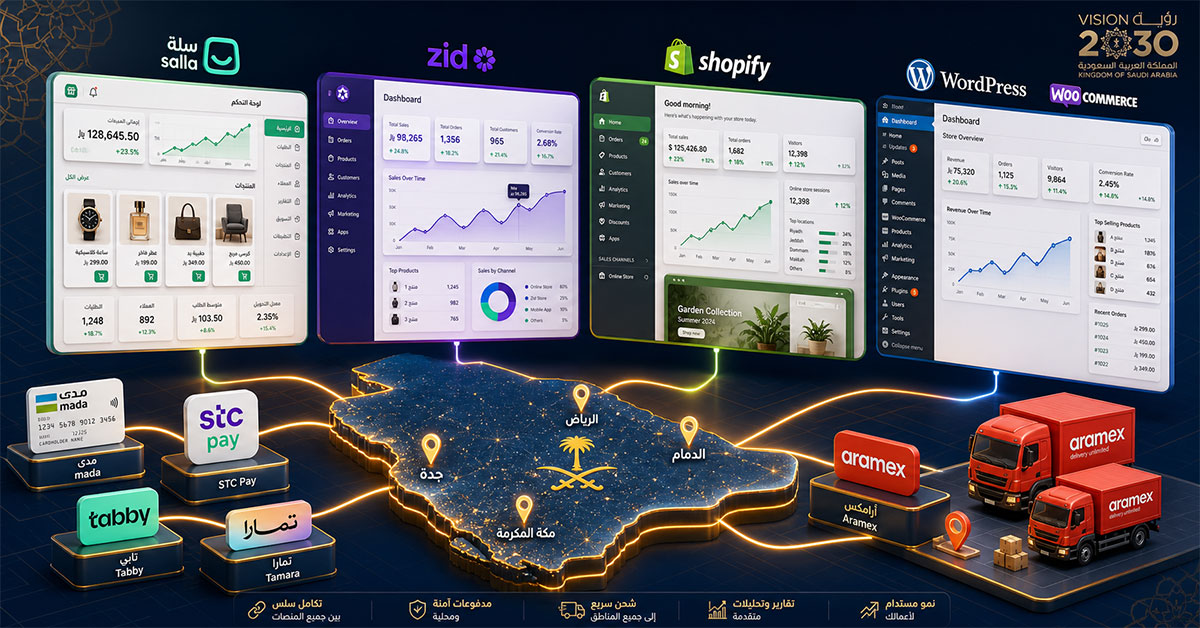
Best Ecommerce Platform Saudi Arabia 2026: Salla vs Zid vs Shopify vs WooCommerce
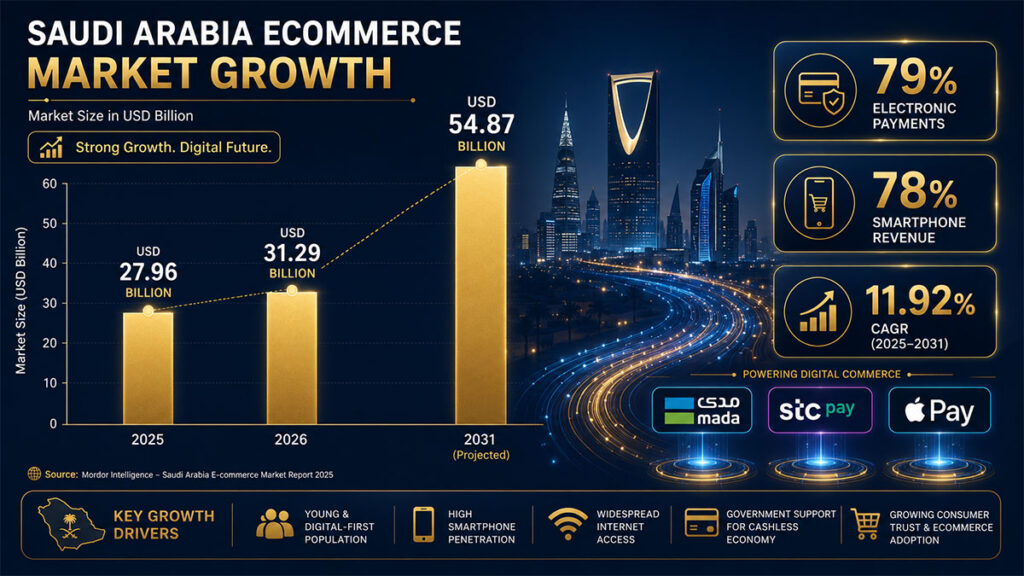
Choosing the best ecommerce platform Saudi Arabia entrepreneurs can rely on is the single most important technical decision you will make before launching your first store. The best ecommerce platform Saudi Arabia for one merchant is rarely the right answer for another — but the wrong choice always shows up the same way: stalled growth and rebuilds. Pick wrong, and you spend months fighting payment integrations, ZATCA compliance gaps, Arabic RTL bugs, or migration headaches. Pick the best ecommerce platform Saudi Arabia has on offer, and you launch in days with mada, STC Pay, Tabby, and Tamara already wired into checkout. With Saudi Arabia’s ecommerce market hitting USD 31.29 billion in 2026 and projected to grow at 11.92% CAGR through 2031, the platform you choose today determines whether you ride that growth or get crushed by it.
This guide compares the four platforms new Saudi entrepreneurs actually consider in 2026 when looking for the best ecommerce platform Saudi Arabia can offer: Salla, Zid, Shopify, and WooCommerce. I will break down pricing in SAR, local payment support, ZATCA Phase 2 readiness, Arabic experience, and which platform genuinely fits a first-time merchant. By the end, you will know exactly which is the best ecommerce platform Saudi Arabia offers for your specific situation — not based on marketing claims, but based on what works in the Kingdom right now.
Table of Contents
The Saudi Ecommerce Landscape in 2026
Before deciding on the best ecommerce platform Saudi Arabia entrepreneurs should adopt, you need to understand the market you are entering. The Kingdom is not a generic emerging market — it is one of the most digitally mature ecommerce environments in the world, with rules and consumer expectations that punish foreign-built platforms.
According to Mordor Intelligence (January 2026), the Saudi ecommerce market grew from USD 27.96 billion in 2025 to USD 31.29 billion in 2026 and will reach USD 54.87 billion by 2031. Smartphones drive 77.98% of revenue, Riyadh accounts for 35.01% of national sales, and digital wallets are growing at 14.71% CAGR. The Saudi Central Bank (SAMA) confirmed that 79% of all retail transactions in 2024 were electronic — exceeding the 70% Vision 2030 target a full year early. That growth rate compounds the importance of getting the best ecommerce platform Saudi Arabia decision right early.
For a new entrepreneur, three local realities shape the platform decision more than any feature checklist:
- ZATCA Phase 2 e-invoicing is mandatory. Wave 24, with a deadline of June 30, 2026, lowered the threshold to SAR 375,000 in annual VATable revenue. Most serious stores hit this threshold quickly, and the platform must integrate directly with the Fatoora portal.
- Mada is non-negotiable. Mada is the national debit card network, and Saudi shoppers expect it at checkout alongside Apple Pay, STC Pay, Tabby, and Tamara. Stores that only accept international Visa or Mastercard lose conversions immediately.
- Arabic RTL is the default, not an add-on. A right-to-left storefront with proper Arabic typography is the baseline. Any platform where Arabic feels like a translation layer will struggle against Saudi-built competitors.
These three realities are exactly why the best ecommerce platform Saudi Arabia entrepreneurs choose is rarely the same one a US or European founder would pick. Local fit beats global feature counts in this market — and the data backs it up. According to ECDB, Salla is now the leading shop software provider in the Saudi ecommerce market, ahead of Shopify and WooCommerce. The four ecommerce platforms Saudi Arabia merchants seriously consider in 2026 are Salla, Zid, Shopify Saudi Arabia, and WooCommerce Saudi Arabia. Each has a distinct profile, and the right answer for “best ecommerce platform Saudi Arabia” depends on which trade-offs you can live with for the next 24 months.
What Makes a Platform the Best for Saudi Arabia
When evaluating the best ecommerce platform Saudi Arabia has available, ignore generic global review sites — most do not weight Saudi-specific factors. Use these eight criteria instead, ranked roughly in order of importance for new entrepreneurs picking the best ecommerce platform Saudi Arabia offers for a first store launch:
Native Saudi Payment Support
The platform must offer mada, Apple Pay, STC Pay, Tabby, and Tamara out of the box. Anything that requires a third-party payment gateway plugin adds setup friction and ongoing transaction fees of 2–3%. This is the single hardest filter when picking the best ecommerce platform Saudi Arabia entrepreneurs can rely on for high-conversion checkout.
ZATCA Phase 2 Compliance
The platform must generate UBL 2.1 XML invoices with QR codes and cryptographic stamps, and submit them to the Fatoora portal in real time for B2B or within 24 hours for B2C. Without native integration, you are building this yourself or buying expensive middleware. The best ecommerce platform Saudi Arabia entrepreneurs use should treat ZATCA as a default, not an add-on.
Arabic First-Class Support
Right-to-left layouts, proper Arabic fonts (Tajawal, Cairo, IBM Plex Sans Arabic), Arabic dashboard, Arabic invoices, and Arabic customer support. Saudi shoppers can tell within 5 seconds whether a store was built for them or translated for them. A genuinely Saudi ecommerce platform feels native; a translated one feels foreign.
Local Shipping and Logistics Integration
Aramex, SMSA, Naqel, J&T, and AJEX are the carriers Saudi customers expect. The platform should generate shipping labels, calculate live rates, and let you track shipments without manual exports.
Total Cost of Ownership
Subscription cost is just the start. Add transaction fees, app subscriptions, theme costs, hosting (for self-hosted), payment gateway fees, and developer time. The cheapest Saudi ecommerce platform on paper often becomes the most expensive in practice, which is why budget-driven founders often misidentify the best ecommerce platform Saudi Arabia has on offer for their stage.
Ease of Use for Non-Technical Founders
If you cannot launch within 48 hours without hiring a developer, the platform is too complex for your first store. Save customization for after you validate the product. The best ecommerce platform Saudi Arabia entrepreneurs adopt early should remove technical complexity, not add it.
Scalability Without Re-Platforming
You want a platform that grows from your first SAR 10,000 month to your first SAR 1 million month without forcing a migration. Migrations cost 3–6 months of momentum and SEO equity.
Marketing and SEO Capabilities
Strong meta tag control, structured data, fast page load, Arabic SEO support, and integration with Meta, TikTok, Snapchat, and Google Ads. These are non-negotiable for organic and paid growth in 2026, especially as AI search engines start citing product pages directly.
Salla: The Saudi-Native Leader
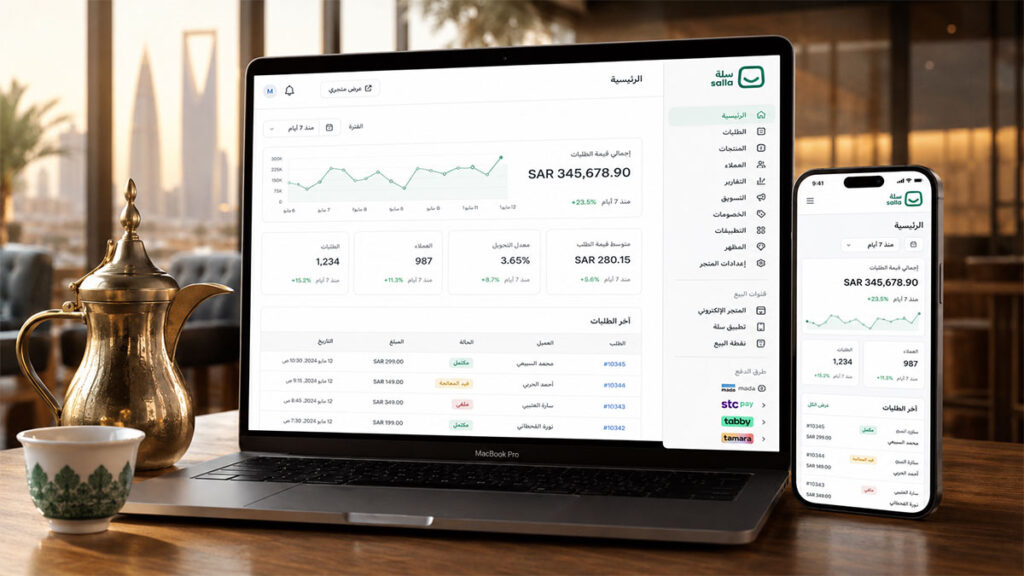
Salla is the dominant hosted SaaS platform in the Kingdom and the default starting point for most Saudi entrepreneurs. Founded in Mecca in 2016 by Nawaf Hariri and Salman Butt, Salla now powers 68,000+ active merchants, has processed over USD 13.3 billion in GMV, and reports that one in two Saudi online shoppers has purchased from a Salla-powered store. For many founders, Salla is straightforwardly the best ecommerce platform Saudi Arabia has produced. In any honest Salla vs Zid comparison, Salla wins on speed-to-launch, app marketplace breadth, and free-tier viability, while Zid wins on inventory depth and merchant financing.
Salla Pricing in 2026
Salla offers a free tier (Salla Basic) with a transaction fee, then three Standard plans starting around SAR 99/month, plus the Salla Special enterprise tier with custom pricing. The free plan is genuinely usable for testing — you can list products, accept mada and Apple Pay, and ship through Salla’s logistics partners. Paid plans unlock SEO controls, custom CSS/JS, more staff accounts, and access to the full app marketplace. For most first-time founders evaluating the best ecommerce platform Saudi Arabia can offer at zero or near-zero cost, the Salla free tier is the obvious starting point.
Salla Strengths
- Built for Saudi from day one. Arabic dashboard, Arabic-first themes, Saudi support team, and full ZATCA Phase 2 integration through the native ZATCA app. This is what makes Salla a serious contender for the best ecommerce platform Saudi Arabia title in any honest review.
- Payment ecosystem already wired. mada, STC Pay, Apple Pay, Tabby, Tamara, and traditional cards work without a separate gateway. Cash on delivery is supported and battle-tested.
- 900+ apps and 200+ shipping partners. The marketplace covers everything from WhatsApp order confirmations and loyalty programs to ERP/POS connectors. Logistics integrations include Aramex, SMSA, Naqel, J&T, and dozens more.
- Mahally marketplace exposure. Every Salla store is automatically listed in Mahally, a built-in marketplace with 9 million+ products across 68,000 merchants — free incremental traffic without Amazon or Noon commissions.
- Mobile app builder. Native iOS and Android apps in 72 hours, no code, with sync to your storefront.
- Speed to launch. A new merchant can build, verify, and launch in under 48 hours — faster than any other Saudi ecommerce platform on this list.
Salla Weaknesses
- Limited customization at lower tiers. Custom CSS/JS is reserved for higher plans. Heavy design work means upgrading or working within theme constraints.
- Regional focus. Salla is excellent across the GCC but less suitable if your roadmap targets Europe, the US, or Southeast Asia as primary markets.
- SEO depth ceiling. SEO is solid out of the box but lacks some of the granular controls advanced operators expect from Shopify or WooCommerce.
Zid: The Total Commerce Challenger
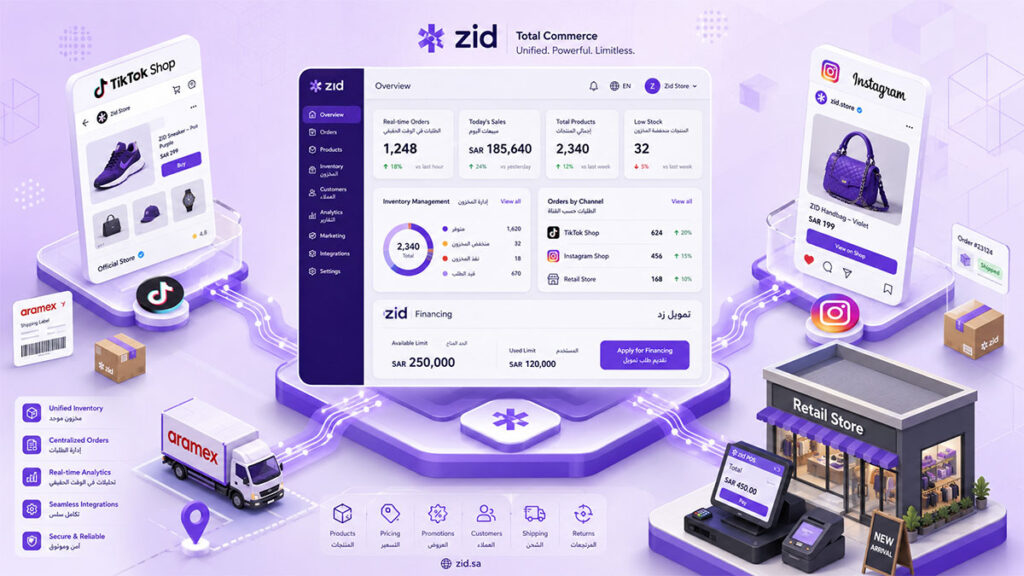
Zid, founded in Riyadh in 2017 by Mazen AlDarrab and Sultan Al-Asmi, is the second major Saudi-built platform and the strongest direct competitor to Salla. Zid has raised USD 59 million across three rounds, including a USD 50 million Series B in October 2022, and serves 12,000+ active merchants. According to Arab News (December 2024), Zid merchants reported a 50% lift in average basket size and conversion rate after adopting the platform’s Total Commerce stack. The Salla vs Zid debate dominates conversations among Saudi merchants — and for good reason. Both are built locally, both are ZATCA-native, and both can credibly claim to be the best ecommerce platform Saudi Arabia has for a first-time founder.
Zid Pricing in 2026
Zid offers a free starter tier and paid plans starting from approximately SAR 100/month, with Growth and Professional tiers ranging up to roughly SAR 4,600 to SAR 13,800 annually depending on the feature set. Zid Financing — a merchant cash advance product — is bundled with paid plans and helps with inventory funding, which is a meaningful differentiator for new merchants short on working capital. Inventory financing alone makes Zid a credible candidate for the best ecommerce platform Saudi Arabia has for working-capital-constrained founders.
Zid Strengths
- Total Commerce vision. Zid unifies online stores, social commerce (TikTok Shop, Snapchat, Instagram, Meta), and physical retail in one dashboard. For founders running an Instagram boutique who want a real online presence too, this is a major fit.
- Strong inventory and pricing tools. Zid is known for sharper inventory management, bundle pricing, and promotion engines than its peers.
- Merchant financing built in. Zid Financing offers capital based on store sales data — a lifeline for new merchants who cannot easily access traditional bank loans.
- Continuous education. Zid runs an active program of merchant workshops and the “10x” growth program, with reports of merchants growing revenue tenfold.
- Strong support culture. Response times and merchant success effort are consistently rated higher than competitors.
Zid Weaknesses
- Steeper learning curve. The depth of Zid’s tools means new merchants need more time to get fully productive than on Salla.
- Higher pricing on advanced tiers. Pro plans cost more than equivalent Salla tiers when you factor in the full feature set.
- Smaller app marketplace than Salla. Fewer third-party integrations available out of the box.
Shopify: The Global Powerhouse
Shopify is the dominant global ecommerce platform and a credible option for Saudi entrepreneurs who plan to sell internationally from day one. The argument for Shopify Saudi Arabia adoption is design flexibility, the largest app ecosystem in ecommerce, and the strongest international expansion infrastructure. The argument against is that nothing about Shopify was built specifically for Saudi Arabia — every local feature is a configuration or third-party app. Whether Shopify Saudi Arabia merchants consider Shopify the best ecommerce platform Saudi Arabia can offer depends entirely on whether their roadmap is GCC-only or international.
Shopify Pricing in 2026
Per Shopify’s official pricing page (2026), the global plan structure is:
- Starter: USD 5/month — checkout link only, no full storefront.
- Basic: USD 39/month (USD 29 annual) — full storefront, 2.9% + 30¢ online card rate.
- Grow: USD 105/month (USD 79 annual) — formerly the “Shopify” plan, with deeper reporting.
- Advanced: USD 399/month (USD 299 annual) — lower transaction fees, advanced reporting.
- Plus: from USD 2,300/month — enterprise tier with custom checkout and B2B.
For a Saudi merchant on the Basic plan, expect roughly SAR 145–150/month in subscription, plus card processing of around 2.9% + 30¢ per online sale, plus an additional 2% third-party transaction fee if you use a non-Shopify-Payments gateway (which most Shopify Saudi Arabia stores have to, since Shopify Payments is not available in Saudi Arabia).
Shopify Strengths
- Best-in-class app ecosystem. 8,000+ apps covering every conceivable use case — reviews, upsells, subscriptions, B2B, headless commerce, you name it.
- Premium themes and design control. The visual ceiling on Shopify is significantly higher than Salla or Zid for merchants with design ambition.
- Multi-market expansion. Shopify Markets makes selling into the GCC, Europe, and the US straightforward once you outgrow Saudi Arabia.
- Mada, STC Pay, Tabby, and Tamara via partners. Saudi payment methods are available through PayTabs, HyperPay, Tap, Network International, and direct Tabby/Tamara apps.
- Strongest SEO foundation. Granular meta control, structured data, fast Liquid templates, and the deepest blog/content tooling of the four platforms.
Shopify Weaknesses
- Shopify Payments is not available in Saudi Arabia. You must use a third-party payment gateway, which adds 2% transaction fees on top of the gateway’s own processing rates.
- ZATCA Phase 2 needs a third-party app. Native ZATCA integration does not exist — you rely on apps like ZATCA E-Invoice connectors or external middleware.
- Arabic is a configuration, not a default. RTL works but requires careful theme selection and often custom development to feel truly native.
- Cost stacks fast. Subscription + transaction fees + apps + premium theme + developer fees can reach USD 200–500/month for a serious store, well above Salla equivalents.
- Saudi support comes from agencies, not Shopify. No 24/7 Arabic support team in Riyadh — you rely on Saudi Shopify partner agencies.
WooCommerce: The Self-Hosted Open-Source Option
WooCommerce is a free WordPress plugin that turns any WordPress site into an ecommerce store. It is the open-source choice and powers a significant slice of global online stores. For Saudi entrepreneurs, WooCommerce Saudi Arabia setups are the platform you choose when you (or a developer you trust) want absolute control over every line of code, every database query, and every integration. WooCommerce Saudi Arabia stores are rarely the right choice for a true beginner, but the platform is included here because many founders ask whether it could be the best ecommerce platform Saudi Arabia has for a content-driven brand.
WooCommerce True Cost in 2026
WooCommerce itself is free, but the realistic monthly cost for a Saudi store typically lands around SAR 400–700/month once you add: hosting, themes, plugins, ZATCA tooling, and shipping integrations. The headline of “free” is what tempts most founders to consider WooCommerce as the best ecommerce platform Saudi Arabia answer for cost-sensitive launches — until they tally the realistic monthly stack:
- Hosting on a managed WordPress host (SAR 100–300/month for decent performance)
- Premium theme like Astra Pro, Flatsome, or Woodmart (SAR 200–400/year)
- Essential plugins: Yoast SEO Premium, WP Rocket, Wordfence, backups (SAR 100–250/month)
- Saudi payment gateway plugin (HyperPay, PayTabs, Tap — gateway fees apply per transaction)
- ZATCA Phase 2 plugin or external integration (SAR 100–500/month for compliant solutions)
- Saudi shipping plugins for Aramex, SMSA, Naqel
- Developer maintenance (security patches, updates) — DIY or SAR 500–2,000/month with a freelancer
WooCommerce Strengths
- Total ownership. You own the code, the database, and the data. No platform can suspend your store, raise fees, or change rules overnight.
- Unlimited customization. Anything WordPress can do, your store can do — custom post types, ACF fields, headless front-ends, custom checkout flows.
- No transaction fees. WooCommerce charges nothing per sale. You only pay your payment gateway’s processing fee.
- Built-in content marketing. WordPress is the world’s best blogging platform, which is a massive SEO advantage for content-driven brands.
- One-time costs scale better. Heavy traffic does not scale your subscription fee — it scales your hosting bill, which is usually cheaper.
WooCommerce Weaknesses
- You are the IT department. Security patches, updates, backups, downtime, plugin conflicts — all your problem. No 24/7 support team will fix a broken site at 2 a.m. on a White Friday sale.
- ZATCA compliance is bring-your-own. No native Fatoora integration. You install a plugin, hire a developer, or pay for SaaS middleware.
- Performance requires expertise. WooCommerce can be lightning-fast, but only with proper hosting, caching (see my guide on caching WordPress with Cloudflare), and image optimization.
- Slow time to launch. A capable WooCommerce store takes 2–6 weeks to set up properly, versus 48 hours for Salla.
- Worst fit for a non-technical first-time founder. The freedom is real, but so is the rope to hang yourself.
Head-to-Head Comparison Table
This side-by-side table summarizes how each platform performs across the criteria that matter most when picking the best ecommerce platform Saudi Arabia entrepreneurs need for their first store. Use it as the fastest way to short-list two finalists, then run a weekend trial on each before you commit to your best ecommerce platform Saudi Arabia choice.
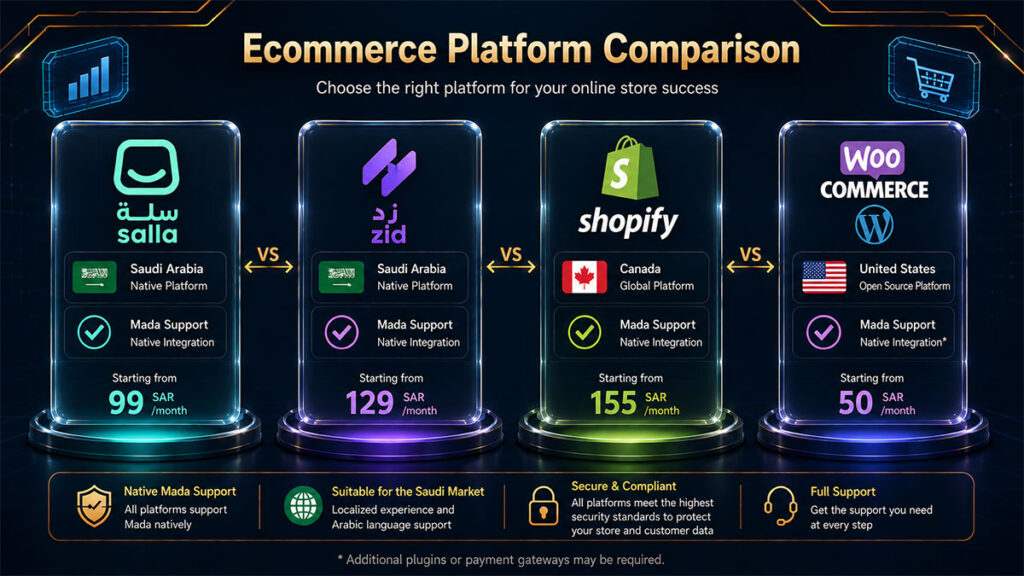
| Criterion | Salla | Zid | Shopify | WooCommerce |
|---|---|---|---|---|
| Starting price | Free / from SAR 99/mo | Free / from SAR 100/mo | ~SAR 145/mo (Basic) | Free + ~SAR 400–700/mo costs |
| mada native | Yes | Yes | Via gateway app | Via gateway plugin |
| STC Pay native | Yes | Yes | Via gateway app | Via gateway plugin |
| Tabby / Tamara | Yes | Yes | Via app | Via plugin |
| ZATCA Phase 2 | Native ZATCA app | Native | Third-party app | Plugin / middleware |
| Arabic dashboard | First-class | First-class | Translation layer | Translation layer |
| Time to launch | 24–48 hours | 2–5 days | 1–2 weeks | 2–6 weeks |
| Saudi support | 24/7 Arabic | 24/7 Arabic | Via partner agencies | Self / freelancer |
| App ecosystem | 900+ apps | Growing | 8,000+ apps | 59,000+ plugins |
| Customization ceiling | Medium | Medium | High | Unlimited |
| Best for | Saudi-first launch | Multi-channel retail | Global ambition | Technical founders |
True Cost of Ownership Breakdown
Sticker price misleads. Here is what a realistic first year actually costs on each platform for a new Saudi store doing roughly SAR 50,000/month in sales (about 200 orders at SAR 250 average order value). This Year 1 view is often what flips a founder’s choice of the best ecommerce platform Saudi Arabia answer from Shopify back to Salla or Zid.
| Cost Component | Salla (Pro) | Zid (Professional) | Shopify (Basic) | WooCommerce |
|---|---|---|---|---|
| Subscription / year | ~SAR 3,588 | ~SAR 2,990 | ~SAR 1,740 | SAR 0 |
| Hosting / year | Included | Included | Included | ~SAR 2,400 |
| Premium theme | ~SAR 200 | Included | ~SAR 1,100 | ~SAR 400 |
| Essential apps/plugins / year | ~SAR 600 | ~SAR 600 | ~SAR 1,800 | ~SAR 1,200 |
| Payment gateway fees (~2.5% of SAR 600K) | ~SAR 15,000 | ~SAR 15,000 | ~SAR 27,000* | ~SAR 15,000 |
| ZATCA solution / year | Included | Included | ~SAR 600 | ~SAR 1,200 |
| Developer maintenance | SAR 0 | SAR 0 | ~SAR 3,000 | ~SAR 6,000 |
| Estimated Year 1 Total | ~SAR 19,388 | ~SAR 18,590 | ~SAR 35,240 | ~SAR 26,200 |
*Shopify Basic in Saudi Arabia incurs Shopify’s third-party payment provider fee (2%) on top of the actual gateway’s processing rate, which is why payment costs are notably higher than Salla, Zid, or WooCommerce. This is one of the biggest hidden costs that new Saudi entrepreneurs underestimate when comparing the best ecommerce platform Saudi Arabia option for their budget.
How to Decide Which Is Best For You
The best ecommerce platform Saudi Arabia has on offer depends entirely on your specific situation. Use this decision framework to narrow it down quickly:
Choose Salla If
Salla is the best ecommerce platform Saudi Arabia entrepreneurs can pick when speed and local fit beat everything else. Choose Salla if any of the following apply to your situation:
- You are launching your first store and want to be live in 48 hours.
- Your customer base is primarily Saudi Arabia or the GCC.
- You are non-technical and want everything pre-integrated.
- You want exposure to the Mahally marketplace from day one.
- Your budget is tight and you want a free starting tier.
Choose Zid If
Zid earns its place as the best ecommerce platform Saudi Arabia has for omnichannel and inventory-heavy merchants. The Salla vs Zid choice tilts toward Zid in these scenarios:
- You already sell on social media (TikTok, Instagram, Snapchat) and need a unified backend.
- You have or plan to have a physical retail location plus online store.
- You need merchant financing to fund inventory.
- You value structured education and 1:1 support over self-serve speed.
- Inventory management complexity is a major part of your business.
Choose Shopify If
Shopify Saudi Arabia adoption makes sense when international ambition outweighs Saudi-specific friction. Choose Shopify Saudi Arabia in these cases:
- Your roadmap targets multiple countries (GCC, Europe, US) within 12–18 months.
- You have budget for a Shopify partner agency to handle the Saudi-specific configuration.
- Brand design is a primary competitive advantage and you want maximum visual control.
- You need a specific app or integration that only exists in the Shopify ecosystem.
- You are comfortable absorbing higher payment costs for ecosystem advantages.
Choose WooCommerce If
WooCommerce Saudi Arabia stores work best for technical founders who treat content marketing as a primary growth channel. Pick a WooCommerce Saudi Arabia setup if:
- You or a co-founder are technical (developer, designer, or experienced WordPress operator).
- Content marketing and SEO are central to your acquisition strategy.
- You need deep customization that hosted platforms cannot deliver.
- You prefer ownership and one-time costs over ongoing subscriptions.
- You can absorb 2–6 weeks of setup time before launch.
Common Mistakes New Entrepreneurs Make
I have watched dozens of Saudi founders pick the best ecommerce platform Saudi Arabia for the wrong reasons and pay for it later. These are the mistakes I see most often when entrepreneurs try to identify the best ecommerce platform Saudi Arabia has for their stage and then act on the wrong signal.
- Optimizing for sticker price instead of total cost. A free Salla plan that converts 4% beats a SAR 0/month WooCommerce Saudi Arabia setup that takes 6 weeks to launch and converts 1.5% because the checkout breaks on mobile. Sticker price is rarely how to identify the best ecommerce platform Saudi Arabia entrepreneurs should commit to.
- Choosing Shopify because “it’s the best globally.” Global popularity does not equal Saudi fitness. Shopify Saudi Arabia stores are excellent — but you pay a Saudi tax (no Shopify Payments, third-party gateway fees, ZATCA workarounds) that local platforms do not charge.
- Underestimating ZATCA Phase 2. Once you cross SAR 375,000 in annual revenue, Fatoora integration is not optional. Picking a platform without native ZATCA support means a future emergency project, and that emergency is the single fastest way to lose confidence in your best ecommerce platform Saudi Arabia decision.
- Ignoring mobile checkout. 78% of Saudi ecommerce revenue comes from smartphones. If your platform’s checkout is not perfect on a mid-range Android, you are leaving most of your revenue on the table.
- Overbuilding before validating. Founders waste 3 months on a custom WooCommerce Saudi Arabia build before they sell their first product. Launch on Salla, validate the product, then re-platform if you have a real reason to.
- Skipping the trial. Salla, Zid, and Shopify all offer free or near-free trial periods. Build a working test store on at least two platforms before you commit — even a quick Salla vs Zid weekend test reveals more than weeks of feature-list reading.
Step-by-Step Launch Plan for Your First Store
Whichever platform you pick as the best ecommerce platform Saudi Arabia option for your situation, the launch sequence is similar. Here is the playbook I would follow if I were starting today.
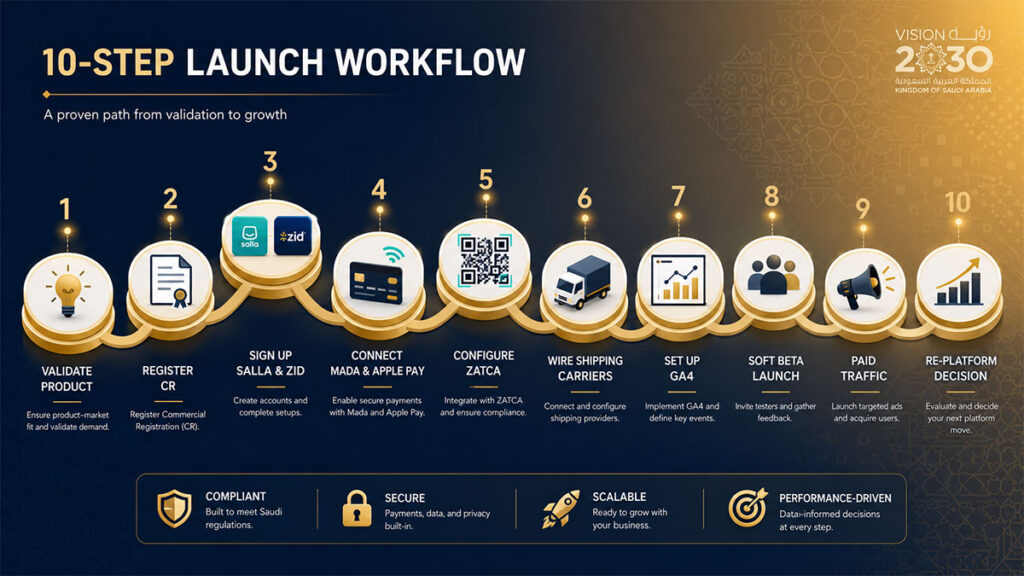
- Step 1 — Validate the product before the platform. Run a 2-week Instagram or TikTok pre-launch with manual order taking via WhatsApp. If you cannot get 20 paid orders without a website, the best ecommerce platform Saudi Arabia has on offer will not save you.
- Step 2 — Register your business and VAT. Get your commercial registration (CR), Maroof verification, and VAT registration if applicable. Most platforms require these before activating payment processors.
- Step 3 — Sign up for Salla and Zid free tiers. Build the same store on both for one weekend. The platform that feels easier after 4 hours is your best ecommerce platform Saudi Arabia answer.
- Step 4 — Connect mada, Apple Pay, Tabby, and Tamara. Native integrations on Salla and Zid take less than an hour each.
- Step 5 — Configure ZATCA Phase 2. Even if you are below the SAR 375,000 threshold, set it up now. It is much harder to retrofit later, regardless of which Saudi ecommerce platform you picked.
- Step 6 — Wire up Aramex and SMSA shipping. Get live rate calculation and label printing working before launch day.
- Step 7 — Set up GA4 and Meta Pixel. Tracking is non-optional. See my guide on GA4 ecommerce tracking for Saudi Arabia for the exact event setup.
- Step 8 — Launch a soft beta with 50 customers. Family, friends, and Instagram followers. Catch the bugs before paid traffic.
- Step 9 — Start paid traffic. Begin with Meta and Snapchat, layer in TikTok, then Google Search. Reinvest profits, not seed capital.
- Step 10 — Re-platform only if you outgrow the choice. Most Saudi merchants stay on Salla forever. Re-platforming should be triggered by a specific limitation, not by FOMO about a different “best ecommerce platform Saudi Arabia” article you read this week.
For a deeper walkthrough of the full business setup, see my detailed guide on starting an ecommerce business in Saudi Arabia.
FAQ: Best Ecommerce Platform Saudi Arabia
Which is the cheapest ecommerce platform in Saudi Arabia?
Salla and Zid both offer free starter tiers, making them the cheapest entry points and a strong candidate for the best ecommerce platform Saudi Arabia can offer on a zero-budget launch. WooCommerce Saudi Arabia setups are technically free but realistically cost SAR 400–700/month once you add hosting, themes, plugins, and ZATCA tooling. Shopify Saudi Arabia stores are the most expensive on a like-for-like basis once you factor in third-party payment gateway fees that Salla and Zid avoid natively.
Is Salla or Zid better for a beginner?
For pure beginners with no retail or social commerce background, Salla is usually the easier first platform — faster to launch, simpler dashboard, and the Mahally marketplace gives free incremental traffic. In a strict Salla vs Zid head-to-head for first-time founders, Salla typically wins. Zid is the better fit if you already sell on Instagram or TikTok and want a unified backend, or if inventory complexity is a core part of your business model. Either way, Salla and Zid are both serious candidates for the best ecommerce platform Saudi Arabia beginners should evaluate first.
Does Shopify work well in Saudi Arabia?
Shopify Saudi Arabia stores work, but with caveats. Shopify Payments is not available, so you must use third-party gateways like PayTabs, HyperPay, or Tap, which adds a 2% Shopify transaction fee on top of the gateway’s own processing fees. ZATCA Phase 2 compliance requires a third-party app. Arabic and RTL work but feel less native than Salla. Shopify is a strong choice if you have international ambition and budget; it is rarely the best ecommerce platform Saudi Arabia founders should pick if their roadmap is purely the Saudi market.
Which platforms have native ZATCA Phase 2 integration?
Salla and Zid both offer native ZATCA Phase 2 integration with the Fatoora portal — invoices are submitted automatically with the correct UBL 2.1 XML, QR codes, and cryptographic stamps. Shopify Saudi Arabia and WooCommerce Saudi Arabia stores require third-party apps or plugins, plus often middleware services from providers like FatooraPlus, ClearTax, or InvoiceQ. ZATCA-readiness is one of the strongest tie-breakers when choosing the best ecommerce platform Saudi Arabia entrepreneurs commit to.
Can I migrate from one platform to another later?
Yes, but migration is painful. Expect 2–6 weeks of work, potential SEO traffic loss if redirects are not done correctly, customer data export/import friction, and rebuilding any custom integrations from scratch. The smartest approach is to pick the best ecommerce platform Saudi Arabia offers for your 12–24 month plan, not your day-one needs — and stick with it.
Should I sell on Salla or list on Noon and Amazon.sa instead?
It is not either/or — most successful Saudi merchants do both. Your Salla, Zid, Shopify Saudi Arabia, or WooCommerce Saudi Arabia store is your owned channel where you control the brand, the customer data, and the margin. Noon and Amazon.sa are paid-traffic channels where you pay 8–15% commissions for marketplace exposure. Start with the best ecommerce platform Saudi Arabia has for your owned store, then add marketplaces once your operations can handle multi-channel inventory.
How important is Arabic RTL support in 2026?
Critical. Arabic-speaking shoppers convert 30–50% better on RTL-native stores than on LTR stores with Arabic translations. Salla and Zid are RTL-native — the dashboards, themes, invoices, and emails are all built for Arabic first, which is why both platforms regularly top lists of the best ecommerce platform Saudi Arabia rankings. Shopify Saudi Arabia and WooCommerce Saudi Arabia stores can be made to work, but you will spend developer hours fixing layout bugs, font rendering, and number formatting issues.
Will AI search engines change which platform is best?
AI shopping agents and generative search are already changing how products get discovered. Platforms with strong structured data, fast page loads, and clean product schema will get cited more often by ChatGPT, Perplexity, and Google’s AI Mode. Shopify and WooCommerce currently lead on technical SEO depth, but Salla has been investing heavily in this area. Whichever Saudi ecommerce platform wins on AI citation rates will likely become the next default answer for “best ecommerce platform Saudi Arabia” queries. For more on this shift, see my coverage of AI shopping agents and agentic commerce.
Final Verdict and Next Steps
If I had to recommend the best ecommerce platform Saudi Arabia entrepreneurs should start with in 2026, my answer for a typical first-time founder is unambiguous: Salla. The free tier is genuinely usable, native mada/STC Pay/Tabby/Tamara/ZATCA integration removes weeks of setup work, the Mahally marketplace adds free traffic, and you can be live in 48 hours. For most launches, Salla is the best ecommerce platform Saudi Arabia can offer right now.
That recommendation flips in three specific situations. Choose Zid if you are already running social commerce or physical retail and need unified Total Commerce — for that profile, Zid is the best ecommerce platform Saudi Arabia has on the market. Choose Shopify Saudi Arabia if international expansion within 12–18 months is non-negotiable. Choose WooCommerce Saudi Arabia if you (or a partner) are technical and content marketing is your primary growth lever.
The platform decision matters, but it matters less than the product, the brand, and the customer experience you build on top of it. Pick the best ecommerce platform Saudi Arabia option for your situation today, launch fast, and iterate. The Saudi market is growing too quickly to spend three months in analysis paralysis trying to find a perfect “best ecommerce platform Saudi Arabia” answer that does not exist. Pick good enough, and let revenue prove the choice right.
Related reading:
- Start an Ecommerce Business in Saudi Arabia: The Complete Guide
- Quick Commerce Saudi Arabia: Dark Stores and 15-Minute Delivery
- Digital Wallets Saudi Arabia: Cashless Payment Guide
- Buy Now Pay Later in Saudi Arabia: Complete Guide to BNPL Services
- GA4 Ecommerce Tracking Saudi Arabia
- AI Agents for eCommerce: Automate Inventory, Customer Service, and Pricing
- Sovereign AI Saudi Arabia and the “Saudi-First” Customer Experience
Sources: Mordor Intelligence Saudi Arabia Ecommerce Market Report (January 2026); Salla Official AI Information Page (November 2025); Tracxn Zid Company Profile (March 2026); Shopify Pricing Page (April 2026); ZATCA E-Invoicing Wave 23/24 Guidance (2026); Saudi Central Bank (SAMA) Electronic Payments Report 2024; Arab News (December 2024); ECDB Saudi Ecommerce Statistics (2026); P&S Market Research Saudi Arabia E-commerce Market Report (2026).

Husain Alhaboubi is Director of Digital Channels at Mobily, where he leads platform optimization, AI-powered customer engagement, and UI/UX strategy. With 20+ years of experience spanning eCommerce, IT infrastructure, and digital marketing, he previously drove a 225% revenue increase and 69% organic traffic growth as eCommerce Senior Manager at flyadeal, and managed enterprise IT operations — including data centers, ERP systems, and network security — as Group IT Manager at IPD Group.
Husain holds a BS in Information Systems from the University of Texas at Arlington and is certified in Google Ads, Google Analytics, and Semrush SEO. He writes from hands-on experience across both sides of digital business: the strategic (eCommerce, SEO, AI, digital transformation) and the technical (server administration, cloud computing, web development, networking, and security) — with a particular focus on the Saudi market and Vision 2030. Read his full resume →