

AI Shopping Agents Ecommerce: The Complete 2026 Guide to Agentic Commerce, Protocols, and How to Get Your Store Ready
Imagine a customer asking ChatGPT, “Find me the best abaya under 300 SAR with fast delivery in Riyadh,” and an AI shopping agent instantly searches product catalogs, compares prices across Salla, Noon, and Amazon Saudi, and completes the purchase — all without the shopper ever visiting a single website. This is not a future scenario. It is happening right now. AI shopping agents ecommerce is no longer a buzzword; it is the most significant shift in online retail since mobile commerce took over. If your store is not ready for AI agents to discover, evaluate, and transact on your behalf, you are already losing sales you will never see in your analytics.
In this guide, I break down everything you need to know about AI shopping agents ecommerce integration, the agentic commerce protocols powering this revolution, the platforms driving adoption, and exactly how ecommerce businesses — especially in Saudi Arabia and the MENA region — should prepare for a world where AI does the shopping.
Table of Contents
What Are AI Shopping Agents and Why Should You Care?
AI shopping agents are autonomous software systems that research, compare, and purchase products on behalf of consumers. Unlike traditional search engines that return a list of links for you to browse, these agents interpret your intent, query product catalogs via APIs, evaluate price, availability, shipping speed, return policies, and reviews — then present curated recommendations or even complete the transaction entirely.
Think of them as a personal shopper with access to every store on the internet, working in seconds rather than hours. When a consumer tells ChatGPT “find me wireless earbuds under $50 with noise cancellation and next-day delivery,” the AI agent does not show ten blue links. It evaluates structured product data from hundreds of merchants, filters by the user’s constraints, and surfaces three to five options with pricing, reviews, and a checkout button.
The numbers tell a compelling story. According to McKinsey, agentic commerce is projected to drive between $3 trillion and $5 trillion in global retail revenue by 2030. Morgan Stanley’s AlphaWise survey shows that nearly half of online shoppers in the United States will use AI shopping agents by 2030, capturing 10% to 20% of total ecommerce spending. Adobe reported a 1,950% year-over-year increase in retail site traffic from AI chat interactions during Cyber Monday 2024. This is not a gradual evolution — it is an acceleration that demands attention from every ecommerce business owner, especially in fast-growing markets like Saudi Arabia. The AI shopping agents ecommerce revolution is here, and the window to prepare is narrowing fast.
How AI Shopping Agents Work: From Intent to Purchase
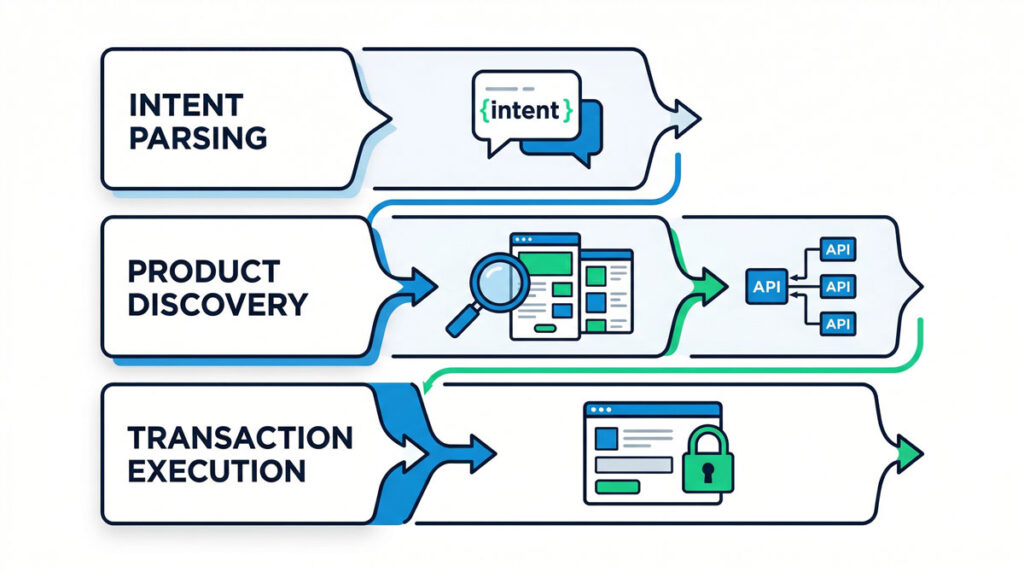
Understanding how AI shopping agents operate is essential for any ecommerce business that wants to remain visible in this new landscape. The AI shopping agents ecommerce workflow unfolds in three distinct layers.
The first layer is intent parsing. When a user submits a prompt like “best running shoes under $120, size 10, that ship before Thursday,” the AI model extracts structured intent. It identifies constraints such as budget ($120), product category (running shoes), size (10), and delivery window (before Thursday). This is fundamentally different from keyword-based search — the agent understands context, not just words.
The second layer is product discovery and evaluation. The shopping agent queries product catalogs, pricing services, availability feeds, and shipping estimators via APIs. It does not browse your website like a human would. It reads structured data feeds, schema markup, and merchant APIs. If your product data is incomplete or inconsistent, the agent may skip your store entirely — and no human shopper will ever know your product existed.
The third layer is transaction execution. Depending on the platform, the agent either completes the purchase natively (as with Google’s UCP-powered checkout) or redirects the shopper to the merchant’s own checkout page (as ChatGPT now does). In both cases, the merchant remains the merchant of record, owns the customer relationship, and handles fulfillment.
The key takeaway for ecommerce businesses is this: AI shopping agents do not see your beautiful homepage, your hero banner, or your carefully crafted category pages. They see your product data. If your data is clean, structured, and complete, you are discoverable. If it is not, you are invisible.
The Major AI Shopping Agent Platforms in 2026
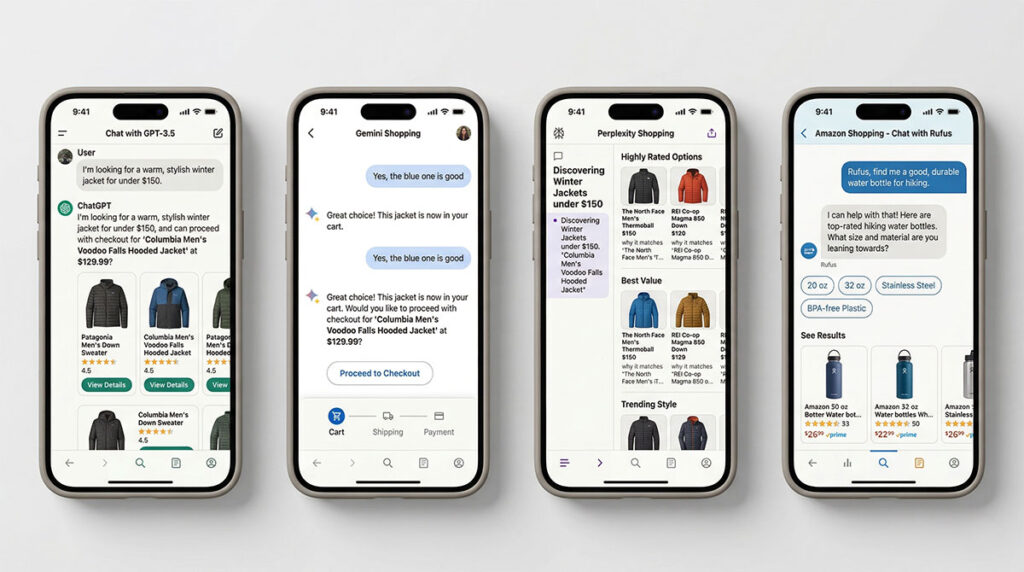
Several major technology companies are competing to become the primary AI shopping agent interface for consumers. Each platform handles product discovery, merchant integration, and checkout differently. Here is a breakdown of the four AI shopping agents ecommerce platforms every online retail professional needs to understand.
ChatGPT Shopping and the Agentic Commerce Protocol
OpenAI’s ChatGPT serves over 700 million weekly users and has rapidly evolved into a product discovery engine. In September 2025, OpenAI launched Instant Checkout, allowing users to purchase products from Etsy and select Shopify merchants directly within the chat interface. The feature was powered by the Agentic Commerce Protocol (ACP), built in partnership with Stripe.
However, Instant Checkout did not gain the traction OpenAI expected. By March 2026, OpenAI pivoted away from in-chat checkout and shifted to a discovery-first model. ChatGPT now focuses on helping users find and compare products, with purchases completed on the merchant’s own website via an in-app browser or a separate browser tab. Shopify rolled out its “Agentic Storefronts” feature, making millions of merchants’ products automatically discoverable in ChatGPT without requiring dedicated app integrations.
For merchants, this means there are no transaction fees beyond standard payment processing, and orders flow into existing systems with proper ChatGPT referral attribution. The shift also means that product data quality — accurate pricing, inventory levels, detailed descriptions, and high-quality images — is what determines whether your products appear in ChatGPT’s AI shopping agent recommendations.
Google’s Universal Commerce Protocol and Gemini
Google launched the Universal Commerce Protocol (UCP) in January 2026 at the National Retail Federation conference. UCP is an open-source standard designed to let AI agents execute commerce transactions across the entire shopping journey — from product discovery through checkout and post-purchase support.
UCP was co-developed with industry leaders including Shopify, Etsy, Wayfair, Target, and Walmart, and is endorsed by over 20 partners including Adyen, American Express, Mastercard, Stripe, Visa, Best Buy, Flipkart, and Zalando. The protocol is compatible with existing industry standards such as the Agent Payments Protocol (AP2), Agent2Agent (A2A), and Model Context Protocol (MCP).
In practical terms, UCP powers a checkout feature on eligible Google product listings in AI Mode in Search and the Gemini app. Shoppers can discover products through conversational AI, compare options, and complete purchases using Google Pay with payment methods stored in Google Wallet. Google plans to expand UCP globally and add capabilities like loyalty program integration and post-purchase tracking throughout 2026.
Google also introduced Business Agent, which allows eligible retailers to create branded conversational agents that shoppers can interact with directly on Google Search — essentially a virtual sales associate. Additionally, new Merchant Center data attributes help retailers get discovered in conversational commerce by going beyond traditional keywords to include product Q&A answers, compatible accessories, and product substitutes.
Perplexity Shopping and Buy with Pro
Perplexity entered the ecommerce AI shopping agents space in November 2024 with its “Buy with Pro” feature. For Pro subscribers ($20/month), the platform enables direct checkout within the Perplexity interface for select products from partner merchants, with free shipping on eligible orders.
What makes Perplexity noteworthy is its audience profile. By early 2026, the platform reached 45 million monthly active users, and shopping-related queries grew five-fold since launch. Perplexity shoppers spend 57% more per order compared to shoppers arriving from other AI platforms, making it an especially attractive channel for premium and niche brands.
Perplexity integrates with Shopify’s product catalog and offers a merchant program where enrolled sellers get better placement in recommendations through more complete product data. The platform also features “Snap to Shop,” a visual search tool that lets users photograph an item and find it for sale online — similar to Google Lens but integrated into the conversational shopping experience. Unlike ChatGPT, Perplexity states that its product recommendations are unbiased with no sponsored placements, and merchants retain 100% of revenue with zero platform fees.
Amazon Rufus: The In-House AI Shopping Assistant
Amazon’s Rufus is a generative AI-powered conversational shopping assistant trained on Amazon’s product catalog, customer reviews, community Q&A, and web information. More than 250 million customers used Rufus in 2025, with monthly active users up 149% and interactions up 210% year-over-year. Customers who engage with Rufus are over 60% more likely to complete a purchase.
Rufus represents a closed-ecosystem approach to AI shopping agents in ecommerce. It operates within the Amazon Shopping app and website, using Amazon’s own data infrastructure to surface product recommendations. The assistant now includes account memory, understanding individual customer preferences based on their shopping history. If you have previously told Rufus about your household, it remembers those details and personalizes future recommendations accordingly.
For sellers on Amazon, optimizing for Rufus requires a shift from traditional keyword stuffing to semantic, benefit-driven product descriptions. Rufus understands meaning and context — it recognizes that “joint pain,” “hip support,” and “orthopedic” are related concepts. Listings that provide clear use-case context, compatibility details, and structured attribute data perform better in Rufus-driven discovery than those relying solely on keyword density. Evercore ISI estimates that Rufus and related AI commerce features will increase Amazon’s retail gross merchandise volume by 4.44% by 2028, with a $10 billion increase already recorded.
Agentic Commerce Protocols Explained: UCP vs. ACP
Two competing open standards are emerging as the infrastructure backbone for AI shopping agents ecommerce transactions. Understanding their differences is critical for merchants planning their integration strategy for AI shopping agents ecommerce readiness.
| Feature | Universal Commerce Protocol (UCP) | Agentic Commerce Protocol (ACP) |
|---|---|---|
| Developer | Google (open-source) | OpenAI with Stripe (open-source) |
| Primary Surface | Google AI Mode, Gemini app | ChatGPT |
| Checkout Model | Native checkout on Google surfaces via Google Pay | Discovery in ChatGPT, checkout on merchant site |
| Merchant of Record | Merchant retains full ownership | Merchant retains full ownership |
| Payment Support | Google Pay, PayPal (coming soon), modular handlers | Stripe, PayPal, merchant’s existing processor |
| Key Partners | Shopify, Walmart, Target, Etsy, Visa, Mastercard | Shopify, Etsy, Walmart, Target, Sephora, Best Buy |
| Protocol Compatibility | AP2, A2A, MCP | ACP spec (open-source) |
| Current Availability | Eligible US merchants (global expansion planned) | US (expanding) |
| Integration Path | Merchant Center + UCP API | Product feeds, Apps SDK, or Shopify Catalog |
The strategic landscape is clear: Google is betting on openness and platform-native checkout. OpenAI initially tried in-chat transactions but pivoted to merchant-owned checkout after discovering that enabling seamless transactions inside a chat interface was more complex than anticipated. For ecommerce businesses, the pragmatic approach is to ensure your product data and checkout infrastructure are compatible with both ecosystems. If you are on Shopify, much of this is handled automatically through Shopify’s integrations with both platforms.
It is worth noting that UCP will also power checkout in some Meta experiences soon, meaning AI agent-driven purchases could extend to Facebook and Instagram surfaces as well. Shopify merchants are already selling through Microsoft Copilot, and Shop Pay is expected to integrate with Copilot for instant checkout. The number of surfaces where AI shopping agents operate is expanding rapidly.

AI Shopping Agents and Saudi Arabia’s Ecommerce Boom
Saudi Arabia’s ecommerce market is estimated at $31.29 billion in 2026, growing at an 11.92% CAGR to reach $54.87 billion by 2031, according to Mordor Intelligence. The Kingdom’s 99% smartphone penetration, 78% 5G coverage, and a young, digitally native population create the perfect conditions for AI shopping agents to gain traction faster than in most other markets.
The World Economic Forum highlights that Saudi Arabia is moving toward AI-powered retail automation, predictive demand planning, and deeply integrated commerce experiences. Retailers already use AI-driven recommendation tools, behavioral analytics, personalized merchandising, and dynamic pricing. The transition to agentic commerce — where AI agents handle discovery and purchase — is a natural next step.
For Saudi ecommerce businesses operating on platforms like Salla and Zid, the AI shopping agents ecommerce challenge is readiness. Current UCP and ACP integrations are US-focused with global expansion planned through 2026. Saudi merchants should be preparing now by cleaning product data, implementing structured schema markup, ensuring Arabic and English bilingual product descriptions are complete, and monitoring when these protocols expand to the MENA region.
Platforms like Noon and Amazon Saudi (amazon.sa) have an inherent advantage because of their existing data infrastructure. Amazon’s Rufus is already operational in Saudi Arabia through the Amazon Shopping app, giving Amazon sellers in the Kingdom a head start in AI-driven product discovery. Independent merchants on Salla and Zid will need to ensure their product feeds are compatible with emerging agent standards as these platforms develop their own integrations.
The payments ecosystem also aligns well with agentic commerce. Saudi Arabia’s digital wallet adoption — led by stc pay (now stc bank), Mada, Apple Pay, and emerging services like barq — provides the tokenized, low-friction payment infrastructure that AI agents require to complete transactions securely. As Google Pay and PayPal expand their UCP and ACP integrations, Saudi-based payment providers that adopt these standards early will position their merchant customers for the agentic commerce era.
How to Optimize Your Ecommerce Store for AI Shopping Agents
Preparing your store for AI shopping agents requires a fundamentally different optimization mindset than traditional SEO or even generative engine optimization (GEO). While GEO focuses on getting your content cited by AI answer engines, optimizing for AI shopping agents ecommerce visibility focuses on making your products selectable and transactable by autonomous systems.
Structured Product Data Is Your New SEO
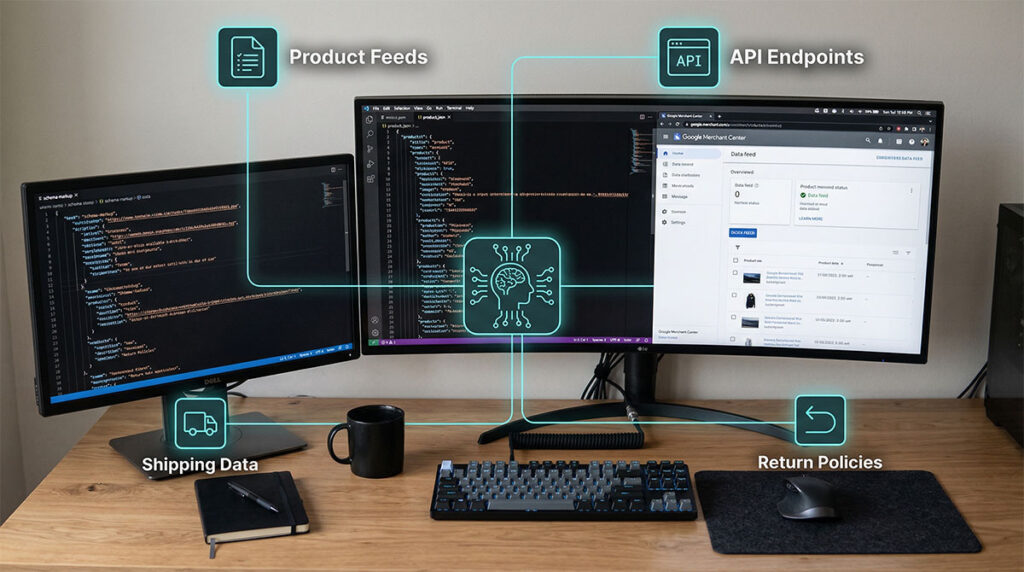
When an AI shopping agent evaluates your products, it does not read your marketing copy the way a human would. It parses structured data fields: product title, description, price, currency, availability, shipping options, return policy, product dimensions, materials, compatible accessories, and customer ratings. Every missing field is a reason for the agent to skip your product in favor of a competitor with more complete data. This is why structured data is the foundation of any AI shopping agents ecommerce optimization effort.
Google’s new Merchant Center data attributes for conversational commerce go beyond traditional keywords. They include fields for answering common product questions (“Is this jacket waterproof?”), listing compatible accessories, and suggesting product substitutes. Merchants who populate these fields early gain a discovery advantage as AI agents increasingly rely on this structured information.
Actionable steps include implementing Product schema markup (JSON-LD) with complete attributes, ensuring your product feed includes GTINs or MPNs for product identification, adding detailed shipping and return policy structured data, and maintaining real-time inventory accuracy. Inaccurate availability data is one of the fastest ways to lose agent trust — if an agent recommends your product and it turns out to be out of stock, the system learns that your data is unreliable.
Agent Legibility: Making Your Store Machine-Readable
“Agent legibility” is an emerging concept that describes how easily AI systems can interpret your product offerings. Traditional ecommerce optimization focused on human readability — attractive product pages, compelling copy, and persuasive CTAs. Agent legibility focuses on machine readability — structured, unambiguous, and comparable data that an AI agent can process in milliseconds.
Key elements of agent legibility include consistent data across channels (your Shopify feed, Google Merchant Center, and your website should all show the same price, availability, and delivery estimates), clear delivery windows expressed in structured formats rather than vague promises, unambiguous return policies with specific timeframes and conditions, and product descriptions that include use-case context rather than just marketing superlatives.
A growing number of ecommerce businesses are also adopting llms.txt files — a lightweight standard (similar to robots.txt) that tells AI systems how to interpret and access your product data. While still early, this represents the direction of agent-merchant communication.
Checkout and API Readiness
For merchants who want to participate in UCP-powered or ACP-powered transactions, checkout infrastructure matters. Google’s UCP requires merchants to expose checkout capabilities via API, including support for tokenized payments. OpenAI’s ACP works through product feeds and either Stripe integration or the Delegated Payments Spec.
If you are on Shopify, much of this is handled automatically. Shopify’s Agentic Storefronts feature makes products discoverable across ChatGPT, Microsoft Copilot, Google AI Mode, and Gemini without requiring merchants to build separate integrations. For merchants on other platforms — including Salla, Zid, Magento, or WooCommerce — manual integration will be necessary as these protocols expand globally.
The minimum requirements for checkout API readiness include real-time price and inventory endpoints, support for tokenized payment methods, server-side order creation and confirmation, and proper error handling for out-of-stock or pricing changes during the transaction window.
AI Shopping Agents vs. Traditional Chatbots: Key Differences
It is important to distinguish between AI shopping agents and the chatbots that ecommerce stores have used for customer support over the past decade. Understanding these differences is central to any AI shopping agents ecommerce strategy.
| Characteristic | Traditional Chatbot | AI Shopping Agent |
|---|---|---|
| Approach | Reactive, script-based | Goal-oriented, autonomous |
| Scope | Single store or platform | Cross-platform, multi-merchant |
| Decision Making | Follows predefined rules | Evaluates options and makes constrained decisions |
| Transaction Capability | Assists with checkout on the store | Can initiate carts, authorize payments, and complete purchases |
| Data Sources | Internal store data only | Product feeds, APIs, reviews, external data |
| Personalization | Basic (name, order history) | Deep (preferences, context, past interactions across sessions) |
| Post-Purchase | Limited to FAQ responses | Can handle returns, tracking, and reorders autonomously |
The shift from chatbots to AI shopping agents transforms AI from a support interface into a transactional engine. For ecommerce businesses using AI agents, this means the agent is no longer just answering questions — it is actively making purchase decisions on behalf of the consumer. The metric that matters is no longer click-through rate but AI citation rate: whether an AI agent retrieves, references, or recommends your product during a shopping query.
Risks and Challenges of Agentic Commerce
Despite the transformative potential, agentic commerce comes with significant challenges that ecommerce businesses should approach with clear eyes.
Trust and accuracy remain major concerns. Research indicates that AI shopping assistants match the actual best product for a query only about 32% of the time. ChatGPT Shopping has been found to hallucinate prices in approximately 28% of queries. Amazon’s Rufus, while effective at driving conversions within Amazon’s ecosystem, has been criticized for recommendations that prioritize Amazon’s margins over genuinely optimal product matches.
Brand disintermediation is another risk. When an AI agent sits between your brand and the consumer, you lose control of the discovery narrative. The shopper may never see your brand story, your curated product page, or your carefully designed user experience. They see a product card generated by the AI — and your brand is reduced to structured data fields. Building brand equity in an agent-mediated world requires rethinking how your brand communicates through data, not just design.
Data quality penalties are high-stakes. If your product data leads an agent to make a wrong recommendation — say, advertising a product as in-stock when it is not, or listing incorrect specifications — the resulting negative feedback loop can damage your product’s visibility in future agent queries far more than a traditional negative review would.
Attribution and analytics are still immature. Most AI shopping agents ecommerce platforms do not yet provide the granular analytics that ecommerce businesses are accustomed to from traditional channels. ChatGPT, for example, offers referral attribution but lacks the detailed conversion funnel data that Google Analytics or Meta Ads Manager provide. Measuring ROI from AI shopping agents ecommerce channels requires patience and new measurement frameworks.
Privacy and regulatory considerations also come into play, particularly in Saudi Arabia where the Personal Data Protection Law (PDPL) governs how consumer data is collected and processed. As AI agents gain more autonomy in commerce, transparency about how purchase decisions are made and how consumer data flows between agents, merchants, and payment providers will become a regulatory focus.
FAQ: AI Shopping Agents Ecommerce
What is agentic commerce and how does it differ from regular ecommerce?
Agentic commerce is a model where AI agents autonomously research, compare, and complete purchases on behalf of consumers. Unlike regular ecommerce where shoppers manually browse websites, compare products, and manage checkout themselves, agentic commerce delegates these steps to an AI system. The shopper sets their intent and constraints (budget, preferences, delivery needs), and the agent handles the rest. This shifts the competitive battleground from visual design and marketing persuasion to data quality and machine readability.
Can AI shopping agents complete purchases in Saudi Arabia right now?
Currently, full agentic checkout through protocols like Google’s UCP and OpenAI’s ACP is limited to eligible US merchants, with global expansion planned through 2026. However, Amazon’s Rufus is already operational in Saudi Arabia through the Amazon Shopping app, enabling AI-assisted product discovery and purchase for Amazon sellers in the Kingdom. ChatGPT’s product discovery features are available to Saudi users, though checkout redirects to merchant websites. Saudi merchants should prepare their product data infrastructure now to be ready when full protocol support expands to the MENA region.
How do I optimize my products to appear in AI shopping agent recommendations?
Focus on three areas: complete structured product data (every field filled — title, description, price, availability, shipping, returns, dimensions, materials, compatibility), schema markup implementation (Product, Offer, and AggregateRating types at minimum), and real-time data accuracy (if your feed says a product is in stock and it is not, the agent learns your data is unreliable). Go beyond keywords and include use-case context, lifestyle attributes, and answers to common product questions in your structured data.
Do I need to be on Shopify to participate in agentic commerce?
No, but Shopify merchants currently have the easiest path. Shopify’s Agentic Storefronts feature automatically makes products discoverable across ChatGPT, Google AI Mode, Gemini, and Microsoft Copilot without requiring dedicated integrations. Merchants on other platforms like WooCommerce, Magento, Salla, or Zid can still participate by submitting product feeds directly to Google Merchant Center, applying to OpenAI’s merchant program, or joining Perplexity’s merchant program. As UCP and ACP are both open-source standards, platform-agnostic integrations will become more accessible over time.
What is Google’s Universal Commerce Protocol (UCP)?
UCP is an open-source standard launched by Google in January 2026 that establishes a common language for AI agents, merchants, and payment providers to interact across the entire shopping journey. It eliminates the need for custom integrations with each AI platform by providing a unified protocol. UCP is compatible with existing standards like A2A, AP2, and MCP, and was co-developed with Shopify, Walmart, Target, and Etsy. It currently powers checkout in Google AI Mode and the Gemini app for eligible US merchants.
Will AI shopping agents replace traditional SEO for ecommerce?
AI shopping agents will not replace SEO entirely, but they will add a parallel discovery channel that demands different optimization. Traditional SEO focuses on ranking in search results for human browsers. AI shopping agents ecommerce optimization focuses on being selectable by autonomous systems that evaluate structured data, not web pages. The two disciplines complement each other — strong SEO builds brand authority and trust signals that AI agents also consider, while agent-specific optimization ensures your products are machine-readable and transactable. Both matter, but neglecting agent optimization means missing a growing share of high-intent shoppers.
Are AI shopping agent recommendations biased?
This depends on the platform. Perplexity states its recommendations are unbiased with no sponsored placements. OpenAI says ChatGPT product results are organic and ranked on relevance, not sponsorship. Google’s AI Mode surfaces products from Merchant Center data and may include Google Ads alongside organic recommendations. Amazon’s Rufus has been criticized for recommendations that favor Amazon’s own margins. As a consumer, it is wise to cross-reference agent recommendations across platforms. As a merchant, focus on data quality rather than trying to game any single platform’s algorithm.
How much revenue will agentic commerce generate by 2030?
McKinsey projects between $900 billion and $1 trillion in US retail revenue from agentic commerce by 2030, and $3 trillion to $5 trillion globally. Morgan Stanley estimates AI agents will capture 10% to 20% of total ecommerce spending, translating to $190 billion to $385 billion. Forrester predicts that by the end of 2026, 20% of B2B sellers will face agent-led quote negotiations. While these projections vary, the directional consensus across all major research firms is clear: AI shopping agents ecommerce will capture a significant and growing share of online retail transactions worldwide.
The Future of AI Shopping Agents: What Comes Next
The AI shopping agents ecommerce landscape is evolving at a pace that few industries have experienced. As someone who has followed the intersection of AI and ecommerce closely, I see several developments shaping the AI shopping agents ecommerce space over the next 12 to 24 months.
First, expect protocol consolidation. Google’s UCP and OpenAI’s ACP are both open-source, and their functional overlap will likely lead to convergence or interoperability layers. Shopify is already powering transactions across both ecosystems from a single integration point, and this pattern will become the norm.
Second, AI shopping agents will expand beyond single-item purchases to multi-item carts, subscription management, and post-purchase workflows like returns and exchanges. Google’s UCP roadmap already includes these capabilities. The goal is for agents to handle the entire commerce lifecycle autonomously, with human confirmation at key decision points.
Third, regional expansion will bring agentic commerce to markets like Saudi Arabia, the UAE, and Southeast Asia — markets with high mobile penetration, young demographics, and fast-growing ecommerce ecosystems. When Google expands UCP globally, Saudi merchants on platforms like Salla and Zid who have already prepared their structured data and payment infrastructure will have a first-mover advantage.
Fourth, the B2B sector will follow the B2C playbook. Forrester predicts one in five B2B sellers will face AI-powered buyer agents with dynamically delivered counteroffers by end of 2026. Manufacturers, distributors, and wholesalers who prepare for agent-to-agent negotiation will lead their industries.
The bottom line is straightforward: the era where humans manually browse websites to shop is not ending, but it is getting a powerful parallel channel. AI shopping agents in ecommerce are the new front door to commerce. The businesses that prepare their AI shopping agents ecommerce strategy — by investing in data quality, protocol readiness, and understanding how AI agents make decisions — will capture disproportionate value. Those that wait will wonder why their traffic declined while their competitors’ orders grew from channels they cannot see in their analytics.
Related reading:
- AI Agents for eCommerce: Automate Inventory, Customer Service, and Pricing in 2026
- Generative Engine Optimization: GEO vs. AEO vs. AIO — The Complete 2026 Guide
- AI Ecommerce Personalization: The Complete Guide to Boosting Revenue in 2026
- Sovereign AI Saudi Arabia & The “Saudi-First” Customer Experience
- Ecommerce Trends 2026: 10 Technologies Reshaping Online Shopping
Sources: OpenAI – Powering Product Discovery in ChatGPT (March 2026), Google Developers – Universal Commerce Protocol (January 2026), Google for Developers – UCP Guide, Shopify – Agentic Commerce Momentum (March 2026), Mordor Intelligence – Saudi Arabia Ecommerce Market 2026, World Economic Forum – Saudi Arabia’s Consumer Economy Digitalization (January 2026), Amazon – Rufus AI Shopping Assistant (November 2025), Perplexity – Shop Like a Pro, Commercetools – AI Trends Shaping Agentic Commerce (February 2026), Accenture – DaVinci Commerce Investment (March 2026)

Husain Alhaboubi is Director of Digital Channels at Mobily, where he leads platform optimization, AI-powered customer engagement, and UI/UX strategy. With 20+ years of experience spanning eCommerce, IT infrastructure, and digital marketing, he previously drove a 225% revenue increase and 69% organic traffic growth as eCommerce Senior Manager at flyadeal, and managed enterprise IT operations — including data centers, ERP systems, and network security — as Group IT Manager at IPD Group.
Husain holds a BS in Information Systems from the University of Texas at Arlington and is certified in Google Ads, Google Analytics, and Semrush SEO. He writes from hands-on experience across both sides of digital business: the strategic (eCommerce, SEO, AI, digital transformation) and the technical (server administration, cloud computing, web development, networking, and security) — with a particular focus on the Saudi market and Vision 2030. Read his full resume →