
AI Robotics Saudi E-commerce: The Ultimate Guide to Revolutionizing Logistics and Retail in 2026
Saudi Arabia’s e-commerce market is projected to reach USD 31.29 billion in 2026, growing at nearly 12% year over year. Behind this explosive growth, a quieter revolution is unfolding inside warehouses, fulfillment centers, and delivery corridors across the Kingdom: AI robotics Saudi e-commerce is no longer a futuristic concept—it is reshaping how products are stored, sorted, packed, and delivered to millions of Saudi consumers.
From autonomous mobile robots zipping through Riyadh’s largest fulfillment centers to AI-driven drone delivery corridors being tested in Jeddah, the merger of artificial intelligence and physical robotics is transforming Saudi logistics from the ground up. If you manage an e-commerce operation or own a brand selling in the Kingdom, understanding this shift is not optional—it is a competitive necessity heading into 2026 and beyond.
Table of Contents
Why AI Robotics Matters for Saudi E-commerce in 2026
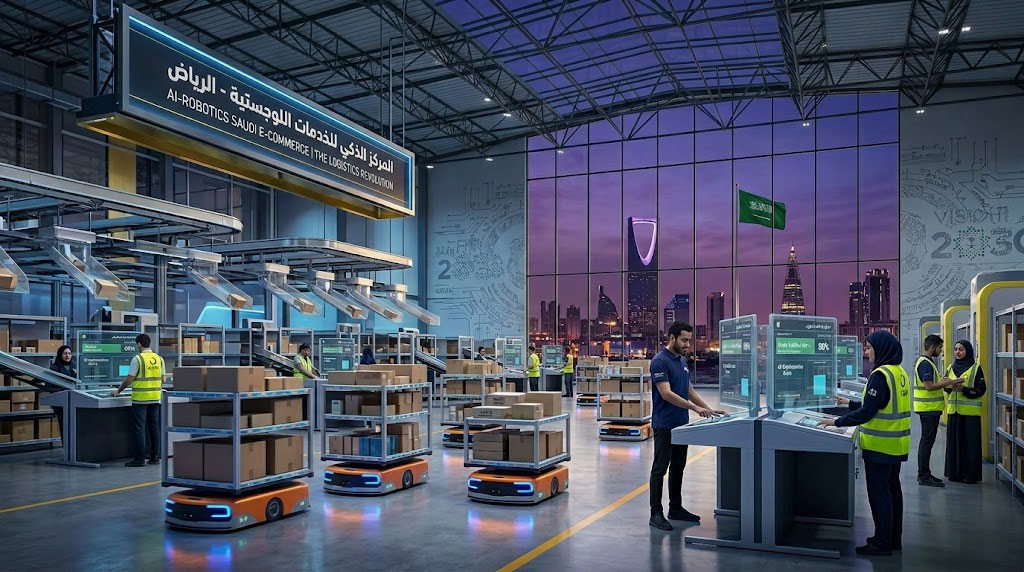
The global warehouse robotics market is valued at approximately USD 10.96 billion in 2026 and is expected to reach USD 24.55 billion by 2031, growing at a 17.5% CAGR (Mordor Intelligence, January 2026). Within this wave, AI robotics Saudi e-commerce stands out as one of the most dynamic segments in the Middle East, powered by Vision 2030 infrastructure investments and a rapidly maturing digital consumer base.
For e-commerce managers and brand owners operating in the Kingdom, AI robotics Saudi e-commerce represents a fundamental shift in how fulfillment operations are designed. The traditional model—large warehouses staffed entirely by manual labor—is giving way to hybrid and fully automated facilities where autonomous mobile robots (AMRs), AI-driven sorting systems, and predictive inventory engines work alongside human teams. The result is faster order processing, fewer errors, lower operational costs, and the ability to meet the same-day and next-day delivery expectations that Saudi consumers increasingly demand.
This is not just about efficiency. It is about survival. With platforms like e-commerce trends in 2026 pushing toward hyper-personalization and instant delivery, brands that fail to integrate AI-powered logistics will struggle to compete against those that do.
The Saudi E-commerce Boom Driving Robotic Adoption
To understand the urgency behind AI robotics Saudi e-commerce adoption, you first need to grasp the scale of the market. Saudi Arabia’s e-commerce sector is experiencing growth that few markets globally can match. According to Mordor Intelligence (January 2026), the Saudi e-commerce market is estimated at USD 31.29 billion in 2026, up from USD 27.96 billion in 2025, with projections reaching USD 54.87 billion by 2031 at an 11.92% CAGR. A separate Research and Markets report (February 2026) values the B2C e-commerce market at USD 20.70 billion in 2025, on track to reach USD 28.80 billion by 2029.
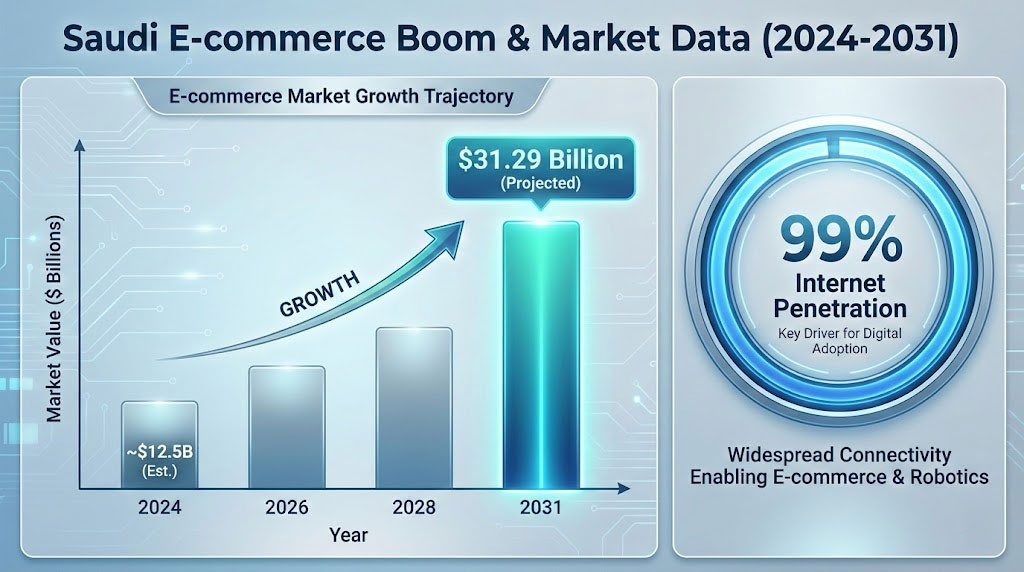
Several factors make this growth particularly relevant for robotics adoption:
- Near-universal connectivity: Saudi Arabia boasts 99% internet penetration and 78% 5G coverage, creating an always-connected consumer base that shops heavily on mobile (smartphones accounted for 77.98% of e-commerce revenue in 2025).
- Rising delivery expectations: Same-day and next-day delivery are rapidly becoming the standard, especially in Riyadh, Jeddah, and Dammam. Manual fulfillment models simply cannot keep up during peak periods like Ramadan and White Friday sales.
- Geographic scale: With 59 logistics zones planned across the Kingdom, the sheer physical infrastructure being built demands automated solutions to operate efficiently.
- Digital payment acceleration: Electronic payments accounted for 79% of all retail transactions in Saudi Arabia in 2024, exceeding the original 70% target set for 2025 under the Financial Sector Development Program. This cashless momentum fuels online ordering volumes.
As order volumes surge, the pressure on warehousing and fulfillment infrastructure becomes immense. This is precisely where AI robotics Saudi e-commerce solutions step in—automating the bottlenecks that manual operations cannot scale past. For brands navigating this rapidly evolving landscape, understanding digital consumer behavior in the Middle East is essential for appreciating why speed and accuracy in fulfillment have become non-negotiable.
Types of AI Robotics Transforming E-commerce Logistics
The term “AI robotics” in e-commerce covers a broad spectrum of technologies, each targeting different stages of the fulfillment chain. For Saudi brand owners, understanding these categories is essential for making informed investment decisions. Here is a breakdown of the core technologies actively being deployed or piloted across Saudi Arabia.
Warehouse Automation: AMRs, AGVs, and AS/RS
The backbone of modern warehouse robotics consists of three key systems:
| Technology | How It Works | Best For | Saudi Adoption Status |
|---|---|---|---|
| Autonomous Mobile Robots (AMRs) | Navigate dynamically using AI, cameras, and sensors—no fixed tracks required | Goods-to-person picking, cross-docking, flexible layouts | Deployed (Starlinks, logistics zones) |
| Automated Guided Vehicles (AGVs) | Follow pre-set paths via magnetic strips, lasers, or vision systems | Heavy pallet transport, fixed-route material handling | Deployed in major warehouses |
| Automated Storage and Retrieval Systems (AS/RS) | Use cranes, shuttles, or mini-loads to store and retrieve items from dense racking | High-density storage, cold chain, pharmaceutical fulfillment | Growing adoption in Riyadh and Jeddah hubs |
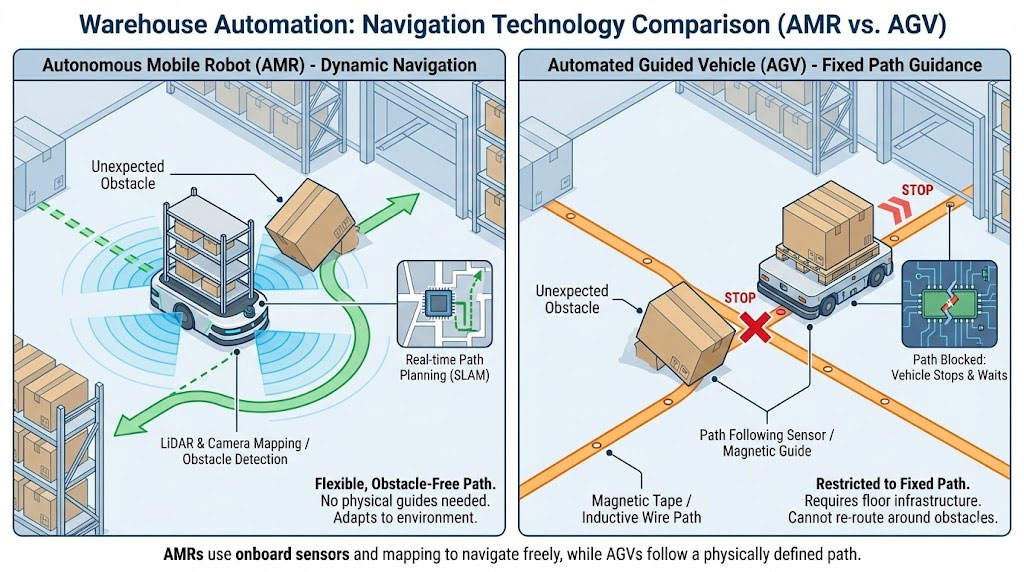
AMRs are seeing the fastest growth globally, projected to have the highest CAGR through 2033, because they offer something AGVs cannot: true flexibility. These systems exemplify why AI robotics Saudi e-commerce warehouses are moving toward intelligent, adaptive automation rather than rigid fixed-path solutions. An AMR can reroute in real-time around obstacles, adapt to changing warehouse layouts, and integrate with AI-powered warehouse management systems (WMS) that optimize picking routes on the fly. For Saudi e-commerce operations dealing with seasonal volume spikes—where order volumes can surge 500% during peak events—this adaptability is critical.
AI-Powered Sorting and Robotic Picking
Sorting and picking account for the most labor-intensive and error-prone stages of fulfillment. AI-driven robotic arms equipped with computer vision can now identify, grasp, and sort diverse products at speeds and accuracy rates that manual teams cannot match consistently. Amazon, for example, has deployed its “Robin” robotic arm system across fulfillment centers globally, completing over three billion successful package moves (IEEE Spectrum, April 2025).
For Saudi e-commerce brands, the implications of AI robotics Saudi e-commerce picking systems are direct: robotic goods-to-person models allow warehouse employees to pack 300–400 products per hour, compared to roughly 100 in a traditional manual setup. When you multiply this across a fulfillment center processing millions of units monthly, the efficiency gains are transformative.
Drone Delivery and Autonomous Last-Mile Solutions
Last-mile delivery is the most expensive segment of the logistics chain, and Saudi Arabia’s urban congestion and extreme heat create additional challenges. This is where AI robotics Saudi e-commerce innovation extends beyond the warehouse and into the streets and skies. The Saudi drone package delivery market is projected to grow from USD 280 million in 2025 to USD 1.62 billion by 2031, reflecting a 33.4% CAGR (Mobility Foresights, 2025).
In January 2025, GACA (General Authority of Civil Aviation) formally approved Matternet’s M2 drone for delivery operations—a first for Saudi Arabia. By mid-2025, GACA released dedicated commercial drone delivery guidelines, opening the door to scalable logistics operations. Drone corridors and sandbox zones for BVLOS (Beyond Visual Line of Sight) testing are being developed in Riyadh, signaling the Kingdom’s regulatory readiness for autonomous aerial delivery.
On the ground, autonomous delivery robots represent another frontier of AI robotics Saudi e-commerce innovation. South Korean company Neubility, through NEOM’s Oxagon accelerator program, is demonstrating how sidewalk-level autonomous vehicles can handle last-mile deliveries in controlled urban environments. These robots navigate independently using cameras and sensors, and NEOM is positioning itself as a testbed for scaling such technologies across the Kingdom.
Real-World Case Studies: AI Robotics in Action Across Saudi Arabia
Theory is one thing—execution is another. Here are concrete examples of AI robotics Saudi e-commerce implementations that are already operational or actively launching in the Kingdom.
Starlinks’ Hybrid Robotics Fulfillment Center in Riyadh
Starlinks, a Saudi-headquartered logistics provider, launched the Kingdom’s first robotics-powered fulfillment center in Agility Logistics Park, Riyadh. The facility spans 400,000 square feet, is equipped with 254 autonomous robots (deployed by Geek+), and has storage capacity for over 12 million units. It processes an average of 3.6 million unit orders per month (Starlinks, 2023).
What makes this AI robotics Saudi e-commerce case study particularly instructive for Saudi e-commerce managers is the hybrid model. Starlinks runs both robotics and manual picking systems within the same facility, allowing humans and machines to work together. The Geek+ P40 picking AMRs, S20C sorting AMRs, and RS8 RobotShuttle systems handle goods-to-person workflows, while human operators manage tasks requiring judgment and dexterity. This approach is especially relevant for brands that need to scale automation incrementally rather than committing to a fully automated greenfield facility.
The total investment exceeded SAR 100 million (approximately USD 26.65 million), and the facility operates under a Robots-as-a-Service (RaaS) model with Geek+, meaning Starlinks pays per item picked or per robot-hour rather than absorbing the full capital cost upfront. This RaaS approach significantly lowers the barrier to entry for AI robotics Saudi e-commerce adoption.
Port of NEOM: Automated Terminal and Smart Logistics Hub
While NEOM’s broader ambitions have been subject to scope adjustments, the Port of NEOM is delivering tangible automation milestones. In mid-2025, the port received Saudi Arabia’s first fully automated, remote-controlled ship-to-shore (STS) and electric rubber-tyred gantry (eRTG) cranes from ZPMC. Terminal 1, scheduled to open in 2026, features a 900-meter quay wall and an 18.5-meter deep access channel capable of accommodating the world’s largest container vessels (Arab News, August 2025).
The port’s automation strategy spans multiple layers: electric equipment, AI-powered energy systems, digital twin platforms (in partnership with Siemens and Mevea), predictive maintenance, and autonomous handling solutions. Fleet Management Systems (FMS) integrated with Terminal Operating Systems (TOS) enable continuous optimization through machine learning. For e-commerce businesses importing goods through the Red Sea corridor, these AI robotics Saudi e-commerce port operations will dramatically reduce vessel turnaround times and customs-to-customer delivery windows.
NEOM’s Oxagon district is also piloting drone delivery trials and self-driving logistics systems through its Research and Innovation Accelerator, positioning the zone as a zero-carbon logistics hub incorporating AI-based inventory systems and autonomous vehicle corridors. Brands interested in the intersection of AI, logistics, and Saudi Arabia’s digital economy transformation should keep a close eye on these developments.
Noon and Amazon: Fulfillment at Scale
The two dominant e-commerce marketplaces in Saudi Arabia—Noon and Amazon.sa—are both investing heavily in automation-driven fulfillment, setting the benchmark for AI robotics Saudi e-commerce infrastructure. Noon, a joint venture between Saudi Arabia’s Public Investment Fund (PIF) and Mohamed Alabbar, operates the largest fulfillment center in the Kingdom at over 45,000 square meters in Riyadh, with a total logistics and fulfillment network exceeding 270,000 square meters across the Kingdom. The facility integrates automation technology for storage, material movement, and sorting.
Amazon, meanwhile, brings its global robotics expertise to the region—a key accelerator for AI robotics Saudi e-commerce maturity. With over 750,000 robots deployed across its global fulfillment network (as of June 2023) and next-generation facilities combining Sequoia ASRS, Robin and Cardinal robotic arms, and Proteus autonomous mobile robots, Amazon’s Saudi operations benefit from this proven technology stack. The company also invested in a USD 5.3 billion AWS region in Riyadh, enabling AI-powered personalization and logistics optimization at scale.
For brand owners selling on these platforms, understanding their AI robotics Saudi e-commerce fulfillment infrastructure is strategic. Products enrolled in Fulfillment by Amazon (FBA) or Noon Express benefit directly from these robotic efficiencies—faster processing, fewer errors, and faster delivery to end customers.
Vision 2030 and Government Support for AI Robotics
Saudi Arabia’s government is not merely watching this transformation unfold—it is actively funding and accelerating it. Several institutional pillars support the growth of AI robotics Saudi e-commerce:
- Saudi Data and Artificial Intelligence Authority (SDAIA): Established in 2019, SDAIA drives the Kingdom’s National Strategy for Data and AI, aiming to establish Saudi Arabia as a global AI leader by 2030.
- HUMAIN Company: Launched under the PIF and announced in May 2025 by the Crown Prince, HUMAIN focuses on accelerating AI adoption, developing Arabic-language large language models (LLMs), and building next-generation data center infrastructure across strategic sectors including logistics and financial services.
- SAR 12 billion AI allocation: The Saudi government has allocated SAR 12 billion for AI initiatives under Vision 2030, creating a funding ecosystem that includes incentives for automation and robotics integration in logistics.
- 59 planned logistics zones: The Kingdom is developing logistics zones across the country, many incorporating smart warehousing technologies, autonomous systems, and AI-driven operations management from day one.
- National Transport and Logistics Strategy (NTLS): This strategy aims to position Saudi Arabia as a global logistics hub connecting three continents, with significant investment in multi-modal freight transport and automation.
The Saudi AI market overall is estimated at USD 2.14 billion in 2025 and is projected to reach USD 16.90 billion by 2032, growing at a 34.3% CAGR (MarketsandMarkets, 2025). This underscores how deeply AI—including robotics applications—is being woven into the Kingdom’s economic diversification strategy. For businesses operating in the e-commerce space, these government-backed initiatives create both direct opportunities (subsidized infrastructure, logistics zone incentives, 100% foreign ownership) and competitive pressure (as AI robotics Saudi e-commerce automation becomes the standard, not the exception).
Understanding the full scope of Saudi Arabia’s digital transformation journey provides essential context for how AI robotics fits within the broader national strategy.
AI-Powered Inventory Management and Demand Forecasting
Beyond physical robots, the intelligence layer of AI robotics Saudi e-commerce operations is equally transformative. Machine learning algorithms now analyze historical sales data, seasonal patterns, social media trends, and even weather data to predict demand fluctuations with increasing accuracy. For Saudi e-commerce operations, this is especially valuable given the dramatic volume swings around Ramadan, Eid, and White Friday.
AI-powered inventory management delivers several measurable benefits:
- Reduced stockouts and overstock: Predictive models help brands maintain optimal inventory levels, reducing lost sales from stockouts while minimizing the capital tied up in excess inventory.
- Dynamic warehouse slotting: AI systems can continuously reposition products within a warehouse based on predicted demand, placing fast-moving SKUs closer to packing stations to reduce pick times.
- Automated reordering: When integrated with supplier systems, AI can trigger purchase orders automatically when inventory falls below dynamically calculated thresholds.
- Returns optimization: With e-commerce return rates varying between 15–30% depending on the product category, AI systems can predict return likelihood and pre-position returned inventory for faster restocking.
When these AI forecasting capabilities are combined with physical robotics on the warehouse floor, the result is a self-optimizing AI robotics Saudi e-commerce fulfillment ecosystem—one where the robots know what to pick before the customer has even checked out, and inventory is already positioned for maximum efficiency. Businesses leveraging AI-driven strategies in their marketing can extend those same data-first principles to their supply chain operations.
Challenges and Considerations for E-commerce Robotics Adoption
While the potential of AI robotics Saudi e-commerce integration is significant, adoption comes with real challenges that brand owners and e-commerce managers need to plan for. The following table outlines common obstacles and practical mitigation strategies:
| Challenge | Details | Mitigation Strategy |
|---|---|---|
| High initial investment | Fully automated greenfield warehouses can require millions in upfront capital. Retrofitting legacy sites costs 60–80% more than new builds. | Start with Robots-as-a-Service (RaaS) models to reduce capital burden. Partner with providers like Geek+, Exotec, or Locus Robotics. |
| Integration complexity | Robotic systems must integrate with existing WMS, ERP, and e-commerce platforms. API compatibility and data standardization are critical. | Choose robotics vendors with proven integration capabilities (Starlinks integrates with Shopify, Magento, WooCommerce, and 60+ platforms). |
| Workforce transition | Automation changes job roles rather than eliminating them entirely. Workers need upskilling for robot supervision, maintenance, and exception handling. | Invest in training programs. Starlinks’ Riyadh facility created 500+ jobs for Saudi nationals in hybrid human-robot roles. |
| Regulatory considerations | Drone delivery and autonomous vehicle regulations are evolving. GACA released commercial drone delivery guidelines in mid-2025, but the framework is still maturing. | Engage early with GACA and relevant authorities. Monitor sandbox programs and drone corridor developments in Riyadh. |
| Cybersecurity risks | Connected robotic systems expand the attack surface. AI-driven logistics data is a high-value target. | Implement zero-trust architecture and ensure compliance with Saudi Personal Data Protection Law (PDPL). Read more about website security essentials. |
The key takeaway is that AI robotics Saudi e-commerce adoption does not need to be an all-or-nothing decision. The hybrid model—starting with partial automation in the most labor-intensive and error-prone areas, then expanding as ROI is proven—is the most practical path for the majority of Saudi e-commerce operations.
How to Prepare Your E-commerce Business for AI Robotics
If you are an e-commerce manager or brand owner in Saudi Arabia looking to leverage AI robotics Saudi e-commerce solutions, here is a practical roadmap for beginning your robotics journey:
1. Audit your current fulfillment pain points. Identify where manual processes create bottlenecks: Is it picking accuracy? Sorting speed? Returns processing? Peak-season scalability? These pain points determine which robotics solutions offer the fastest ROI.
2. Evaluate 3PL partners with AI robotics Saudi e-commerce capabilities. If you are not ready to invest in your own automated facility, partner with fulfillment providers that already have robotic infrastructure. Starlinks (robotics-powered fulfillment in Riyadh, Jeddah, and Dammam), Amazon FBA, and Noon Express all offer varying degrees of automated fulfillment.
3. Explore the Robots-as-a-Service (RaaS) model. Rather than purchasing robots outright, RaaS allows you to pay per pick or per robot-hour. This model dramatically reduces the financial barrier and lets you scale automation up or down based on seasonal demand.
4. Invest in data infrastructure. AI robotics Saudi e-commerce solutions are only as effective as the data feeding them. Ensure your WMS, order management system, and e-commerce platforms are producing clean, structured data that robotic systems can consume. If you are using platforms like Shopify, Salla, or Zid, verify integration compatibility with your chosen fulfillment partner.
5. Plan for workforce upskilling. Communicate transparently with your teams about how automation will change their roles. Focus training on robot supervision, exception handling, data analysis, and system maintenance. The jobs of the future in e-commerce logistics are more technical and higher-value.
6. Monitor regulatory developments. Keep track of GACA drone delivery regulations, SDAIA AI governance frameworks, and any incentive programs from Monsha’at or the Ministry of Commerce related to automation investment. Vision 2030’s logistics incentives—including 100% foreign ownership in logistics zones and tax exemptions—may apply to your business.
7. Adopt an agile approach. Start small with a pilot project, measure results, iterate, and scale. The modular nature of modern robotics solutions means you do not need to automate everything at once—begin with the highest-impact use case and expand from there.
FAQ: AI Robotics in Saudi E-commerce
What is AI robotics in e-commerce?
AI robotics in Saudi e-commerce refers to the use of intelligent robotic systems—such as autonomous mobile robots, AI-powered sorting arms, drone delivery vehicles, and automated storage systems—to automate warehouse operations, order fulfillment, and last-mile delivery across the Kingdom. These systems use artificial intelligence for tasks like navigation, demand prediction, inventory optimization, and real-time decision-making.
How much does warehouse robotics implementation cost in Saudi Arabia?
Costs of AI robotics Saudi e-commerce implementation vary significantly depending on scale and complexity. Starlinks’ hybrid robotics fulfillment center in Riyadh involved a total investment exceeding SAR 100 million (approximately USD 26.65 million) for a 400,000 sq ft facility with 254 robots. However, Robots-as-a-Service (RaaS) models allow businesses to start with much lower capital outlay by paying per pick or per robot-hour, making automation accessible for mid-sized e-commerce operations as well.
Is drone delivery legal in Saudi Arabia?
Yes, drone delivery is legal as part of the broader AI robotics Saudi e-commerce ecosystem, but with evolving regulations. In January 2025, GACA approved Matternet’s M2 drone for commercial delivery operations—a first for the Kingdom. GACA released dedicated commercial drone delivery guidelines in mid-2025, and drone corridors and BVLOS sandbox testing zones are being developed in Riyadh. The Saudi drone package delivery market is projected to grow at a 33.4% CAGR through 2031, indicating strong regulatory and market momentum.
Will AI robots replace warehouse workers in Saudi Arabia?
The evidence around AI robotics Saudi e-commerce workforce impact points to transformation rather than replacement. Hybrid models—where robots handle repetitive, physically demanding tasks like sorting and transport while humans manage quality checks, exception handling, and supervision—are the dominant approach in the Kingdom. Starlinks’ Riyadh facility created over 500 jobs for Saudi nationals in hybrid human-robot roles. The shift is toward higher-skilled, higher-value positions rather than wholesale job elimination.
What ROI can e-commerce businesses expect from robotics?
AI robotics Saudi e-commerce ROI depends on the specific implementation, but industry data suggests robotic goods-to-person systems can increase picking productivity by 3–4x (from approximately 100 items/hour manually to 300–400 items/hour). Automated systems also reduce picking errors, lower labor costs during peak seasons, and enable 24/7 operations. Predictive maintenance algorithms can prevent up to 40% of unexpected stoppages, extending asset life and boosting return on invested capital.
How does Vision 2030 support e-commerce robotics adoption?
Vision 2030 supports AI robotics Saudi e-commerce adoption through multiple channels: SAR 12 billion allocated for AI initiatives, the establishment of SDAIA and HUMAIN for AI infrastructure development, 59 planned logistics zones with smart warehousing capabilities, 100% foreign ownership provisions in logistics and e-commerce, and regulatory frameworks being developed for drone delivery and autonomous systems. The National Transport and Logistics Strategy specifically targets automation as a pillar of making Saudi Arabia a global logistics hub.
Can small e-commerce brands benefit from AI robotics?
Absolutely. You do not need to build your own robotic warehouse to benefit from AI robotics Saudi e-commerce infrastructure. Small and mid-sized brands can access robotic fulfillment through 3PL partners like Starlinks, through Amazon FBA, or through Noon Express—all of which leverage automated infrastructure. The RaaS model further democratizes access by eliminating large upfront capital requirements. Additionally, AI-powered inventory management and demand forecasting tools are available as SaaS solutions that any brand can integrate with their e-commerce platform.
The Future of AI Robotics in Saudi E-commerce Is Already Here
The convergence of AI robotics Saudi e-commerce is not a distant trend to monitor—it is a present-day reality reshaping the competitive landscape of the Kingdom’s retail sector. From Starlinks’ 254-robot fulfillment center in Riyadh to NEOM’s fully automated port terminal, from GACA’s drone delivery approvals to the SAR 12 billion government AI investment, the infrastructure, regulation, and market demand are all aligning in 2026.
For e-commerce managers and brand owners in Saudi Arabia, the message is clear: AI robotics Saudi e-commerce leaders—the brands that integrate AI-powered logistics, whether through direct investment, 3PL partnerships, or marketplace fulfillment programs—will be the ones delivering faster, more accurately, and more cost-effectively. Those that wait risk being outpaced by competitors who have already begun automating their supply chains.
Start by auditing your current fulfillment operations, evaluate RaaS models and robotics-capable 3PLs, and align your AI robotics Saudi e-commerce logistics strategy with the massive infrastructure investments being made under Vision 2030. The robots are already here. The question is whether your business is ready to work alongside them.
Related reading:
- Ecommerce Trends 2026: 10 Technologies Reshaping Online Shopping
- AI Agents for eCommerce: Automate Inventory, Customer Service, and Pricing in 2026
- Sovereign AI Saudi Arabia and The “Saudi-First” Customer Experience
- The Ultimate Guide to Autonomous AI Agents
- Best AI Models and Agents in 2026: Hands-On Pricing, Pros, Cons, and Comparison
- A Beginner’s Guide to Opening an E-commerce Website in Saudi Arabia
Sources: Mordor Intelligence (January 2026), Research and Markets (January/February 2026), MarketsandMarkets (2025), Mobility Foresights (2025), Ken Research (October 2025), Arab News (August 2025), IEEE Spectrum (April 2025), Starlinks (2023–2024), Geek+ (2023), Saudi Logistics Consulting (March 2025), Saudi National Portal my.gov.sa (2025), IMARC Group (2025), Fortune Business Insights (2025).

Husain Alhaboubi is Director of Digital Channels at Mobily, where he leads platform optimization, AI-powered customer engagement, and UI/UX strategy. With 20+ years of experience spanning eCommerce, IT infrastructure, and digital marketing, he previously drove a 225% revenue increase and 69% organic traffic growth as eCommerce Senior Manager at flyadeal, and managed enterprise IT operations — including data centers, ERP systems, and network security — as Group IT Manager at IPD Group.
Husain holds a BS in Information Systems from the University of Texas at Arlington and is certified in Google Ads, Google Analytics, and Semrush SEO. He writes from hands-on experience across both sides of digital business: the strategic (eCommerce, SEO, AI, digital transformation) and the technical (server administration, cloud computing, web development, networking, and security) — with a particular focus on the Saudi market and Vision 2030. Read his full resume →