
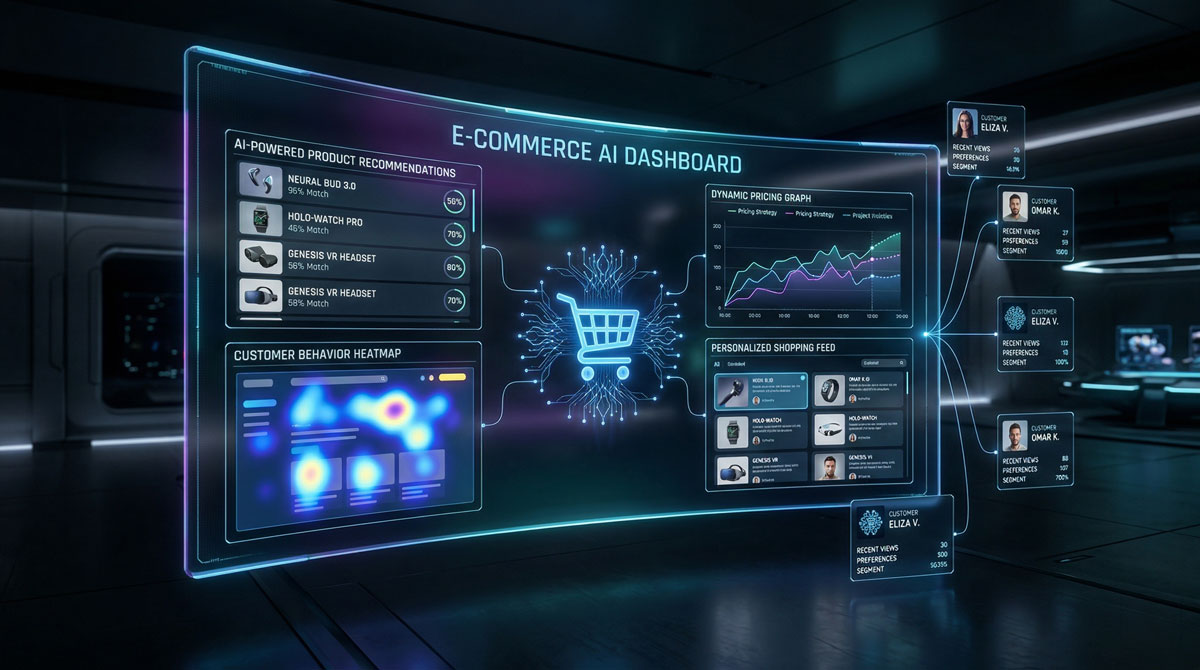
AI Ecommerce Personalization: The Complete Guide to Boosting Revenue in 2026
Every online store shows the same homepage to every visitor — and that is exactly why most stores lose customers before they even scroll. AI ecommerce personalization changes that equation entirely. Instead of treating every shopper the same way, AI analyzes real-time behavior, purchase history, and contextual signals to deliver a unique experience for each individual. Companies that invest in AI ecommerce personalization generate up to 40% more revenue from their personalization activities than companies that rely on generic, one-size-fits-all approaches. In a market like Saudi Arabia — where the ecommerce sector is projected to reach $31.29 billion in 2026 and $54.87 billion by 2031 — the brands that master personalization will dominate, and those that ignore it will lose ground fast.
Table of Contents
What Is AI Ecommerce Personalization and Why Does It Matter?
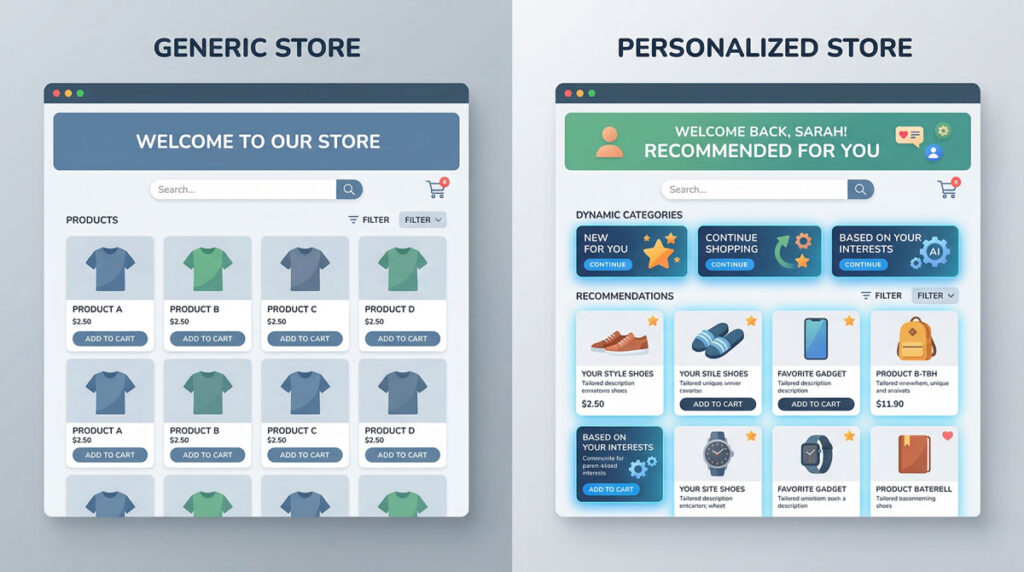
AI ecommerce personalization is the practice of using artificial intelligence — including machine learning, predictive analytics, and natural language processing — to tailor every element of the online shopping experience to each individual customer. This goes far beyond the old approach of manually creating customer segments based on demographics. AI systems learn from every click, scroll, search query, and purchase to build a real-time understanding of what each shopper wants, needs, and is likely to buy next.
Think of it this way: traditional personalization is like a waiter who remembers your name. AI ecommerce personalization is like a waiter who remembers your name, knows you always order the steak medium-rare on Fridays, suggests a wine that pairs perfectly with tonight’s special, and has already set your preferred table by the window. The difference is not incremental — it is transformational.
Why does this matter now more than ever? Because 71% of consumers expect personalized interactions from brands, and 76% feel frustrated when personalization is missing. In 2026, 92% of companies use AI-driven personalization to drive growth, and 87% of brands plan to increase their personalization budgets. If you are running an ecommerce store — whether on Salla, Zid, Shopify, or WooCommerce — AI ecommerce personalization is no longer optional. It is the baseline for competing.
AI Ecommerce Personalization Statistics You Need to Know in 2026
Before diving into strategies, let me share the numbers that demonstrate why AI ecommerce personalization deserves your immediate attention. These statistics come from McKinsey, Twilio Segment, Epsilon, and other leading research firms.
| Metric | Statistic | Source |
|---|---|---|
| Revenue lift from personalization leaders | 40% more revenue than average performers | McKinsey |
| AI-enabled ecommerce market value (2026) | $9.01 billion, projected $22.60B by 2032 | SellersCommerce |
| Companies using AI-driven personalization | 92% of companies with a personalization strategy | WiserNotify |
| Conversion rate boost from AI personalization | Up to 30% increase | WiserNotify |
| Product recommendations share of revenue | Up to 31% of ecommerce site revenues | Barilliance |
| AOV increase from recommendation engagement | Up to 369% for engaged sessions | Barilliance |
| Consumers expecting personalized interactions | 71% | Salesforce |
| ROI positive from AI personalization | 89% of companies report positive ROI | Envive |
| Hyper-personalization market size by 2032 | $80.2 billion (18.1% CAGR) | Precision Business Insights |
| Budget allocated to personalization in 2026 | ~40% of marketing budgets (up from 22% in 2023) | Involve.me |
These numbers tell a clear story: AI ecommerce personalization is not a future trend — it is the present competitive standard. Companies that implement it correctly earn significantly more, convert better, and retain customers longer. The 89% positive ROI rate with an average 9-month payback period makes this one of the most reliable growth investments available to any ecommerce business today.
How AI Ecommerce Personalization Works: The Technical Engine
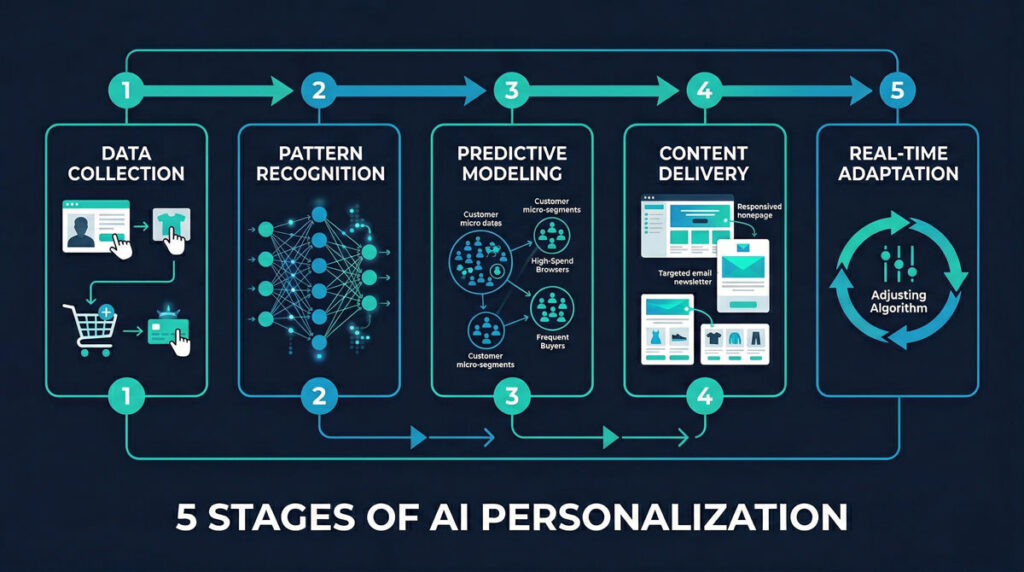
Understanding how AI ecommerce personalization works under the hood helps you make better implementation decisions. The process follows five core stages that happen in real time, often within milliseconds.
Data Collection Layer
AI personalization systems collect data from every touchpoint: browsing history, search queries, cart additions, purchase history, time spent on pages, scroll depth, email engagement, and even device type. Many stores centralize this using a Customer Data Platform (CDP) to create a unified customer profile. The richer the data, the more accurate your AI ecommerce personalization outcomes become.
Machine Learning and Pattern Recognition
Once data flows in, machine learning algorithms identify patterns that humans cannot detect at scale. For example, the system might recognize that a customer tends to buy activewear in neutral colors during weekend sessions and prefers to use discount codes. It detects purchasing cycles, seasonal preferences, and price sensitivity — all without manual rule-setting.
Predictive Modeling and Dynamic Segmentation
AI groups customers into dynamic micro-segments that shift in real time. Unlike static segments (“men aged 25-35”), these AI-driven segments might include “high-intent mobile shoppers who browse electronics on Thursday evenings and respond to free shipping offers.” This granularity is what makes AI ecommerce personalization so effective. Predictive models then forecast what each micro-segment — or even each individual — is most likely to do next, such as abandoning their cart, converting during a flash sale, or subscribing to a loyalty program.
Personalized Content Delivery
Based on predictions, the AI dynamically adjusts what each visitor sees. This includes AI product recommendations on the homepage, personalized search results, tailored email subject lines, customized pricing or promotions, and even adjusted page layouts. The goal of AI ecommerce personalization at this stage is to make every touchpoint feel relevant and timely.
Real-Time Adaptation
The most powerful aspect of AI-driven personalization is continuous learning. When a customer who normally buys electronics suddenly starts browsing baby products, the system adapts instantly without any manual intervention. This real-time adaptation is what separates AI ecommerce personalization from static, rule-based systems that require constant human updates.
AI Product Recommendations: The Revenue Engine Behind Every Smart Store
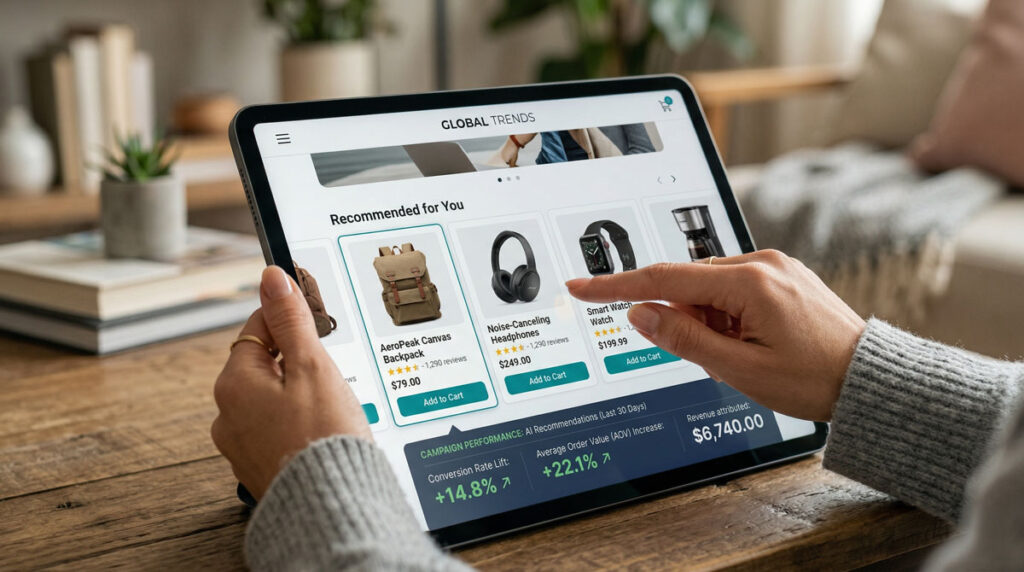
AI product recommendations are the single most impactful application of AI ecommerce personalization. Research from Barilliance shows that product recommendations can drive up to 31% of total ecommerce site revenue in sessions where customers engage with them. Amazon, the company that pioneered recommendation engines at scale, generates an estimated 35% of its purchases through personalized suggestions.
There are several types of AI product recommendations that every ecommerce store should implement. Collaborative filtering analyzes what similar customers purchased and suggests items based on collective behavior patterns. Content-based filtering recommends products similar to what a specific customer has already viewed or bought. Hybrid systems combine both approaches for higher accuracy. And newer deep learning models analyze complex patterns across millions of data points to surface recommendations that simpler algorithms would miss entirely.
The impact on key metrics is dramatic. Sessions where customers interact with AI product recommendations show average order values up to 369% higher than sessions without recommendation engagement. Personalized recommendations produce conversion rates approximately four times higher than non-personalized product displays. For ecommerce stores looking to increase revenue without increasing traffic, investing in a robust recommendation engine as part of your AI ecommerce personalization strategy delivers among the highest returns on investment available.
I have seen firsthand how adding intelligent recommendations to product pages, cart pages, and post-purchase emails transforms store performance. A well-configured recommendation engine does not just suggest “similar products” — it builds personalized shopping journeys that increase both basket size and customer satisfaction simultaneously.
Dynamic Pricing Ecommerce: How AI Sets the Right Price at the Right Time
Dynamic pricing ecommerce is one of the most powerful — and most misunderstood — applications of AI ecommerce personalization. At its core, dynamic pricing uses AI to adjust product prices based on real-time market conditions, demand patterns, competitor pricing, inventory levels, and customer behavior. This is different from personalized pricing (which sets individual prices per customer) and has been common in the airline and hospitality industries for decades.
For ecommerce retailers, dynamic pricing ecommerce strategies deliver measurable results. AI-driven pricing optimization can improve margins by up to 10%, while reducing cart abandonment by approximately 9% through strategic price adjustments. Machine learning algorithms can analyze up to 60 variables simultaneously — far more than any human pricing team could process — including competitor prices, seasonal demand, weather patterns, local events, and real-time inventory levels.
In Saudi Arabia, platforms like Noon already use AI-based pricing models that automatically calculate product values based on user behavior, time periods, and market activity. Amazon.sa applies its global machine learning systems to the Middle Eastern market, offering personalized bundle offers and seasonal promotions tailored to Saudi shopping periods like Ramadan, Saudi National Day, and salary-day cycles around the 27th of each month.
However, dynamic pricing ecommerce requires careful implementation. Transparency is critical — customers who discover they paid more than someone else for the same product lose trust quickly. I recommend focusing on demand-based pricing (adjusting prices based on overall market conditions) rather than individual-level pricing. Combine dynamic pricing ecommerce strategies with loyalty rewards and price-match guarantees to maintain customer confidence while optimizing revenue.
Ecommerce Hyper-Personalization Strategies That Drive Conversions
Ecommerce hyper-personalization goes beyond basic recommendations and pricing. It uses real-time behavioral data, contextual signals, and predictive AI to create shopping experiences that feel individually crafted. The hyper-personalization market is expected to reach $80.2 billion by 2032, growing at an 18.1% CAGR — making it the fastest-growing segment within the broader AI ecommerce personalization ecosystem.
Here are the most effective ecommerce hyper-personalization strategies I recommend implementing.
Personalized Homepage Experiences
Every returning visitor should see a homepage tailored to their interests. AI analyzes their browsing and purchase history to surface relevant categories, trending items in their preferred niches, and personalized banners. Platforms like Amazon and Netflix have proven that dynamically shaping each user’s experience — from product feeds to homepage layouts — significantly increases engagement and time on site.
Behavioral Email and SMS Personalization
Personalized emails deliver six times higher transaction rates than generic emails. AI ecommerce personalization enables automated email workflows triggered by specific behaviors: abandoned cart sequences achieve up to 42% click-to-purchase rates, while post-purchase cross-sell emails based on AI analysis of complementary products drive repeat purchases. SMS notifications for restocked items or flash sales targeted to price-sensitive segments add another high-converting channel.
AI-Powered Personalized Search
Site search users are 2.4 times more likely to buy and spend 2.6 times more than non-search users. AI-powered search goes beyond keyword matching — it understands intent, corrects misspellings, surfaces results based on individual preferences, and learns from each interaction. For ecommerce stores with large catalogs, investing in intelligent search and discovery powered by AI ecommerce personalization is one of the highest-impact improvements available.
Contextual and Location-Based Personalization
Context matters enormously for a personalized shopping experience. AI systems that factor in time of day, device type, weather, and geographic location can deliver dramatically more relevant experiences. A shopper browsing from Riyadh during a 45°C afternoon might see indoor entertainment products prioritized, while the same shopper browsing during cooler winter months sees outdoor gear. This level of contextual intelligence — where ecommerce hyper-personalization meets local market understanding — separates good stores from great ones.
AI Personalization Saudi Arabia: How Local Brands Are Winning
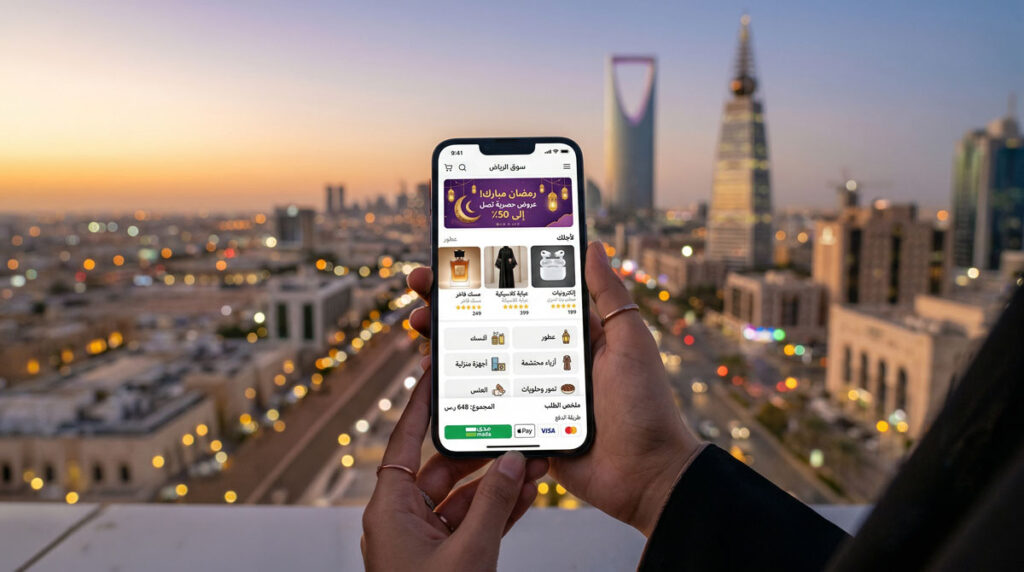
The Saudi Arabian ecommerce market presents a unique and compelling opportunity for AI personalization Saudi Arabia strategies. With 99% internet penetration, 78% 5G coverage, and a young, digitally native population, the Kingdom has the infrastructure and consumer appetite to support advanced personalization at scale. Saudi Arabia has designated 2026 as the Year of Artificial Intelligence, and the country’s AI market is projected to grow from $2.14 billion in 2025 to $16.90 billion by 2032 at a 34.3% CAGR.
How Salla, Zid, and Noon Use AI Personalization
Local ecommerce enablers are rapidly integrating AI ecommerce personalization into their platforms. Salla, which powers over 68,000 merchants and processes more than $13 billion in transactions, offers an app store with over 900 integrations — including marketing automation tools from Klaviyo, Meta Ads, and WhatsApp notification systems that enable behavior-triggered personalization. Zid provides advanced analytics with predictive insights and detailed customer segmentation, giving merchants the data foundation needed for effective AI personalization Saudi Arabia implementation.
Noon uses AI ecommerce personalization through pricing models that automatically calculate product values based on user actions, time periods, and competitive market activity. Amazon.sa applies its global collaborative filtering systems to deliver localized recommendations, offering personalized bundle deals and seasonal promotions specifically designed for Saudi shopping patterns during Ramadan, Saudi National Day, and Founding Day.
Cultural Intelligence in Saudi AI Personalization
Effective AI personalization Saudi Arabia requires more than translating English interfaces into Arabic. It requires cultural intelligence. The most successful brands in the Kingdom understand that Saudi consumers have distinct purchasing rhythms: spending spikes around the 27th of each month (salary day), extended browsing sessions during Ramadan evenings, and peak gift-buying during Eid and Saudi National Day. AI systems trained on these local patterns dramatically outperform generic global models.
Arabic-first AI capabilities matter too. Models like ALLaM and sovereign AI systems built by HUMAIN are designed to understand not just Modern Standard Arabic but Saudi dialect nuances — critical for chatbot interactions, search intent matching, and sentiment analysis. A personalized shopping experience for a Riyadh-based shopper should understand regional dialect, cultural references, and local product preferences in ways that a generic global AI model simply cannot achieve.
PDPL Compliance and Data Privacy for Personalization
Saudi Arabia’s Personal Data Protection Law (PDPL), enforced by SDAIA, sets clear rules for how customer data can be collected and used for personalization. In the first year of enforcement, 48 PDPL enforcement decisions were issued, signaling that the regulator is actively monitoring compliance. For any AI personalization Saudi Arabia strategy, this means implementing transparent consent mechanisms, allowing customers to control their data preferences, and ensuring that personalization algorithms comply with data residency and processing requirements. Brands that handle data privacy proactively build deeper customer trust — which directly improves the effectiveness of their personalization efforts.
Best AI Ecommerce Personalization Tools and Platforms in 2026
Choosing the right tools is critical for successful AI ecommerce personalization implementation. Here is a comparison of the leading platforms and where each excels.
| Tool / Platform | Best For | Key AI Features | Pricing Model |
|---|---|---|---|
| Dynamic Yield (Mastercard) | Enterprise-level personalization | Real-time recommendations, A/B testing, predictive targeting | Enterprise (custom pricing) |
| Clerk.io | Mid-market ecommerce | AI search, recommendations, email personalization | Based on traffic volume |
| SAP Emarsys | Omnichannel retailers | Predictive segmentation, lifecycle campaigns, mobile wallet | Enterprise tier |
| Nosto | Shopify and Magento stores | Visual merchandising AI, behavioral pop-ups, content personalization | Revenue-based |
| Algolia | AI-powered search and discovery | NLP search, personalized ranking, recommendations API | Usage-based |
| Klaviyo | Email and SMS personalization | Predictive analytics, behavioral triggers, AI subject lines | Contact-based |
| Salla App Store | Saudi and GCC merchants | 900+ integrations including marketing automation and loyalty tools | Varies by app |
| Zid Analytics | Saudi merchants needing data insights | Predictive insights, customer segmentation, business intelligence | Included in plans |
For Saudi-based stores, I recommend starting with your existing platform’s built-in capabilities. If you are on Salla or Zid, leverage their native analytics and integrate Klaviyo or a similar tool for behavioral email personalization. For larger operations, Dynamic Yield or SAP Emarsys provide the deep AI ecommerce personalization capabilities needed for sophisticated, multi-channel strategies. If you are exploring the best AI models and agents for building custom personalization systems, consider pairing your ecommerce platform with APIs from providers like Algolia for search and a recommendation engine like Clerk.io.
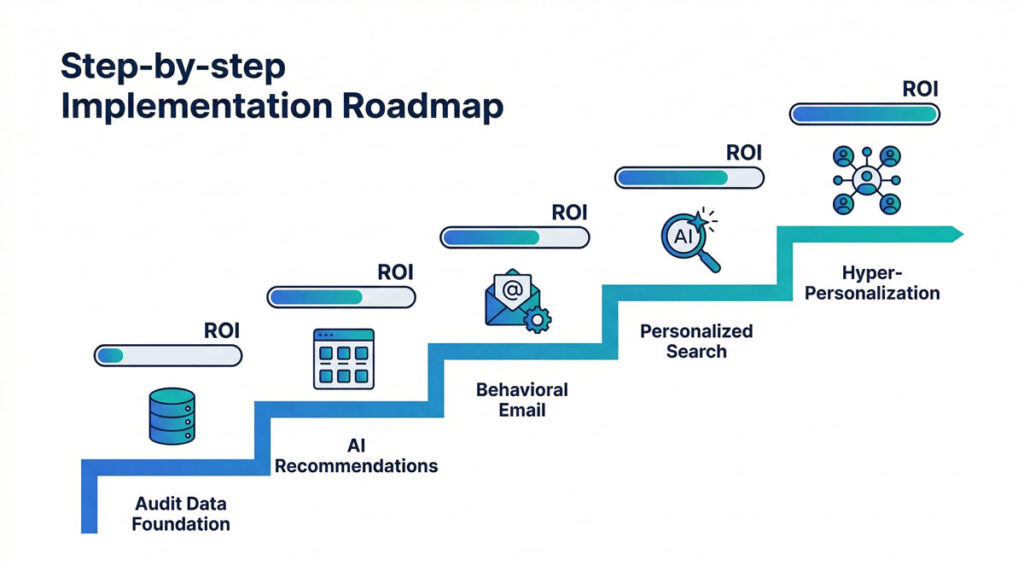
How to Implement AI Ecommerce Personalization: A Step-by-Step Guide
Implementing AI ecommerce personalization does not require a massive upfront investment or a team of data scientists. Here is a practical, phased approach that works for stores of any size.
Step 1: Audit Your Data Foundation
Before adding any AI tools, audit the data you already have. Review your GA4 ecommerce tracking setup to ensure purchase events, add-to-cart events, and user properties are being captured correctly. Check that your product catalog data is clean and consistent — AI personalization is only as good as the data it learns from. Identify gaps in your customer data collection and prioritize filling them before launching personalization campaigns.
Step 2: Start with AI Product Recommendations
Product recommendations offer the fastest path to measurable ROI. Install a recommendation engine on your product pages (“customers also bought”), cart page (“frequently bought together”), and homepage (“recommended for you”). Most ecommerce platforms support this through plugins or apps. Track the recommendation revenue attribution percentage — aim for AI product recommendations to contribute at least 10-15% of total revenue within 90 days.
Step 3: Build Behavioral Email Automation
Set up automated email flows triggered by customer behavior: abandoned cart recovery (the highest-converting flow), browse abandonment, post-purchase cross-sell, win-back sequences for lapsed customers, and restock notifications. Personalize the content within each email using AI-generated product suggestions based on individual behavior. This layer of AI ecommerce personalization through behavioral email typically delivers the fastest revenue gains after recommendation engines.
Step 4: Personalize Search and Navigation
Upgrade your site search from basic keyword matching to AI-powered search that understands intent and personalizes results. For stores with 500+ products, this investment pays for itself quickly through increased conversions from search users. Implement personalized category pages that reorder products based on each visitor’s browsing history and purchase preferences.
Step 5: Layer in Advanced Hyper-Personalization
Once the foundational elements are generating results, expand into ecommerce hyper-personalization: dynamic homepage experiences, dynamic pricing ecommerce strategies, personalized pop-ups based on exit intent and behavior, WhatsApp-based shopping assistance with AI agents, and predictive restocking reminders. At this stage, you are building a fully intelligent store where every touchpoint adapts to each individual customer.
Common AI Ecommerce Personalization Mistakes to Avoid
In my experience working with ecommerce businesses, these are the most frequent mistakes that undermine AI ecommerce personalization efforts.
Dirty data, no results. Only 33% of businesses have fully implemented AI despite 71% having tried it. The most common reason for failure is poor data quality. If your product catalog has inconsistent categories, missing attributes, or duplicated listings, AI algorithms produce irrelevant recommendations. Clean your data before investing in AI ecommerce personalization tools.
Over-personalizing too early. Showing a first-time visitor deeply personalized content based on one page view feels intrusive rather than helpful. Effective AI ecommerce personalization builds progressively — start with broad relevance signals and deepen personalization as you accumulate more behavioral data for each user.
Ignoring privacy and transparency. With regulations like Saudi Arabia’s PDPL and global standards like GDPR, customers are increasingly aware of data practices. Implementing AI ecommerce personalization without clear consent mechanisms and transparent data policies will erode trust and may result in regulatory penalties.
Focusing only on acquisition, not retention. Many stores use personalization only for attracting new customers and neglect the post-purchase experience. The highest ROI from AI ecommerce personalization comes from retention and repeat purchase optimization. Personalized post-purchase flows, loyalty-based recommendations, and predictive reorder reminders generate significantly more lifetime value than acquisition-only personalization.
Not testing and iterating. AI personalization is not “set and forget.” The most successful ecommerce brands continuously A/B test their personalization strategies, comparing AI-generated recommendations against alternative models, testing different dynamic pricing ecommerce approaches, and refining their segmentation logic based on performance data.
FAQ: AI Ecommerce Personalization
What is AI ecommerce personalization and how does it differ from traditional personalization?
AI ecommerce personalization uses machine learning and predictive analytics to automatically tailor shopping experiences for each individual customer in real time. Traditional personalization relies on static, manually created rules and broad demographic segments. AI systems learn continuously from each interaction, adapting dynamically without human intervention, and can process thousands of data signals simultaneously to deliver far more precise and relevant experiences.
How much revenue increase can I expect from AI ecommerce personalization?
Results vary by industry and implementation quality, but research consistently shows that companies with strong AI ecommerce personalization generate 5-40% more revenue from personalization activities. McKinsey reports that personalization leaders grow approximately 10 percentage points faster than laggards. Product recommendations alone can account for up to 31% of total ecommerce revenue. Most companies achieve positive ROI within 9 months of implementation.
Can small ecommerce stores benefit from AI personalization, or is it only for large enterprises?
Small and mid-sized stores can absolutely benefit. Platforms like Klaviyo, Clerk.io, and Nosto are designed for businesses of all sizes with accessible pricing models. If you run a store on Salla or Zid, you can start with built-in analytics and app store integrations. Even basic AI ecommerce personalization through product recommendations and behavioral email automation can significantly improve conversion rates and average order values for stores of any scale.
Is dynamic pricing ethical for ecommerce?
Dynamic pricing ecommerce based on market conditions (supply, demand, competition, seasonality) is widely accepted and ethically sound. However, personalized pricing that charges different individuals different prices for the same product based on their personal data raises ethical concerns and can damage customer trust. I recommend using demand-based dynamic pricing ecommerce strategies combined with transparency, loyalty rewards, and price-match policies to maintain fairness while optimizing revenue.
What are the unique challenges of AI personalization in Saudi Arabia?
AI personalization Saudi Arabia involves three primary challenges: Arabic language processing (including dialect variations across Najdi, Hejazi, and other regional dialects), PDPL data compliance requirements for customer data collection and processing, and cultural intelligence in understanding Saudi-specific purchasing patterns like salary-day spending cycles and seasonal events. Stores that address these challenges with sovereign AI tools and culturally trained models gain a significant competitive advantage in the Kingdom.
What are the best AI ecommerce personalization tools for 2026?
The best tools depend on your platform and scale. For Saudi merchants on Salla or Zid, start with native platform analytics and integrate Klaviyo for email personalization. For Shopify stores, Nosto and Clerk.io offer strong AI ecommerce personalization capabilities. Enterprise-level retailers should evaluate Dynamic Yield or SAP Emarsys. For AI-powered search, Algolia leads the market. The key is choosing tools that integrate cleanly with your existing stack and scale with your growth.
How do I measure the success of AI ecommerce personalization?
Track these key metrics: recommendation revenue attribution (percentage of total revenue from AI product recommendations), conversion rate by personalized vs. non-personalized segments, average order value changes, email click-to-purchase rates for personalized flows, customer lifetime value trends, and repeat purchase rates. Set up proper GA4 tracking with ecommerce events to measure the full impact of your AI ecommerce personalization strategy across all touchpoints.
Does PDPL affect how I can personalize in Saudi Arabia?
Yes. Saudi Arabia’s Personal Data Protection Law requires that businesses obtain proper consent before collecting and processing customer data for personalization purposes. You must provide clear privacy notices explaining how data is used, offer opt-out mechanisms, and ensure data is stored securely with compliant processing practices. However, PDPL does not prevent personalization — it requires transparent, consent-based personalization that ultimately builds stronger customer trust and better long-term engagement.
The Future of AI Ecommerce Personalization Starts Now
AI ecommerce personalization is no longer a competitive advantage reserved for Amazon and Netflix. With accessible tools, proven implementation frameworks, and clear ROI data, any ecommerce business — from a single-product Salla store to a multi-brand enterprise on Shopify — can deliver the kind of personalized shopping experience that drives conversions, builds loyalty, and grows revenue.
The data speaks clearly: 92% of companies already use AI-driven personalization, 89% report positive ROI, and the global hyper-personalization market is growing at 18.1% annually toward $80.2 billion by 2032. In Saudi Arabia specifically, where the ecommerce market is growing at 11.92% CAGR and ecommerce trends increasingly favor AI-native stores, the window for early-mover advantage in AI ecommerce personalization is closing fast.
Start with recommendations and behavioral email automation. Build your data foundation. Layer in dynamic pricing ecommerce and ecommerce hyper-personalization as you grow. The brands that will dominate Saudi and global ecommerce over the next five years are the ones investing in AI ecommerce personalization today — not tomorrow.
Related reading:
- AI Agents for eCommerce: Automate Inventory, Customer Service, and Pricing in 2026
- Digital Consumer Behavior in Middle East E-commerce: The 2026 Guide
- Sovereign AI Saudi Arabia & The “Saudi-First” Customer Experience
- Generative Engine Optimization for Ecommerce: The Complete 2026 Guide
Sources: McKinsey — The Value of Personalization, Mordor Intelligence — Saudi Arabia Ecommerce Market, Precision Business Insights — Hyper-Personalization Market, MarketsandMarkets — Saudi Arabia AI Market, Frontiers in AI — AI Impact on E-customer Loyalty in Saudi Arabia, Salesforce — State of the Connected Customer, Twilio Segment — State of Personalization Report, Saudi Press Agency — Saudi Arabia Year of AI

Husain Alhaboubi is Director of Digital Channels at Mobily, where he leads platform optimization, AI-powered customer engagement, and UI/UX strategy. With 20+ years of experience spanning eCommerce, IT infrastructure, and digital marketing, he previously drove a 225% revenue increase and 69% organic traffic growth as eCommerce Senior Manager at flyadeal, and managed enterprise IT operations — including data centers, ERP systems, and network security — as Group IT Manager at IPD Group.
Husain holds a BS in Information Systems from the University of Texas at Arlington and is certified in Google Ads, Google Analytics, and Semrush SEO. He writes from hands-on experience across both sides of digital business: the strategic (eCommerce, SEO, AI, digital transformation) and the technical (server administration, cloud computing, web development, networking, and security) — with a particular focus on the Saudi market and Vision 2030. Read his full resume →