
Generative Engine Optimization: GEO vs. AEO vs. AIO — The Complete 2026 Guide
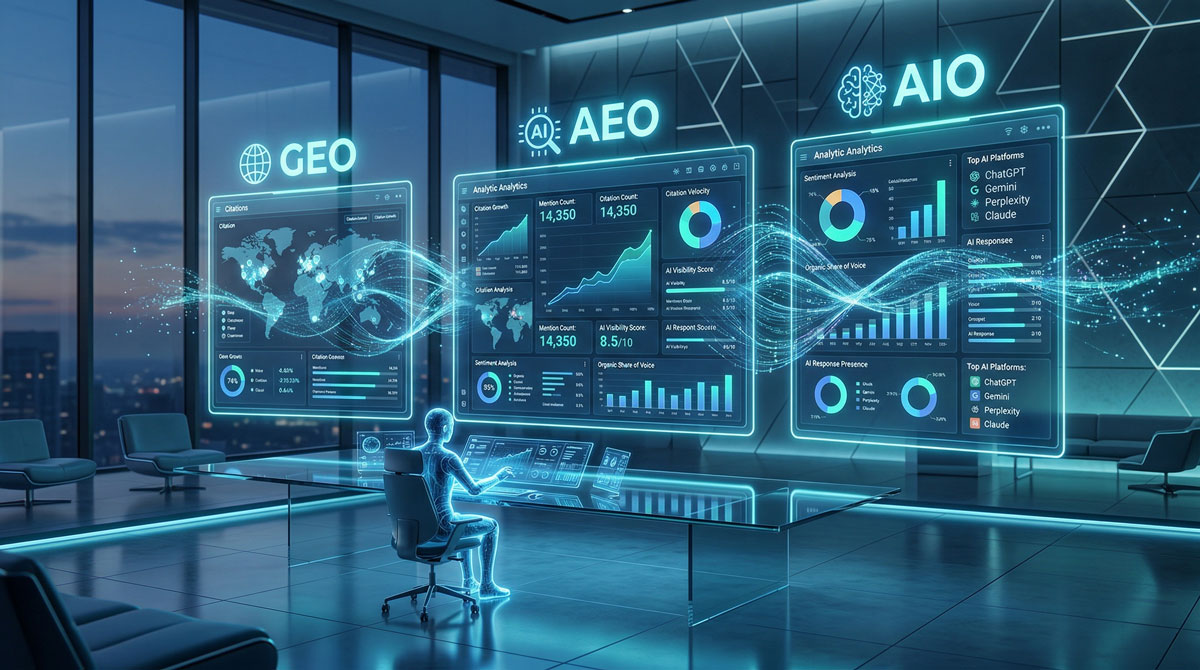
If you’re still measuring SEO success by rankings and clicks alone, you’re optimizing for a shrinking pool. In 2026, generative engine optimization has emerged alongside Answer Engine Optimization (AEO) and AI Optimization (AIO) as the three pillars of modern search visibility. With nearly 60% of Google searches ending without a click and AI-referred traffic growing over 500% year-over-year, the question is no longer whether to adapt — it’s how quickly you can master all three disciplines before your competitors do.
I’ve spent the past year testing and refining my approach to each of these strategies, and I can tell you from firsthand experience: they’re not interchangeable. Each solves a different visibility problem, targets a different layer of the search ecosystem, and requires its own tactical playbook. In this guide, I’ll break down what generative engine optimization, AEO, and AIO actually mean, how they differ, where they overlap, and — most importantly — how to build a unified strategy that covers all three.
Table of Contents
What Is Generative Engine Optimization (GEO)?
Generative engine optimization is the practice of optimizing your content so that AI-powered generative engines — such as ChatGPT, Google AI Overviews, Perplexity, and Gemini — retrieve, cite, and recommend it when generating responses to user queries. Unlike traditional SEO, which aims to rank pages in a list of blue links, GEO focuses on making your content the source that AI systems choose to reference when composing answers.
The term was formalized in a 2024 research paper by Princeton University and IIT Delhi, which demonstrated that specific content optimization strategies can improve source visibility in generative engines by up to 40%. Since then, the discipline has moved from academic concept to operational necessity. AI search traffic grew 527% year-over-year between 2024 and 2025 (Semrush, 2025), and Gartner predicts a 25% drop in traditional search volume by the end of 2026 as users shift to AI-powered interfaces.
Here’s the critical insight: fewer than 10% of sources cited in ChatGPT, Gemini, and Copilot rank in the top 10 Google organic search results for the same query (eMarketer, 2025). That means your traditional SEO rankings alone won’t guarantee visibility in AI-generated answers. Generative engine optimization addresses this gap directly.
How GEO Works: The RAG Pipeline Explained
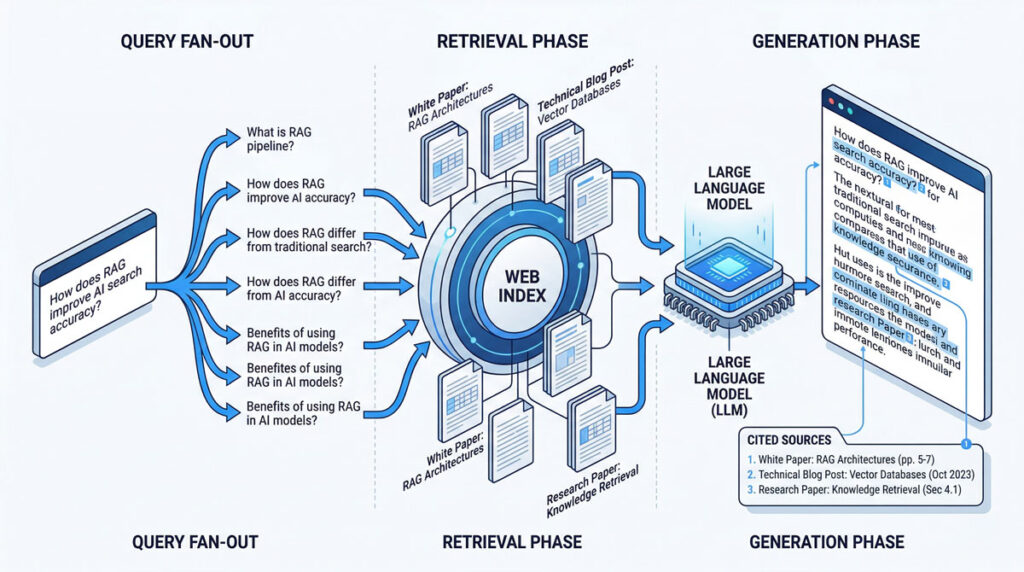
Understanding generative engine optimization requires understanding how generative AI systems produce answers. Most use a process called Retrieval-Augmented Generation (RAG), which operates in three stages:
- Query fan-out: The AI breaks the user’s question into multiple sub-queries and searches for each one separately. A question like “What’s the best CRM for small ecommerce businesses?” might trigger separate searches for “best CRM 2026,” “CRM ecommerce features,” and “CRM small business pricing.”
- Retrieval: The system searches its index and the live web for semantically relevant documents. It doesn’t rely on exact keyword matching — it identifies conceptual similarity and relationships between entities.
- Generation: The large language model synthesizes retrieved documents into a single, coherent response. It decides which sources to cite, how prominently to feature them, and what to say about them. Your content is either woven in — or left out.
The practical implication is clear: being indexed is necessary but not sufficient. Your content must also be structurally clear, factually dense, and authoritative enough for the LLM to choose it as worth citing. That’s the generative engine optimization layer that sits on top of traditional SEO.
Key GEO Tactics That Increase AI Citations
Based on the Princeton research and emerging best practices in 2026, the following tactics have shown the strongest impact on generative engine optimization performance:
- Statistics and data inclusion: Pages with statistics and cited sources achieve 30–40% higher visibility in AI responses (Princeton GEO study, 2024). AI systems treat quantified claims backed by primary sources as more credible and citable.
- Clear H1–H2–H3 structure: Content with a well-defined heading hierarchy gets cited 2.8x more often than unstructured content (Incremys, 2026). Each section should address one topic completely.
- BLUF (Bottom Line Up Front) formatting: Lead every section with the direct answer, then provide context. AI systems extract the first sentence or two of a section, so burying the answer reduces your citation probability.
- Expert quotations: Including attributed quotes from credible sources signals authority and increases AI citation rates.
- Schema markup: FAQ, Article, Product, and Organization schema give generative engines machine-readable context that improves retrieval accuracy.
- AI crawler access: Many sites unknowingly block AI crawlers through robots.txt or CDN settings. If you use Cloudflare, check its default bot-blocking settings — your AI visibility may have been cut off automatically.
What Is Answer Engine Optimization (AEO)?
Answer engine optimization (AEO) is the practice of structuring your content so AI-powered platforms can find it, understand it, and deliver it as a direct answer to a user’s question. While generative engine optimization focuses on being cited within generated responses, AEO focuses specifically on the answer-retrieval layer — ensuring your content is selected when an AI engine needs a source for a specific fact, definition, or recommendation.
AEO spans all answer surfaces: Google AI Overviews, featured snippets, People Also Ask boxes, voice assistants (Alexa, Siri, Google Assistant), and AI chat platforms including ChatGPT, Perplexity, Gemini, and Claude. The goal isn’t just to rank — it’s to become the answer itself.
The scale of this shift is significant. ChatGPT now processes over 2 billion queries daily and has surpassed 800 million monthly users (OpenAI, 2025). Google AI Overviews appear in an increasing share of search results, and voice commerce is projected to reach $80 billion in annual transaction value. If your content isn’t structured for answer engine optimization, you’re invisible on a growing number of discovery surfaces.
AEO vs. Featured Snippets: What Changed
Featured snippets were the original form of answer engine optimization — Google would extract a single answer from one page and display it at position zero. The new AEO landscape is fundamentally different. AI Overviews synthesize information from multiple sources and rephrase it into a conversational summary. Instead of extracting your exact text, the AI system understands your content, evaluates its credibility, and decides whether to include your information in a blended response.
This means answer engine optimization now requires content that’s independently citable at the section level — not just optimized as a whole page. Each H2 or H3 section needs to function as a standalone, extractable answer that an AI system can pull without needing the surrounding context.
Proven AEO Tactics for 2026
Effective answer engine optimization in 2026 combines structural clarity with topical authority:
- Question-based headings: Use headings that mirror how users ask questions across chat, voice, and search interfaces. This aligns with how AI systems parse intent and match content to queries.
- Concise definitions up front: Provide a clear 40–60 word answer immediately after each question heading, followed by expanded context. AI systems preferentially extract these lead-in answers.
- FAQ schema markup: Implement FAQPage structured data on all question-answer content. This helps AI systems identify your content as purpose-built for answering queries.
- Topic cluster architecture: Build pillar pages with 8–15 supporting articles that cover sub-topics in depth. AI engines reward comprehensive topical coverage more than isolated articles.
- Cross-platform presence: AI systems evaluate your brand’s presence across the web. Publishing on Reddit, LinkedIn, YouTube, and industry forums increases the likelihood that AI engines consider your brand authoritative. Research shows 48% of AI citations come from community platforms (Incremys, 2026).
- Freshness signals: Update content quarterly. Studies show 79% of AI systems prefer recently updated content when selecting sources to cite.
What Is AI Optimization (AIO)?
AI optimization (AIO) is the broadest of the three disciplines. It’s the strategic process of making your entire digital content, brand presence, and technical infrastructure AI-ready — so that content can be ingested, understood, and reused by LLMs and AI systems at every stage, from training data to real-time retrieval to agentic workflows.
Think of it this way: GEO focuses on being cited in generative search responses. AEO focuses on being the direct answer to specific questions. AIO encompasses both — and extends further to ensure your brand is present in AI training data, recommendation systems, voice assistants, autonomous AI agents, and every other AI-powered interface where decisions get made.
In 2026, Google’s AI Overviews now reach over 2 billion monthly users, and Google’s global search market share has dipped below 90% for the first time since 2015 as users migrate to AI-powered alternatives. The businesses winning aren’t just those ranking well on Google — they’re the ones whose content is the preferred source that AI systems choose to trust and cite.
AIO Content Structure Best Practices
AI optimization requires a different content architecture than traditional SEO. AI systems don’t browse your site the way humans do — they extract, parse, and evaluate. Here’s what works:
- Entity-first content: AI engines don’t think in keywords. They map entities (people, products, brands, concepts) and their relationships. Use clear entity definitions with consistent naming across your site and external platforms to build what practitioners call “entity authority.”
- Machine-readable data: Ensure pricing, specifications, comparisons, and factual claims are presented in structured formats (tables, schema, clean HTML) rather than buried in narrative prose. AI agents extracting data will prioritize content they can parse programmatically.
- Multimodal optimization: AI platforms in 2026 process text, images, video, and audio simultaneously. Use descriptive filenames, comprehensive alt text, and video transcripts so AI can index and understand visual and audio content. The global multimodal AI market surpassed $1.6 billion in 2024 and is projected to grow at 32.7% CAGR through 2034 (Devenup, 2026).
- Topic cluster model: Create one in-depth pillar page on a broad topic, supported by 8–15 cluster articles on specific sub-topics. Use internal links to demonstrate the semantic relationships between pages. This signals to AI systems that your site is the authoritative source for an entire subject area.
- llms.txt file: Consider creating an llms.txt file (similar to robots.txt) that helps AI systems understand your site structure and prioritize the most important content for retrieval.
GEO vs. AEO vs. AIO: Side-by-Side Comparison
Understanding the differences and relationships between generative engine optimization, AEO, and AIO is essential for building an effective strategy. Here’s a detailed comparison:
| Dimension | GEO (Generative Engine Optimization) | AEO (Answer Engine Optimization) | AIO (AI Optimization) |
|---|---|---|---|
| What it is | Optimizing content to be retrieved, summarized, or cited by AI tools like ChatGPT, Perplexity, or Google AI Overviews | Structuring content for Google and Bing to extract direct answers, powering featured snippets and voice results | Making your content AI-ready so it can be ingested, understood, and reused by LLMs and AI systems |
| Primary goal | Be cited in AI-generated responses | Be the direct answer to specific questions | Be the trusted, preferred source across all AI interfaces |
| Key metric | Share of Model, citation frequency | Featured snippet wins, AI Overview inclusion, voice answer selection | Brand presence across AI training data, citation authority, entity recognition |
| Target platforms | ChatGPT, Perplexity, Gemini, Claude, Google AI Overviews | Google Featured Snippets, People Also Ask, Voice assistants, AI Overviews | All AI systems: search, voice, agents, recommendation engines, training data |
| Core tactics | Statistics addition, expert quotes, BLUF structure, schema markup, AI crawler access | FAQ formatting, question-based headings, concise answers, topic clusters | Entity optimization, multimodal content, structured data, cross-platform authority |
| Relationship to SEO | Builds on SEO but adds citation-specific tactics | Evolution of featured snippet optimization | Encompasses and extends both GEO and AEO |
Where GEO, AEO, and AIO Overlap
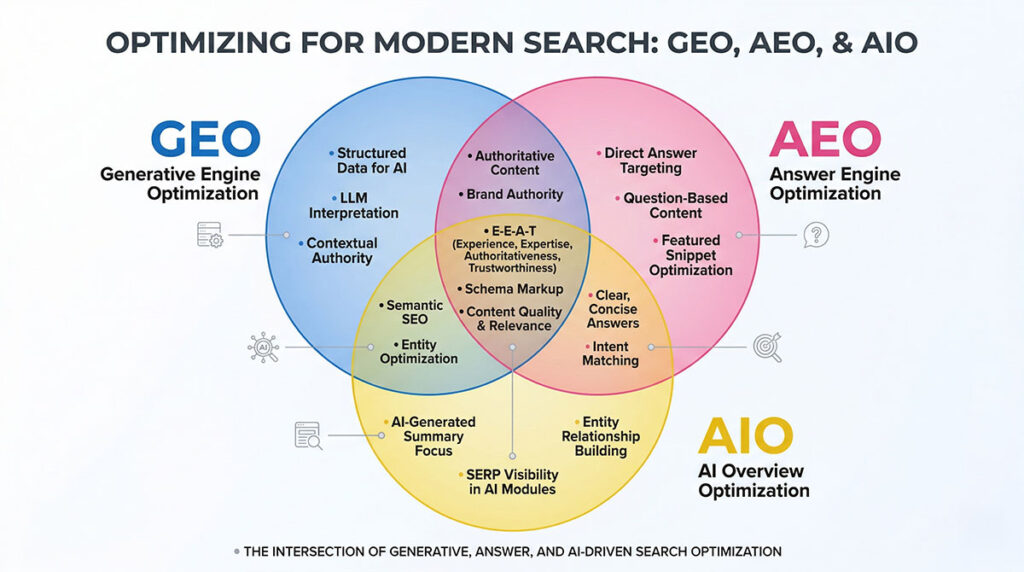
Despite their distinct focus areas, generative engine optimization, AEO, and AIO share significant common ground. All three require high-quality, well-structured, authoritative content. All three reward E-E-A-T signals (Experience, Expertise, Authoritativeness, Trustworthiness). And all three benefit from schema markup, topic cluster architecture, and regular content updates.
The optimal strategy in 2026 combines all three in complementary layers: SEO drives the organic foundation, AEO wins the answer boxes and snippets, GEO earns citations in AI-generated responses, and AIO ensures your brand is the trusted source across every AI-powered touchpoint. Research confirms that 99% of AI Overview citations come from the organic top 10 (Incremys, 2026), which means traditional SEO remains the foundation that everything else builds upon.
The Zero-Click Search Reality Driving This Shift
The urgency behind generative engine optimization, AEO, and AIO becomes clear when you examine the zero-click search data. Understanding these numbers is essential for anyone investing in generative engine optimization — the numbers are dramatic and accelerating:
- Between 57% and 60% of all Google searches now end without a single click to any website (Semrush, 2025).
- Searches that trigger AI Overviews show an average zero-click rate of 83% — meaning 8 out of 10 users get their answer directly in the search interface (Click-Vision, 2026).
- Google AI Overviews appeared in 13.14% of queries by March 2025, up from 6.49% in January — a 102% increase in just two months (Semrush, 2025).
- News-related zero-click searches jumped from 56% to 69% year-over-year (Similarweb, 2025).
- Organic click rates in the U.S. dropped from 44.2% in March 2024 to 40.3% in March 2025 (Semrush, 2025).
- Industry projections suggest zero-click rates could reach 70%+ by mid-2026 as AI Overviews expand to more query types.
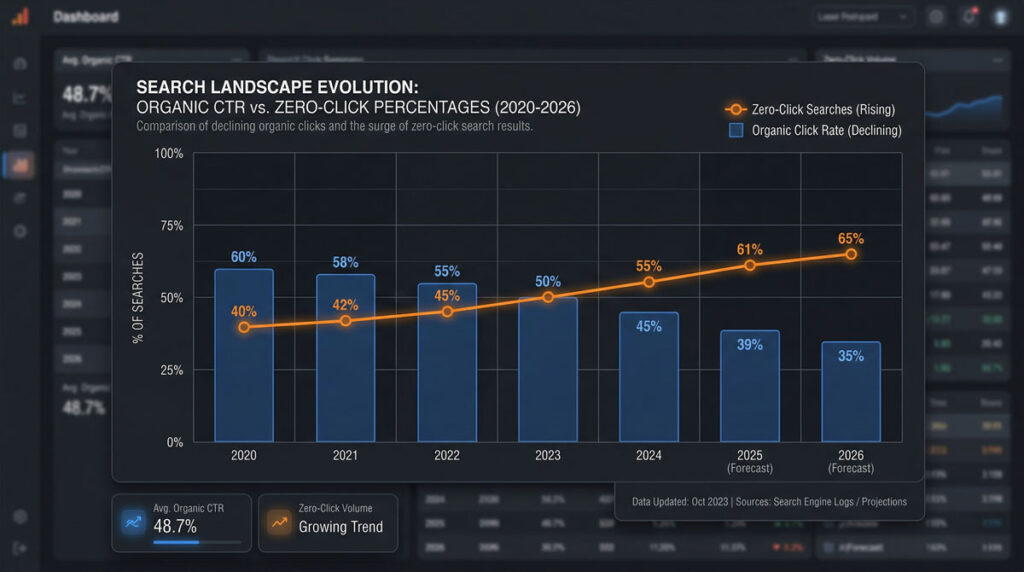
But here’s the silver lining that makes generative engine optimization so valuable: AI search visitors convert 23x better than traditional organic traffic, and AI-referred traffic is valued at 4.4x higher economic value (Ahrefs, cited by Onely, 2025). The traffic pool is smaller, but the visitors who arrive through AI citations are far more qualified and closer to a purchasing decision. Brands appearing in AI-generated answers experience a 38% click lift and a 39% increase in paid ad performance (Envive, 2026).
How to Build a Unified GEO + AEO + AIO Strategy
The most effective approach to generative engine optimization in 2026 isn’t treating GEO, AEO, and AIO as separate initiatives. It’s building a unified content strategy that satisfies all three simultaneously. Here’s the framework I use:
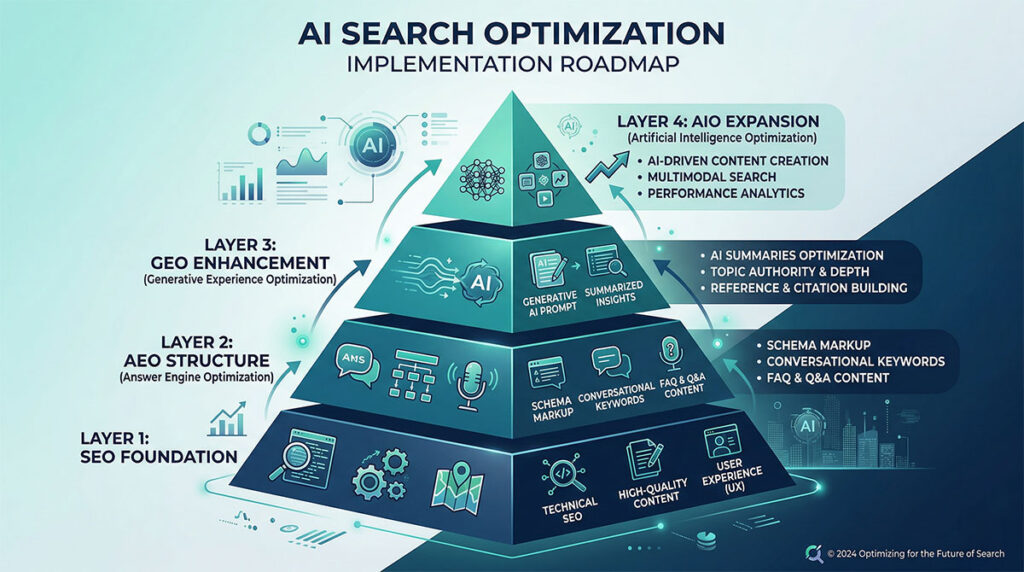
Layer 1 — SEO Foundation: Start with solid traditional SEO. Conduct keyword research, build technical health, optimize page speed, and earn backlinks. This remains the foundation because 99% of AI Overview citations and 87% of ChatGPT citations correspond to top-ranking organic results.
Layer 2 — AEO Structure: Layer question-based headings, FAQ sections, and concise lead-in answers onto your existing content. Implement FAQPage, HowTo, and Article schema. This captures featured snippets, People Also Ask boxes, and voice results.
Layer 3 — GEO Enhancement: Add generative engine optimization signals: statistics with primary source citations, expert quotations, comparison tables, and BLUF-formatted sections. Verify that AI crawlers can access your content. This earns citations in ChatGPT, Perplexity, and Google AI Overviews.
Layer 4 — AIO Expansion: Build cross-platform brand authority through thought leadership on LinkedIn, Reddit, YouTube, and industry publications. Create multimodal content (video, audio, infographics) with proper metadata. Implement entity-focused schema and maintain consistent brand signals across the web.
Step-by-Step Implementation Checklist
Here’s a practical checklist for implementing a unified generative engine optimization strategy across your content:
- Audit AI crawler access: Check your robots.txt for blocks on ChatGPT-User, GPTBot, ClaudeBot, PerplexityBot, and GoogleOther. If you use Cloudflare, review the AI bot traffic settings in your dashboard.
- Implement schema markup: Add FAQPage, Article, Organization, and Product schema to your highest-value pages. This gives AI systems machine-readable context about your content.
- Restructure existing content: Rewrite introductions to lead with the answer (BLUF format). Break content into self-contained H2/H3 sections that can be extracted independently.
- Add statistics and citations: Include at least 3–5 cited statistics per major content piece. Use primary sources whenever possible — AI systems weight original data higher than secondary reporting.
- Build topic clusters: For each core topic, create a pillar page and 8–15 supporting articles. Link them with descriptive anchor text that reinforces entity relationships.
- Create an llms.txt file: Add a file at your domain root that describes your site structure and highlights your most important content for AI crawlers.
- Publish on community platforms: Share thought leadership on Reddit, LinkedIn, Quora, and YouTube. Research shows these are among the most-cited platforms in AI-generated responses.
- Monitor AI visibility: Use tools like Semrush, Ahrefs Brand Radar, or specialized platforms to track your brand’s citation frequency across AI engines.
- Update content quarterly: Refresh statistics, add new data points, and update recommendations. AI systems favor fresh content when selecting sources to cite.
- Track AI-referred conversions: Set up attribution tracking for traffic arriving from AI platforms. Measure not just traffic volume but conversion quality and revenue impact.
Essential Tools for Measuring AI Search Visibility
Traditional SEO tools don’t capture the full picture of generative engine optimization performance. Here are the tools and platforms that matter in 2026:
| Tool | What It Measures | Best For |
|---|---|---|
| Semrush | AI Overview presence, keyword tracking, AI-referred traffic | Comprehensive SEO + GEO monitoring |
| Ahrefs Brand Radar | Brand mentions and citations across AI platforms | Tracking brand visibility in LLM responses |
| Otterly.ai | Brand visibility across ChatGPT, Perplexity, Gemini | Dedicated AI search monitoring |
| Google Search Console | Impressions, clicks, and queries triggering AI Overviews | Identifying high-impression/low-click queries (AEO signals) |
| Profound / Rankscale | Citation frequency and share of voice across AI engines | Enterprise-level AI visibility tracking |
| OmniSEO | AI mentions across various AI and answer platforms | Cross-platform AEO tracking |
When using these tools, focus on the metrics that matter for generative engine optimization: Share of Model (how often your brand appears in AI responses for relevant queries), citation frequency, and AI-referred conversion rates — not just traditional rankings and click-through rates.
Common Mistakes to Avoid with GEO, AEO, and AIO
From my experience implementing generative engine optimization strategies, these are the most common mistakes I see marketers and SEO professionals make:
- Treating GEO as a replacement for SEO: GEO builds on SEO — it doesn’t replace it. Data shows that 99% of AI Overview citations come from the organic top 10, and 87% of ChatGPT citations correspond to Bing’s top results. You still need a strong SEO foundation.
- Blocking AI crawlers unknowingly: Many CDN providers (including Cloudflare) have changed default settings to block AI bots. Check your server logs for ChatGPT-User, GPTBot, and other AI user agents to confirm they can access your content.
- Keyword stuffing in the age of AI: AI systems use semantic understanding, not keyword matching. Stuffing your content with exact-match keywords hurts readability without improving AI citation rates. Focus on comprehensive coverage and entity clarity instead.
- Ignoring cross-platform presence: AI engines don’t only evaluate your website. They assess your brand’s presence across the web. If you’re absent from Reddit, LinkedIn, YouTube, and industry publications, AI systems are less likely to consider you authoritative.
- Measuring only traditional metrics: If your only KPIs are rankings and organic clicks, you’re measuring a shrinking pool. Add AI citation frequency, Share of Model, and AI-referred conversions to your reporting dashboard.
- Publishing and forgetting: AI systems favor fresh, recently updated content. Content that was last updated 12+ months ago gets deprioritized in AI responses. Establish a quarterly content refresh cycle.
- Optimizing for one AI platform only: ChatGPT, Perplexity, Google AI Overviews, and Gemini each weight different signals. A robust generative engine optimization strategy targets all major platforms, not just the one you use personally.
The Future of AI-Driven SEO: What’s Next
Looking beyond 2026, the trajectory of generative engine optimization points toward several major developments. Practitioners who master generative engine optimization today will be well-positioned to capitalize on these trends as they reshape the SEO landscape:
Agentic AI optimization (AAIO) is the emerging next frontier. Autonomous AI agents don’t just answer questions — they browse, evaluate, compare, and transact on behalf of users. When an AI agent is tasked with finding the best CRM for a small business, it doesn’t scan headlines. It extracts structured data, evaluates pricing tables, and compares feature specifications programmatically. Content that isn’t machine-readable gets skipped entirely. Expect this to become a major focus area by 2027.
Multimodal search will continue expanding. AI platforms now process text, images, video, and audio simultaneously. Brands that optimize only text content are missing the growing share of AI queries that involve visual or audio components. The global multimodal AI market is projected to grow at 32.7% CAGR through 2034.
Personalized AI responses represent another major shift. AI systems are beginning to tailor their answers based on user context — skill level, location, purchase history, and stated preferences. Content that serves multiple audience segments with appropriate depth levels will outperform one-size-fits-all approaches.
The core principle remains constant: generative engine optimization rewards content that is clear, credible, structured, and genuinely helpful. The tactics may evolve, but the foundation of quality, authority, and user value will continue to drive AI citation success.
FAQ: Generative Engine Optimization, AEO, and AIO
What is generative engine optimization in simple terms?
Generative engine optimization (GEO) is the practice of optimizing your content so that AI-powered tools like ChatGPT, Perplexity, and Google AI Overviews choose to cite it when generating answers. Instead of ranking in a list of links, you’re optimizing to be the source that AI recommends. Research from Princeton University shows that adding statistics, expert quotes, and clear structure can improve AI visibility by 30–40%.
What is the difference between GEO, AEO, and AIO?
GEO focuses on being cited in AI-generated responses. AEO focuses on being selected as the direct answer to specific questions across featured snippets, voice assistants, and AI chat platforms. AIO is the broadest discipline — it ensures your content is AI-ready across all interfaces, from search to agents to training data. They work as complementary layers: SEO provides the foundation, AEO captures the answer layer, GEO earns citations, and AIO ensures comprehensive AI optimization across every touchpoint.
Does generative engine optimization replace traditional SEO?
No. Generative engine optimization complements and extends SEO — it doesn’t replace it. Data shows that 99% of AI Overview citations come from Google’s organic top 10 results, and 87% of ChatGPT citations correspond to top Bing results. A strong SEO foundation makes GEO significantly more effective. The optimal approach is layering GEO tactics on top of proven SEO practices.
How do I measure generative engine optimization success?
Traditional ranking tools don’t fully capture GEO performance. Track these metrics instead: Share of Model (how often your brand appears in AI responses for relevant queries), citation frequency across ChatGPT, Perplexity, and Google AI Overviews, AI-referred traffic and conversion rates, and branded search growth driven by AI mentions. Tools like Semrush, Ahrefs Brand Radar, Otterly.ai, and Profound specialize in AI visibility tracking.
How long does it take to see results from generative engine optimization?
Results vary depending on your existing domain authority and content quality. Sites with strong SEO foundations typically see initial AI citation improvements within 4–8 weeks of implementing GEO tactics. Building substantial Share of Model visibility usually takes 3–6 months of consistent optimization, content creation, and cross-platform authority building. The compounding nature of generative engine optimization means early movers build citation authority that competitors find increasingly difficult to displace.
Can small businesses compete with generative engine optimization?
Yes. In fact, generative engine optimization can level the playing field for smaller brands. AI systems prioritize content quality, topical depth, and entity authority over raw domain size. A small business with deep expertise in a specific niche can outperform larger competitors in AI citations for their target topics. The key is focusing on niche authority, structured content, and consistent entity reinforcement rather than trying to compete on broad, high-volume terms.
How do I check if AI crawlers can access my content?
Check your robots.txt file for blocks on user agents like GPTBot, ChatGPT-User, ClaudeBot, PerplexityBot, and GoogleOther. If you use Cloudflare, check the “AI Crawl Metrics” dashboard and review your bot management settings. You can also look for these user agents in your server logs to confirm they’re visiting your site. If you don’t see AI bot traffic, your content may be invisible to generative engine optimization entirely.
What content format works best for AI citations?
Content that performs best for generative engine optimization shares several characteristics: clear heading hierarchy (H1/H2/H3), BLUF (Bottom Line Up Front) formatting with the answer leading each section, cited statistics from primary sources, comparison tables, FAQ sections, and short paragraphs of 2–3 sentences. Pages with structured lists, expert quotes, and quantified data achieve 30–40% higher visibility in AI responses compared to unstructured content.
Conclusion: Why You Need All Three in 2026
The search landscape has undergone its most significant transformation since Google’s launch. Generative engine optimization, answer engine optimization, and AI optimization aren’t competing frameworks — they’re complementary layers of a unified visibility strategy that every content creator and business needs in 2026.
The data is unambiguous: with 60% of searches ending without clicks, AI search traffic growing 527% year-over-year, and Gartner predicting a 25% decline in traditional search volume, a purely SEO-focused strategy is no longer enough. At the same time, AI-referred traffic converts at dramatically higher rates and carries 4.4x the economic value of traditional organic traffic — making generative engine optimization not just a defensive play, but a growth opportunity.
Start with your SEO foundation, layer on AEO structure, enhance with GEO citation signals, and expand into full AIO coverage. Mastering generative engine optimization alongside AEO and AIO gives you the complete visibility stack. The businesses that adopt this layered approach now will build a compounding citation advantage that competitors will struggle to overcome. The question isn’t whether to invest in generative engine optimization — it’s whether you can afford to wait.
Related reading:
- Generative Engine Optimization for Ecommerce: The Complete Guide to Getting Cited by AI
- AI Content Strategy: Proven Playbook to Skyrocket Ranking
- Best AI Models and Agents: Hands-On Pricing, Pros, Cons, and Comparison
- 15 SEO Myths You Should Ignore
- Google Discover: Your Comprehensive Guide to Success
Sources: Princeton University GEO Research (2024), Semrush State of Search Q1 2025, Similarweb 2026 Generative AI Brand Visibility Index, eMarketer Generative Engine Optimization Report (2025), Gartner AI Search Predictions, Incremys GEO Statistics (2026), Envive GEO Statistics (2026), Ahrefs AI Citation Research (2025), Click-Vision Zero-Click Report (2026), Onely Zero-Click Analysis (2025).
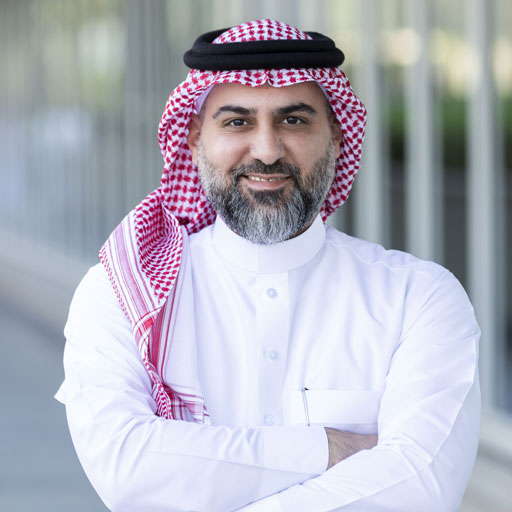
Husain Alhaboubi is Director of Digital Channels at Mobily, where he leads platform optimization, AI-powered customer engagement, and UI/UX strategy. With 20+ years of experience spanning eCommerce, IT infrastructure, and digital marketing, he previously drove a 225% revenue increase and 69% organic traffic growth as eCommerce Senior Manager at flyadeal, and managed enterprise IT operations — including data centers, ERP systems, and network security — as Group IT Manager at IPD Group.
Husain holds a BS in Information Systems from the University of Texas at Arlington and is certified in Google Ads, Google Analytics, and Semrush SEO. He writes from hands-on experience across both sides of digital business: the strategic (eCommerce, SEO, AI, digital transformation) and the technical (server administration, cloud computing, web development, networking, and security) — with a particular focus on the Saudi market and Vision 2030. Read his full resume →