

Jobs Replaced by AI: The Complete Guide to What’s Changing and How to Adapt in 2026
Artificial intelligence is no longer a futuristic concept — it is actively reshaping the global workforce right now. If you have been wondering which jobs replaced by AI are already disappearing and which ones could be next, you are not alone.
According to the World Economic Forum’s Future of Jobs Report 2025, automation and AI are projected to displace 92 million jobs globally by 2030, while simultaneously creating 170 million new roles — a net gain of 78 million positions. But behind that optimistic net number, millions of workers face real disruption.
In this comprehensive guide, I break down the latest data on jobs replaced by AI, identify the most at-risk industries and roles, and share practical strategies to future-proof your career in the age of AI.
Table of Contents
Jobs Replaced by AI: The Key Statistics You Need to Know in 2026
Before diving into specific roles and industries, it is important to understand the scale of what is happening. The data on jobs replaced by AI paints a picture that is both alarming and nuanced. Here are the most important numbers from authoritative sources:
| Statistic | Source | Year |
|---|---|---|
| 92 million jobs displaced globally by 2030, offset by 170 million new roles (net gain of 78 million) | World Economic Forum, Future of Jobs Report 2025 | 2025 |
| 37% of companies expect to have jobs replaced by AI by end of 2026 | Resume.org survey of 1,000 U.S. companies | 2025 |
| 11.7% of the U.S. workforce can already be replaced by current AI systems | MIT Iceberg Index Study | 2025 |
| Nearly 55,000 U.S. job cuts directly attributed to AI in 2025 | Challenger, Gray & Christmas | 2025 |
| Computer programmers face 75% task coverage by AI | Anthropic Economic Index, March 2026 | 2026 |
| 41% of employers plan to reduce workforce — more jobs replaced by AI each quarter | World Economic Forum | 2025 |
| Workers with AI skills earn up to 56% more than peers in identical roles | PwC 2025 Global AI Jobs Barometer | 2025 |
| 300 million full-time jobs globally could be impacted by generative AI | Goldman Sachs | 2023 |
These statistics reveal an important pattern: the trend of jobs replaced by AI is not simply about eliminating positions in a vacuum. It is reshaping the entire labor market, creating new opportunities while displacing old ones.
The challenge is that the displacement is happening faster than many workers can adapt. The new roles being created often require skills that the displaced workers do not yet have, which makes proactive upskilling more critical than ever.
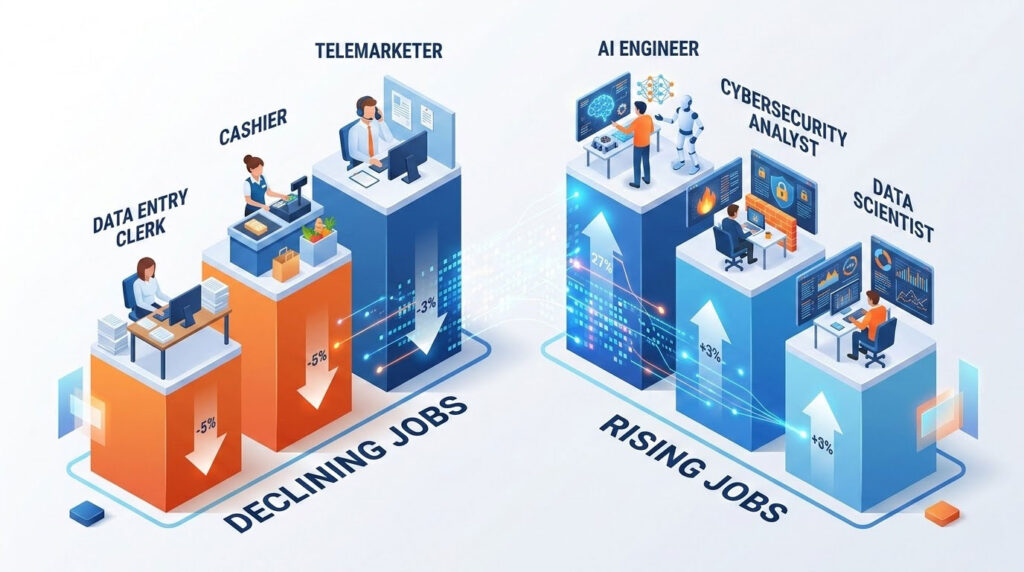
How AI Actually Replaces Jobs: The Mechanism Behind Automation
Understanding how AI displaces workers is essential to figuring out whether your role is at risk. AI does not typically eliminate an entire job overnight. Instead, it follows a predictable pattern that I call the “task erosion” model.
First, AI automates the most repetitive and structured tasks within a role — think data entry, basic research, or scheduling. Then, as the technology improves, it takes over more complex tasks such as analysis, content generation, and even decision-making support.
Eventually, the role itself shrinks to the point where one human can do what previously required a team, or the role disappears entirely. This is the fundamental mechanism behind jobs replaced by AI across every industry.
A landmark study published by Anthropic in March 2026 introduced a new measurement called “observed exposure,” which separates what AI could theoretically do from what it is actually doing in professional settings today. The researchers found that while 94% of tasks in computer and math occupations are theoretically automatable, actual AI coverage currently sits at around 33%.
This gap is both reassuring — the disruption has not fully arrived — and alarming, because it suggests massive displacement potential still lies ahead. The Anthropic study also raised the possibility of what they describe as a scenario comparable to a major economic downturn, but specifically concentrated among white-collar workers.
During the 2007–2009 financial crisis, U.S. unemployment doubled from 5% to 10%. A comparable doubling among the most AI-exposed occupations — from 3% to 6% — would be clearly detectable and could unfold as more jobs replaced by AI accumulate across sectors. It has not happened yet, but the researchers emphasize it absolutely could.
Task Automation vs. Job Automation
This distinction is crucial. According to McKinsey’s research, approximately 25% of current work tasks globally could be automated with existing technology. But that does not mean 25% of jobs will vanish.
Many roles will simply change — some tasks will be handled by AI while the human focuses on higher-value work like strategy, creativity, and relationship building. The real danger zone for jobs replaced by AI is roles where most tasks are repetitive and rule-based, leaving little room for uniquely human contributions.

Industries Most Affected: Jobs Replaced by AI Across Sectors
Not every industry faces the same level of risk from jobs replaced by AI. Some sectors are already deep into the transformation, while others are only beginning to feel the impact. Based on recent reports from the WEF, Goldman Sachs, PwC, and Anthropic, here is how the disruption breaks down by industry.
Technology and Software
Ironically, the industry building AI is also among the most disrupted by it. In the first seven months of 2025, the tech sector reported 89,251 job cuts — a 36% increase from the same period in 2024. Hiring in tech declined by 58% year-over-year, with only 5,510 new positions announced in 2025 compared to 13,263 the previous year.
Anthropic’s 2026 research found that computer programmers face the highest task coverage by AI at 75%, followed by customer service representatives at 70.1%. Software developers aged 22–25 experienced a nearly 20% decline in employment compared to their late-2022 peak. Among all jobs replaced by AI, routine programming roles are being hit the hardest and earliest.
If you are building AI-powered tools, like those used in autonomous AI agents, you are in a growing field. But if your role involves routine coding without strategic or architectural depth, the outlook is far more uncertain.
Finance and Banking
The financial sector is one of the earliest and heaviest adopters of AI automation. Goldman Sachs estimates that 46% of administrative tasks in finance are automatable by AI. Wall Street banks are planning to eliminate approximately 200,000 positions over the next three to five years, primarily in entry-level and back-office roles.
Bank teller employment is projected to decline by 15% between 2023 and 2033, eliminating roughly 51,400 positions in the U.S. alone. AI is already handling fraud detection, risk assessment, loan underwriting, and algorithmic trading. Banking represents one of the clearest examples of jobs replaced by AI at scale, with banks collectively expecting pretax profits to rise by 12% to 17% by 2027 — much of it from labor savings.
Retail and E-commerce
The retail industry faces significant automation pressure. According to WEF data, 65% of retail tasks are exposed to AI. Self-checkout and computer-vision systems are advancing rapidly, with AI-powered checkout expected to reach 25% adoption by 2026–2028.
Cashier employment in the U.S. is projected to decline by 11%, a reduction of approximately 353,100 jobs replaced by AI and automation by 2033. Major retailers are already leading this shift — large chains are rolling out AI verification systems that could eliminate thousands of checkout positions. For those in the Saudi e-commerce market, understanding how AI agents are transforming e-commerce operations is essential for staying ahead of this curve.
Healthcare
Healthcare presents a mixed picture when it comes to jobs replaced by AI. Medical transcription is already 99% automated, and 40% of medical coding was projected to be automated by 2025. Employment of medical transcriptionists in the U.S. is expected to decline by 4.7% from 2023 to 2033.
Radiology technicians performing routine scans face displacement risk by 2030 as AI diagnostic tools improve. However, front-line clinical roles — nurses, therapists, surgeons — remain highly resilient. Nurse practitioners, for example, are projected to grow by 52% from 2023 to 2033. AI in healthcare is augmenting human capabilities rather than replacing them for most patient-facing roles.
Legal Services
The legal profession is undergoing rapid AI transformation, with many support jobs replaced by AI tools that can review contracts and research precedents in seconds. Goldman Sachs estimated that 44% of legal tasks are automatable.
Paralegals face an 80% risk of automation by 2026, and legal researchers face a 65% risk by 2027. AI platforms are now performing contract review, precedent research, and document analysis at a fraction of the cost and time of human legal professionals. Senior attorneys focused on strategy, litigation, and client relationships remain essential, but support roles are shrinking fast.
Manufacturing and Logistics
Manufacturing has been dealing with automation for decades, but AI is accelerating the pace. Research from MIT and Boston University indicates that AI-driven robotics will replace approximately 2 million manufacturing workers globally by 2026. Oxford Economics predicts up to 20 million manufacturing jobs replaced by AI and robotics by 2030.
Assembly line roles could shrink from 2.1 million to 1.0 million, machine operators from 1.8 million to 0.9 million, and packaging workers from 890,000 to 320,000. The United States alone has lost approximately 1.7 million manufacturing jobs to automation since 2000. For those interested in how AI robotics is specifically transforming logistics in the Middle East, I have covered this in depth in my post on AI robotics in Saudi e-commerce.
Media, Marketing, and Content Creation
Content creation is one of the fastest-changing fields due to generative AI. Writing and editing are among the most visible jobs replaced by AI in the media industry. Positions for digital marketing content writers are projected to decline by 50% by 2030, and reporter and writer positions are expected to shrink by 30% over the same period.
A survey found that 81.6% of digital marketers already fear being replaced by AI. AI tools can now generate blog posts, social media content, ad copy, email campaigns, and even video scripts at scale. However, strategic content planning, brand voice development, and AI content strategy require human creativity and judgment that remain difficult to automate.
Specific Jobs Replaced by AI: A Role-by-Role Breakdown
Moving beyond industries, let me drill down into the specific roles that face the highest displacement risk. This table summarizes the most at-risk jobs replaced by AI based on data from Anthropic, the WEF, Goldman Sachs, the Bureau of Labor Statistics, and other authoritative sources.
| Job Role | Automation Risk | Key Driver | Timeline |
|---|---|---|---|
| Data Entry Clerks | 95% | OCR, automated data pipelines, ML processing | Already underway |
| Customer Service Representatives | 70–80% | AI chatbots, NLP, automated ticketing | 2025–2027 |
| Computer Programmers (routine coding) | 75% task coverage | AI code generation tools (Copilot, Claude Code) | 2025–2028 |
| Telemarketers | 90%+ | AI voice agents, predictive dialing | Already underway |
| Paralegals | 80% | AI contract review, legal research tools | 2025–2026 |
| Bank Tellers | High (15% BLS decline) | Digital banking, mobile apps, AI assistants | 2023–2033 |
| Retail Cashiers | 65% | Self-checkout, computer vision, cashierless stores | 2025–2028 |
| Medical Transcriptionists | 99% | Speech recognition AI, NLP | Already automated |
| Bookkeepers & Accounting Clerks | High | AI accounting platforms, automated reconciliation | 2025–2028 |
| Market Research Analysts (entry-level) | 53% task automatable | AI data analysis, survey automation | 2025–2028 |
| Translators & Interpreters | High | Neural machine translation (DeepL, Google Translate) | 2025–2030 |
| Content Writers (generic) | 50% decline by 2030 | Generative AI (ChatGPT, Claude, Gemini) | 2025–2030 |
| Manufacturing Assembly Workers | High | AI-driven robotics, computer vision | 2025–2030 |
| Sales Representatives (entry-level) | 67% task automatable | AI CRM, automated outreach, chatbots | 2025–2028 |
What stands out from this list of jobs replaced by AI is that the highest-risk roles share common characteristics: they involve structured and repetitive tasks, rely heavily on data processing, and require limited creative or emotional intelligence.
If your daily work involves tasks that follow predictable patterns and rules, your role is likely in the crosshairs. The more routine your responsibilities, the more vulnerable you are to having your job replaced by AI in the coming years.
The Other Side: New Jobs Created by AI
The narrative around jobs replaced by AI is incomplete without discussing the new opportunities emerging. AI is not just a destroyer of jobs — it is also the most powerful job creation engine of our generation.
According to LinkedIn data published by the WEF in January 2026, AI has already created 1.3 million new roles including AI Engineers, Forward-Deployed Engineers, and Data Annotators, along with more than 600,000 new AI-enabled data center jobs.
The median annual salary for AI roles in the U.S. reached $156,998 in Q1 2025, with AI-related job postings growing 25.2% year-over-year. Employer job postings related to AI skills jumped 117% between 2024 and 2025. Here are the fastest-growing roles being created even as other jobs replaced by AI continue to decline:
| Emerging Role | Description | Growth Outlook |
|---|---|---|
| AI/Machine Learning Engineer | Design and deploy AI models and systems | One of the fastest-growing roles on LinkedIn over the past three years |
| Data Scientist | Analyze and interpret complex data for business decisions | 36% projected growth 2023–2033 (BLS) |
| Prompt Engineer | Optimize AI model interactions for quality outputs | Job postings surged 100x since 2022 |
| AI Ethics & Compliance Specialist | Ensure responsible AI use, manage bias, and meet regulatory requirements | Rapidly emerging as EU AI Act and global regulations expand |
| Cybersecurity Analyst | Protect digital systems against increasingly AI-powered threats | 33% projected growth 2023–2033 (BLS) |
| AI Product Manager | Define AI product roadmaps and bridge technology with business strategy | High demand as AI moves into core business operations |
| AI Operations (MLOps) Specialist | Deploy, monitor, and maintain AI systems in production | Over 60% of enterprise AI initiatives fail without this role |
| Renewable Energy Technician | Install and maintain solar, wind, and other renewable energy systems | Solar installers: 22% growth; Wind technicians: 44% growth (BLS) |
The key takeaway is that the best AI models and agents are tools that need human oversight, strategy, and governance. The workers who thrive will be those who learn to work with AI, not compete against it.
Jobs Replaced by AI in Saudi Arabia: What Vision 2030 Means for Your Career
Saudi Arabia is not a passive bystander in the global AI revolution — it is one of its most aggressive drivers. Understanding how jobs replaced by AI will reshape the Kingdom’s labor market is essential for any professional working in or targeting the Saudi market.
The Kingdom has committed unprecedented resources to AI. In late 2024, Saudi Arabia announced Project Transcendence, a $100 billion AI initiative aimed at turning the country into a global AI powerhouse. In May 2025, the Public Investment Fund (PIF) launched HUMAIN, a government-owned company focused on accelerating AI adoption across strategic sectors including energy, healthcare, industry, and financial services. The Saudi Data and AI Authority (SDAIA) oversees the national AI strategy, and 70% of Vision 2030’s strategic goals directly involve data and AI.
The Scale of AI Adoption in Saudi Arabia
According to data from Microsoft’s AI Tour Riyadh in November 2025, 81% of enterprises in Saudi Arabia are already deploying AI solutions tailored to their industries. An additional 96% plan to invest in data consolidation and quality improvement programs within the next 12 months. Over half (51%) of Saudi enterprises expect significant returns from AI investments within one to two years.
Generative AI alone could contribute up to SAR 60–90 billion (approximately $16–24 billion) to Saudi Arabia’s GDP by 2030, according to an Oliver Wyman report. This massive investment means that jobs replaced by AI in the Kingdom will follow a different pattern than in Western economies — the government is simultaneously creating demand for AI-skilled workers while automating traditional roles.
Which Saudi Jobs Are Most at Risk?
The sectors facing the highest automation risk in Saudi Arabia mirror global trends but have unique local dynamics. Routine administrative and data entry roles — particularly those historically filled by expatriate workers — are among the first jobs replaced by AI. AI-powered recruitment platforms are already transforming hiring processes across the Kingdom, with automated resume screening reducing time-to-hire by up to 60%.
Key sectors facing disruption in Saudi Arabia include banking and financial services (where AI handles fraud detection, credit scoring, and customer service), retail and e-commerce (with quick commerce and automated fulfillment expanding rapidly), government administration (where AI tools like the GCA’s Internal Assistant are automating audit and compliance tasks), and customer service roles across telecom, hospitality, and utilities.
Saudization Meets AI: A Unique Challenge
Saudi Arabia faces a unique intersection that no other major economy deals with in the same way: the push for Saudization (increasing the share of Saudi nationals in the private sector workforce) is happening simultaneously with AI-driven automation. This creates both opportunity and tension.
On one hand, the unemployment rate for Saudi nationals dropped to 6.3% in Q1 2025, beating Vision 2030’s original 7% target six years early. The PIF alone has created 400,000 jobs over the past five years and plans to generate another 1.8 million in the next five. On the other hand, there is a 20% shortfall between tech job vacancies and qualified local talent, with AI engineers, cloud architects, and data analysts in critically short supply.
This means that while some traditional jobs replaced by AI are disappearing in Saudi Arabia, the Kingdom simultaneously has a massive unmet demand for AI-skilled workers. Microsoft announced an ambition to help 3 million people in Saudi Arabia acquire AI skills by 2030. Fresh graduates in the private sector have seen incomes grow by 30% in a single year, with some professionals receiving offers 60% above current salaries — driven largely by this skills gap.
Opportunities for Saudi Professionals
For Saudi professionals, the message is clear: the jobs replaced by AI in the Kingdom are overwhelmingly routine and administrative roles. Meanwhile, the opportunities being created are significant. AI job postings in Saudi Arabia grew by 54% annually from 2018 to 2022, and AI-related graduation rates rose 42% in 2023. AI engineer hiring specifically increased 26% year-over-year in 2024–2025.
The Kingdom is investing in infrastructure through SDAIA, HUMAIN, and partnerships with global tech companies. Saudi Arabia has also launched the sovereign AI initiative to develop Arabic large language models and domestic AI capabilities. For professionals in Saudi Arabia — whether Saudi nationals or expatriates — developing AI fluency, pursuing certifications in high-demand fields like cybersecurity and data science, and aligning with Vision 2030 priorities is the clearest path to career security.
Who Is Most Vulnerable When Jobs Are Replaced by AI?
The wave of jobs replaced by AI does not affect everyone equally. Research reveals clear demographic patterns in who faces the greatest risk of displacement.
Young Workers and Entry-Level Employees
Young workers are disproportionately affected by jobs replaced by AI. Software developers aged 22–25 experienced a nearly 20% decline in employment compared to their late-2022 peak. Anthropic’s 2026 research found suggestive evidence that hiring of younger workers has slowed specifically in AI-exposed occupations.
Bloomberg found that AI could replace more than 50% of tasks performed by entry-level market research analysts and 67% of tasks for entry-level sales representatives, compared to just 9% and 21% for their managerial counterparts. Anthropic CEO Dario Amodei has warned that AI could eliminate up to half of entry-level white-collar jobs within five years.
Women in the Workforce
Women face significantly higher automation exposure. In the U.S., 79% of employed women hold positions at high risk of automation, compared to 58% of men. The clerical and administrative occupations most at risk are 86% female.
In high-income countries, jobs replaced by AI-driven task automation make up 9.6% of female employment — nearly three times the proportion for male employment at 3.2%. Women are also underrepresented in AI and STEM fields, limiting their access to the new high-paying tech roles being created.
Developing vs. Developed Economies
Generative AI exposure varies dramatically by income level. In high-income countries, 34% of jobs have significant exposure to generative AI, compared to just 11% in low-income countries. North America is expected to lead automation adoption at 70% in 2025.
However, emerging markets like India (+40% hiring growth) and the UAE (+37%) are showing continued workforce momentum. This suggests that jobs replaced by AI in developed economies do not necessarily translate to the same pattern in emerging markets — at least not yet.

How to Future-Proof Your Career as Jobs Are Replaced by AI
Knowing which jobs replaced by AI are at risk is only half the battle. The more important question is: what can you do about it? Based on the latest research and my experience in the technology and digital marketing space, here is a practical framework for future-proofing your career.
1. Develop AI Fluency (Not Necessarily AI Expertise)
You do not need to become a machine learning engineer to stay relevant. But you absolutely need to understand how AI tools work, what they can do for you, and when to rely on your own judgment instead.
AI fluency is the modern equivalent of computer literacy in the early 2000s. Start by learning how to use AI tools like AI prompt builders effectively, understand how AI integrations work within your existing software, and practice crafting prompts that produce useful outputs. According to PwC, workers with AI skills command salaries up to 56% higher than peers in identical roles without those skills.
2. Invest in Human-Centric Skills
The World Economic Forum’s Future of Jobs Report identifies the top skills on the rise: creative thinking, resilience and flexibility, curiosity and lifelong learning, leadership and social influence, and analytical thinking.
These are all inherently human capabilities that AI struggles to replicate. Focus on developing empathy, strategic thinking, complex problem-solving, and your ability to navigate ambiguity. As more jobs replaced by AI automation disappear, these skills will become more valuable, not less.
3. Pursue Continuous Upskilling and Reskilling
The WEF reports that 39% of key skills required in the job market will change by 2030. That means nearly half of what you know today may become outdated within five years.
Commit to structured learning — whether through certifications in data analytics, cybersecurity, cloud computing, or AI tools. LinkedIn Learning, Google Certifications, and university bootcamps are all accessible options. Employers are already prioritizing this — 85% of companies surveyed by the WEF plan to offer upskilling programs, and 77% will provide specific AI training.
4. Move Toward Strategic, Creative, and Interpersonal Roles
If your current role is heavy on execution and light on strategy, consider pivoting. AI excels at executing well-defined tasks, but it struggles with framing problems, setting priorities, and navigating human relationships.
Roles that combine technical knowledge with business understanding — such as AI product managers, solutions architects, or digital strategy consultants — are among the most in-demand and hardest to automate. This is particularly true in industries going through digital transformation, where leadership and strategic vision are essential. These are not the jobs replaced by AI — they are the jobs created by AI.
5. Build Deep Domain Expertise
AI is a generalist tool. It can write decent code, generate passable marketing copy, and summarize legal documents. But it lacks the deep, contextual understanding that comes from years of experience in a specific domain.
A cybersecurity expert who understands the unique threat landscape of Saudi financial institutions, a supply chain specialist who knows the regulatory nuances of Middle Eastern logistics, or a healthcare professional who can navigate complex patient relationships — these people are far harder to replace than a generalist data analyst. Domain expertise combined with AI fluency is the ultimate career moat against having your job replaced by AI.
Jobs AI Cannot Replace: Roles That Remain Safe
While the discussion around jobs replaced by AI can feel overwhelming, there are entire categories of work that remain highly resilient to automation. According to research from McKinsey, the BLS, and the WEF, these roles share key traits: they require managing people, exercising complex judgment, performing unpredictable physical work, or building deep human relationships.
| AI-Resilient Category | Example Roles | Why AI Cannot Replace Them |
|---|---|---|
| Healthcare (Clinical) | Nurses, surgeons, therapists, nurse practitioners | Requires empathy, physical assessment, ethical judgment, and complex decision-making |
| Skilled Trades | Electricians, plumbers, HVAC technicians | Unpredictable physical environments, hands-on problem-solving, no two jobs alike |
| Senior Leadership | CEOs, VPs, strategic consultants | High-level decision-making, relationship building, organizational vision |
| Creative Arts | Directors, fine artists, musicians, novelists | Original creativity, cultural context, emotional authenticity |
| Mental Health | Psychologists, counselors, social workers | Deep emotional intelligence, trust-building, nuanced human understanding |
| Education | Teachers, professors, academic mentors | Mentorship, motivation, adapting to individual learner needs |
| Emergency Services | Firefighters, EMTs, police officers | Split-second physical judgment, unpredictable crisis response |
Anthropic’s 2026 research confirmed this divide: occupations with 0% AI task coverage included cooks, motorcycle mechanics, lifeguards, bartenders, dishwashers, and dressing room attendants. These roles are fundamentally physical, interpersonal, or require real-time situational awareness — making them the opposite of jobs replaced by AI.
Common Mistakes People Make About Jobs Replaced by AI
As someone who works closely with AI and digital technology, I have observed several recurring mistakes that people make when they hear about jobs replaced by AI. Avoiding these can significantly improve your career trajectory.
Mistake 1: Ignoring the Threat Entirely
The “it will not happen to me” mindset is the most dangerous. AI adoption is accelerating across every industry, and 86% of employers expect AI and big data analytics to drive transformation in their businesses. Burying your head in the sand is not a strategy when jobs replaced by AI are increasing every quarter.
Mistake 2: Panic-Switching Careers Without a Plan
On the other end, some people react to AI anxiety by abandoning their field entirely without doing proper research. The reality is that most roles will not disappear overnight.
You likely have time to upskill within your current field before considering a complete pivot. A strategic, phased approach is much more effective than a panicked leap into an unfamiliar industry.
Mistake 3: Learning Only AI Tools Without Building Foundational Skills
Knowing how to use ChatGPT or Midjourney is useful, but it is not a career moat. AI tools change rapidly — what is cutting-edge today may be obsolete in a year.
Instead, focus on building foundational skills like analytical thinking, data literacy, and strategic communication. These transferable skills will remain valuable regardless of which specific tools dominate the market — and they are exactly what separates you from the jobs replaced by AI.
Mistake 4: Assuming AI Outputs Are Always Accurate
AI systems can hallucinate facts, generate biased outputs, and produce plausible-sounding but incorrect information. Professionals who can critically evaluate AI outputs, catch errors, and add the human judgment layer will be more valuable than ever.
This is why Gartner predicts that by 2026, 50% of organizations will require AI-free skills assessments to combat the atrophy of critical thinking.
Mistake 5: Overlooking Soft Skills in Favor of Technical Skills Alone
The most valuable professionals in 2026 and beyond will combine technical AI fluency with distinctly human capabilities — empathy, leadership, adaptability, and collaboration.
Companies are not just looking for people who can operate AI systems. They need people who can manage teams through transition, communicate complex changes to stakeholders, and make ethical decisions in ambiguous situations. These human strengths are the best defense in an era of jobs replaced by AI.
FAQ: Jobs Replaced by AI
How many jobs will be replaced by AI by 2030?
According to the World Economic Forum’s Future of Jobs Report 2025, AI and automation are projected to displace approximately 92 million jobs globally by 2030. However, the same report forecasts the creation of 170 million new roles, resulting in a net gain of 78 million positions. The number of jobs replaced by AI will vary significantly by industry, geography, and skill level.
Which specific jobs are most at risk of being replaced by AI?
The most at-risk roles include data entry clerks, telemarketers, customer service representatives, paralegals, bank tellers, retail cashiers, medical transcriptionists, bookkeepers, entry-level market research analysts, and routine software programmers. These jobs replaced by AI share a common trait: they involve structured, repetitive tasks that AI can perform faster and cheaper.
Will programming jobs be replaced by AI?
AI is unlikely to fully replace experienced software developers, but it is already transforming the role. Anthropic’s March 2026 study found that computer programming has 75% task coverage by AI — the highest of any occupation measured.
Routine coding tasks are increasingly automated by tools like GitHub Copilot and Claude Code. However, senior roles involving architecture, system design, and strategic technical decision-making remain essential and are growing. These higher-level programming roles are not among the jobs replaced by AI.
Can creative jobs like writing and design be replaced by AI?
AI is already automating generic content creation — blog posts, social media captions, ad copy, and basic graphic design. Content writer positions are projected to decline by 50% by 2030.
However, high-level creative work that requires originality, cultural context, brand voice, and emotional authenticity remains difficult for AI to replicate. Writers who develop strategic content expertise and AI-assisted workflows will thrive rather than be among the jobs replaced by AI.
How can I protect my job from being replaced by AI?
Focus on five key areas: develop AI fluency so you can work with AI tools effectively, invest in human-centric skills like creative thinking and leadership, pursue continuous upskilling in high-demand areas such as data analytics or cybersecurity, move toward strategic roles that require judgment and relationship management, and build deep domain expertise in your industry.
Workers with AI skills earn up to 56% more than peers in identical roles, according to PwC. Those who proactively adapt are far less likely to see their jobs replaced by AI.
Are women more affected when jobs are replaced by AI?
Yes. Research shows that 79% of employed women in the U.S. hold positions at high risk of automation, compared to 58% of men. The clerical and administrative occupations most at risk are 86% female.
In high-income countries, jobs most vulnerable to AI-driven task automation represent 9.6% of female employment, nearly three times the male proportion at 3.2%. Closing this gap requires targeted reskilling initiatives and greater representation of women in AI and STEM fields.
Is AI creating more jobs than it is replacing?
Current projections suggest yes — in the long term. The WEF forecasts a net gain of 78 million jobs by 2030. LinkedIn data shows AI has already created 1.3 million new roles.
However, the transition is painful for many workers because the new jobs require different skills than the ones being displaced. Workers who lose their roles in data entry or customer service may not have the skills to immediately step into AI engineering or cybersecurity without significant retraining. The jobs replaced by AI and the jobs created by AI require fundamentally different skill sets.
Which industries are safest from having jobs replaced by AI?
Industries requiring hands-on physical work, deep human interaction, or unpredictable decision-making are most resilient. These include skilled trades (electricians, plumbers), healthcare (clinical roles), education, emergency services, creative arts, and senior leadership.
Construction and skilled trade roles face minimal automation risk and continue to see strong demand, with over 663,000 annual openings projected in U.S. construction and extraction fields through 2033.
How will jobs replaced by AI affect Saudi Arabia specifically?
Saudi Arabia faces a unique situation. The Kingdom is investing over $100 billion in AI through Project Transcendence, and 81% of Saudi enterprises are already deploying AI solutions. Routine administrative and customer service roles are among the jobs replaced by AI in the Kingdom. However, Saudi Arabia’s unemployment rate has already beaten Vision 2030 targets, and there is a significant skills gap — AI engineers, cloud architects, and data analysts are in critically short supply.
For Saudi professionals, this means the biggest risk is not AI taking your job, but failing to develop the AI skills that the market desperately needs. Microsoft plans to help 3 million Saudis acquire AI skills by 2030, and fresh graduates with tech skills are seeing 30% salary increases. The opportunity far outweighs the threat — if you invest in the right skills now.
Conclusion: Preparing for a World Where Jobs Are Replaced by AI
The reality of jobs replaced by AI is neither the apocalyptic scenario some fear nor the harmless evolution others hope for. It sits somewhere in the middle — a profound transformation that will displace millions of roles while simultaneously creating millions of new ones.
The data is clear: 92 million jobs displaced, 170 million created, a net gain of 78 million. But those net numbers mask real human disruption for the workers caught in the transition.
The single most important thing you can do right now is to stop being a passive observer and start actively preparing. Develop AI fluency, invest in uniquely human skills, pursue continuous learning, and position yourself in roles that complement AI rather than compete with it.
The professionals who adapt — combining technical literacy with creative thinking, domain expertise, and leadership — will not just survive the wave of jobs replaced by AI. They will thrive in it.
Whether you are a recent graduate entering the workforce, a mid-career professional feeling the pressure, or a business leader navigating digital transformation, the time to act is now. The AI wave is not coming — it is already here. Your competitive advantage lies in how quickly and strategically you ride it.
Related reading:
- The Ultimate Guide to Autonomous AI Agents
- AI Content Strategy: Proven Playbook to Skyrocket Ranking
- Best AI Models and Agents in 2026: Hands-On Pricing, Pros, Cons, and Comparison
- AI Agents for eCommerce: Automate Inventory, Customer Service, and Pricing in 2026
- 5 Keys to Leadership in Digital Transformation
Sources: World Economic Forum Future of Jobs Report 2025, Anthropic “Labor market impacts of AI” (March 2026), PwC 2025 Global AI Jobs Barometer, MIT Iceberg Index Study (November 2025), Goldman Sachs AI Economic Impact Report, McKinsey Global Institute, U.S. Bureau of Labor Statistics, Resume.org September 2025 Survey, Challenger Gray & Christmas 2025 Layoff Report, LinkedIn Work Change Report 2026, National University AI Job Statistics (May 2025).

Husain Alhaboubi is Director of Digital Channels at Mobily, where he leads platform optimization, AI-powered customer engagement, and UI/UX strategy. With 20+ years of experience spanning eCommerce, IT infrastructure, and digital marketing, he previously drove a 225% revenue increase and 69% organic traffic growth as eCommerce Senior Manager at flyadeal, and managed enterprise IT operations — including data centers, ERP systems, and network security — as Group IT Manager at IPD Group.
Husain holds a BS in Information Systems from the University of Texas at Arlington and is certified in Google Ads, Google Analytics, and Semrush SEO. He writes from hands-on experience across both sides of digital business: the strategic (eCommerce, SEO, AI, digital transformation) and the technical (server administration, cloud computing, web development, networking, and security) — with a particular focus on the Saudi market and Vision 2030. Read his full resume →