
Paid Media Advertising in 2026: Every Platform, Ad Type, and How to Optimize
Paid media advertising in 2026 is no longer a collection of separate ad accounts you log into one at a time. It has become a single, interconnected discipline where a shopper might discover your brand in a TikTok video, research it inside an AI assistant, see a retargeting ad on Instagram, and finally convert through a Google search — all in the same afternoon. If you still treat each platform as its own silo, you are almost certainly paying more for worse results.
I have spent years running campaigns across nearly every major ad platform, and the biggest shift I have seen is this: every platform is racing to automate targeting and creative with AI, while the ad formats themselves are converging on the same handful of shapes — short vertical video, shoppable product feeds, and native in-feed units. This guide breaks down every major paid media platform, the exact ad types each one offers, how to use them, and how to optimize them so your budget actually compounds. Whether you run a lean ecommerce store or manage a multi-market budget, understanding the full paid media landscape is what separates advertisers who scale from those who quietly burn cash.
Table of Contents
What Paid Media Advertising Actually Means Today
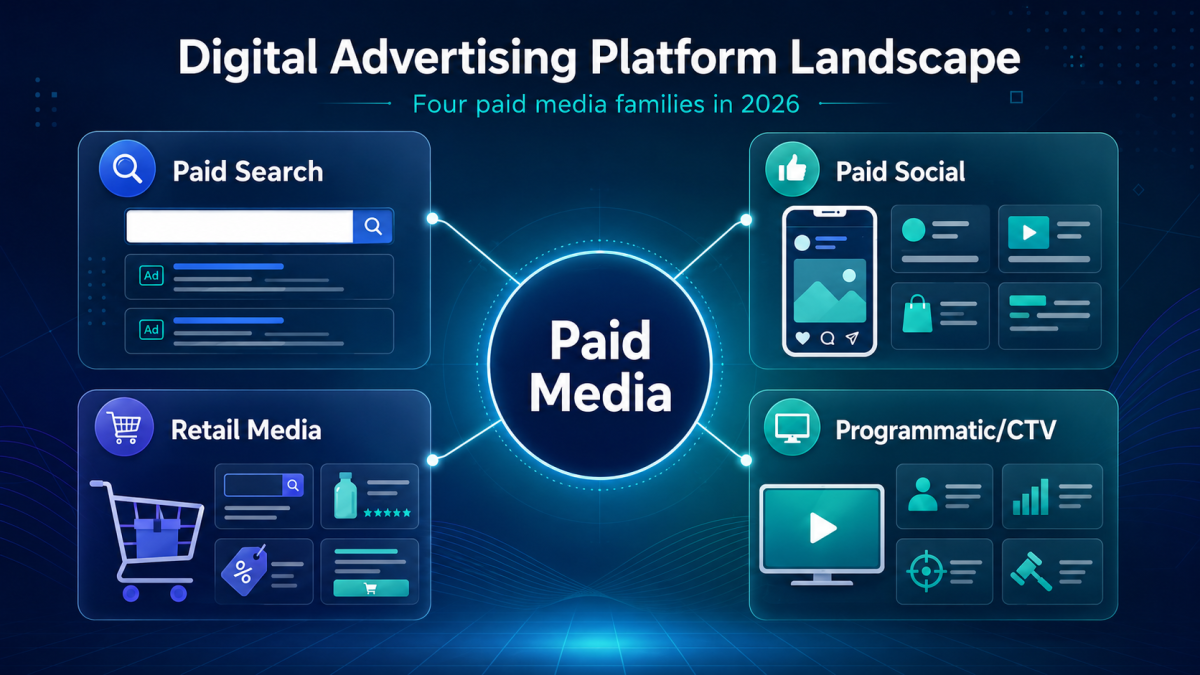
Paid media is any digital advertising you pay to place — as opposed to owned media (your website, app, email list) or earned media (organic mentions and shares you do not pay for directly). In practice, paid media advertising in 2026 splits into four broad families, and the line between them is blurring fast.
- Paid search: text and shopping ads on Google and Microsoft, now extending into AI answer engines like Copilot.
- Paid social: in-feed, Stories, Reels, and interactive ads on Meta, TikTok, Snapchat, X, Pinterest, Reddit, and LinkedIn.
- Retail media: sponsored product and display ads inside marketplaces like Amazon and Noon, powered by first-party purchase data.
- Programmatic and Connected TV (CTV): display, video, audio, and streaming-TV ads bought through demand-side platforms.
These families no longer sit in neat boxes. Google’s Performance Max spans search, social-style feeds, and video from a single campaign. Amazon and Pinterest are both pushing into CTV. Microsoft is placing ads directly inside Copilot conversations. The practical takeaway is simple: choose your paid media platforms by where your customers actually are and what stage of the journey you are targeting — not by habit or by which account you happen to know best.
How to Choose the Right Paid Media Platform
Before you touch any ad account, map your goal to the funnel. Every paid media platform is strong at a different stage, and matching platform to stage is the single most important decision you will make.
- Bottom of funnel (capture existing demand): Google Search, Microsoft Search, Amazon Sponsored Products. People are actively looking — you meet declared intent.
- Middle of funnel (consideration): Meta, Pinterest, Reddit, LinkedIn, YouTube. People are comparing and researching options.
- Top of funnel (create demand): TikTok, Snapchat, Google Demand Gen, Connected TV. People are not searching yet — you spark interest before it exists.
A healthy paid media mix usually runs all three at once, so the demand you create up-funnel gets captured down-funnel. Then match that mix to three inputs: your audience (B2C versus B2B, age, and market), your creative capacity (can you realistically produce vertical video every week?), and your margins (high-cost search clicks only make sense for high-value conversions). For any of this to be measurable, get conversion tracking right first — a properly configured setup like GA4 ecommerce tracking is the foundation every platform’s AI now depends on to optimize your spend.
Google Ads: Search, Performance Max, and the AI-First Shift
Google Ads remains the largest single destination for paid media budgets, and 2026 brought the biggest campaign-type shake-up in years. Eight campaign types are now active: Search, Performance Max, Shopping, Demand Gen, Display, Video, App, and the newest arrival, AI Max for Search. Two older types — Discovery and Video Action Campaigns — have been fully retired into Demand Gen, and standalone Display campaigns are being migrated into Demand Gen as well, so any new visual campaign should start there rather than in Display.
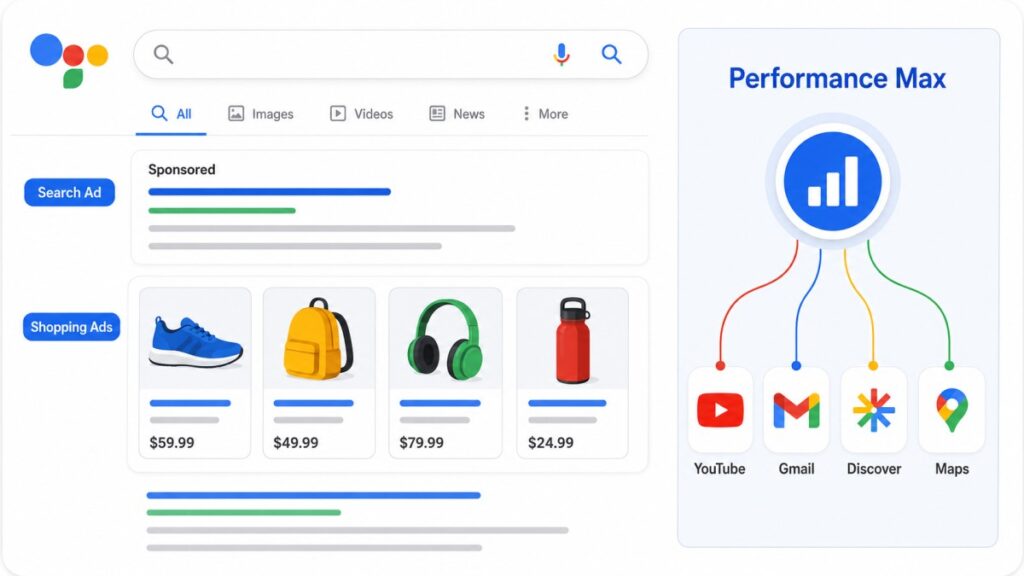
Google Ads campaign types
| Campaign type | What it does | Best for |
|---|---|---|
| Search | Text ads on results for high-intent queries | Capturing active demand |
| Performance Max | AI-run ads across Search, Shopping, YouTube, Gmail, Discover, and Maps from one budget | Ecommerce and full-funnel automation |
| Shopping | Product listings with image, price, and title | Retailers wanting product-level control |
| Demand Gen | Image, video, and carousel ads across YouTube (including Shorts), Discover, and Gmail | Creating demand with visual creative |
| Video | Skippable, non-skippable, bumper, and in-feed ads on YouTube | Awareness and consideration |
| App | Automated install and in-app-action campaigns | App growth |
| AI Max for Search | Opt-in AI layer that matches conversational queries beyond keywords and personalizes assets | Modern, AI-era search coverage |
Two recent changes are worth knowing. Demand Gen added Shoppable Connected TV in early 2026 and is shifting its Lookalike segments to AI-powered audience signals. AI Max for Search exited beta in 2026, and Google is now auto-upgrading legacy Dynamic Search Ads into it — a clear signal of where the platform is heading.
How to optimize Google Ads
Google’s own recommended structure for 2026 pairs three campaign types: Performance Max for broad cross-channel reach, AI Max for Search to capture high-intent queries, and Demand Gen to fill the upper funnel. The practical rules I follow across accounts:
- Nail conversion tracking with the Google tag before you spend — Smart Bidding is only as good as the signals you feed it.
- With Smart Bidding, start on broad match and let the AI find relevant searches; exact-match-only campaigns now limit reach.
- Give strategies like Target CPA or Target ROAS 20–30 conversions in 30 days to learn, and start new campaigns on Maximize Conversions.
- Average cost per click across industries sits around $5.42 in 2026, but Demand Gen runs a fraction of that ($0.30–$1.50), making it a cost-efficient way to prospect new audiences.
Meta Ads: Facebook and Instagram
Meta is still the workhorse of paid social, reaching nearly four billion people across Facebook, Instagram, Messenger, Threads, WhatsApp, and the Audience Network. In 2026, Meta’s advertising runs on its Advantage+ AI system, and the company consolidated several manual controls: the old Flexible Format picker was removed from Ad Setup, Collection moved into Format Display settings, and the Stories and Reels safe zones were unified into a single template.
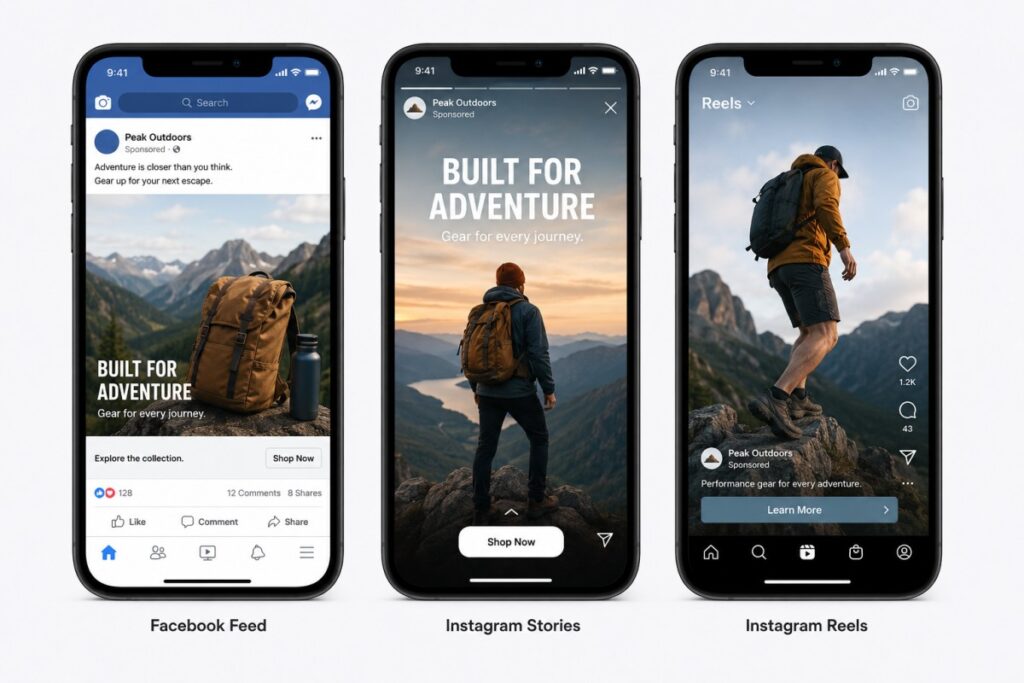
Meta ad formats
| Format | What it is | Best for |
|---|---|---|
| Single image | One static image in feed | Simplest to ship and test; still drives 60–70% of conversions |
| Single video | Sound-off-friendly video | Demos and storytelling |
| Carousel | 2–10 swipeable cards, each with its own link | Product ranges and step-by-step |
| Collection | Hero image or video over a product grid (mobile) | Mobile shopping |
| Reels & Stories | Full-screen 9:16 vertical | Native, high-attention placements |
| Advantage+ catalog (DPA) | Dynamic product ads pulled from your feed | Retargeting and catalog scale |
| Lead ads (Instant Forms) | Native forms inside the app | Lead capture without a landing page |
Placements span Facebook, Instagram, Messenger, Threads, and WhatsApp Status. That last point matters: you can now reach Threads (over 400 million monthly users) and WhatsApp Status (1.5 billion daily users) through the same Ads Manager, extending your paid social reach well beyond the classic feed.
How to optimize Meta campaigns
- Build creative at three ratios — 4:5 (1080×1350) for feed, 9:16 (1080×1920) for Stories and Reels, and 1:1 (1080×1080) for carousel cards — which covers roughly 90% of delivery.
- Design for sound-off (add captions) and hook viewers in the first two to three seconds.
- Install the Conversions API (CAPI) alongside the pixel for durable, privacy-resilient tracking.
- Refresh creative every three to six weeks to fight fatigue, and scale winners by raising budgets 15–20% every three to four days so you do not reset the algorithm’s learning phase.
- Typical costs run $8–$14 CPM and $0.50–$1.50 CPC, higher in finance and B2B.
TikTok Ads
TikTok turned paid social into an entertainment-first channel, and its ad system has matured far beyond simple video boosts. The platform now offers a full spectrum, from self-serve in-feed units any budget can access to premium reservation buys that dominate the app for a day.
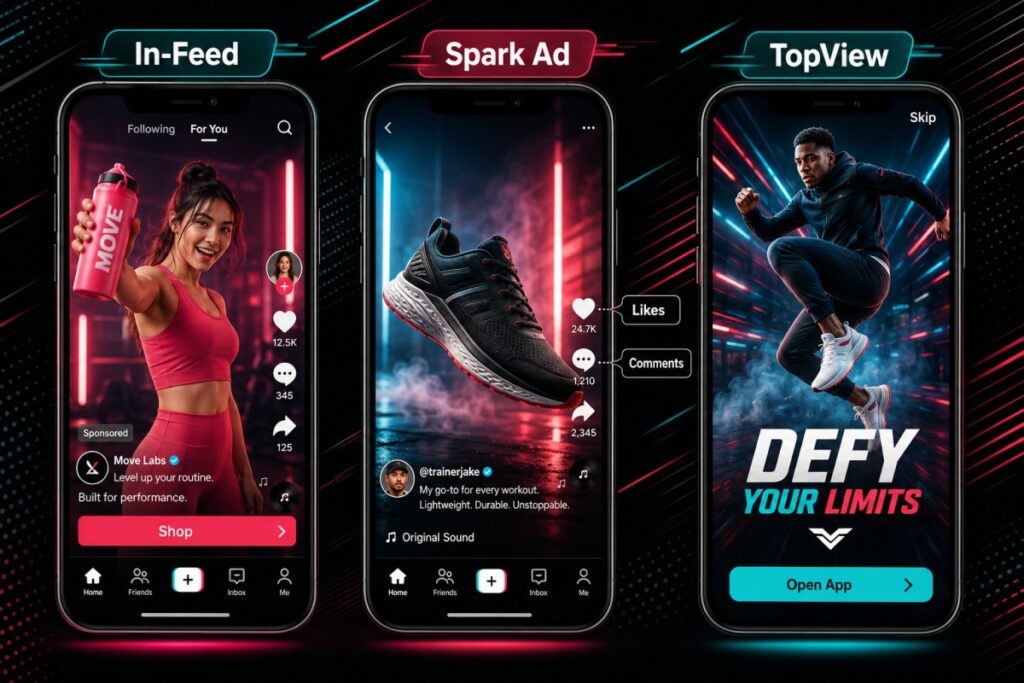
TikTok ad formats
| Format | What it is | Best for |
|---|---|---|
| In-Feed Ads | Native videos in the For You feed (Standard and Top Feed) | Scalable performance; most budgets live here |
| Spark Ads | Promote organic posts (yours or a creator’s) while keeping likes and comments | Highest ROI; built-in social proof |
| TopView | First full-screen ad on app open | Maximum reach and awareness |
| Video Shopping Ads | Shoppable video, catalog listing, and LIVE shopping | Ecommerce with TikTok Shop |
| Carousel / Photo Ads | Image-based in-feed units | Product showcases |
| Playable & interactive ads | Gamified units and interactive add-ons | App installs and engagement |
| Branded Mission / Effects / Hashtag Challenge | Creator-participation and AR campaigns | Large-scale brand moments |
| Search Ads & Smart+ | Search-placement ads and AI-automated campaigns | Intent capture and hands-off scaling |
Spark Ads consistently outperform standard In-Feed ads by 20–40% because they carry proven organic engagement into the paid placement. In-Feed videos now support up to 10 minutes, though 9–15 seconds still performs best. TopView moved to CPM buying in 2026, and Smart+ is TikTok’s new AI automation layer for advertisers who have enough conversion signal to feed it.
How to optimize TikTok campaigns
- Shoot 9:16 vertical (1080×1920), keep files under 500MB, and land your hook in the first 1.5 seconds.
- Start with In-Feed and Spark Ads before touching premium reservation formats — you get roughly 80% of the results at a fraction of the cost.
- Make ads feel like creator content, not polished TV spots; the platform rewards native, fast-cut, sound-on video.
- Turn on Smart+ only once you have clean conversion tracking and a steady flow of creative to test.
X (Twitter) Ads
Every ad on X is fundamentally a Promoted Post — the variation is simply what you embed inside it. With more than 600 million monthly users, X is a real-time, conversation-driven platform where strong copy is native in a way it is not elsewhere; roughly half of all X ads are text-only, and they work.
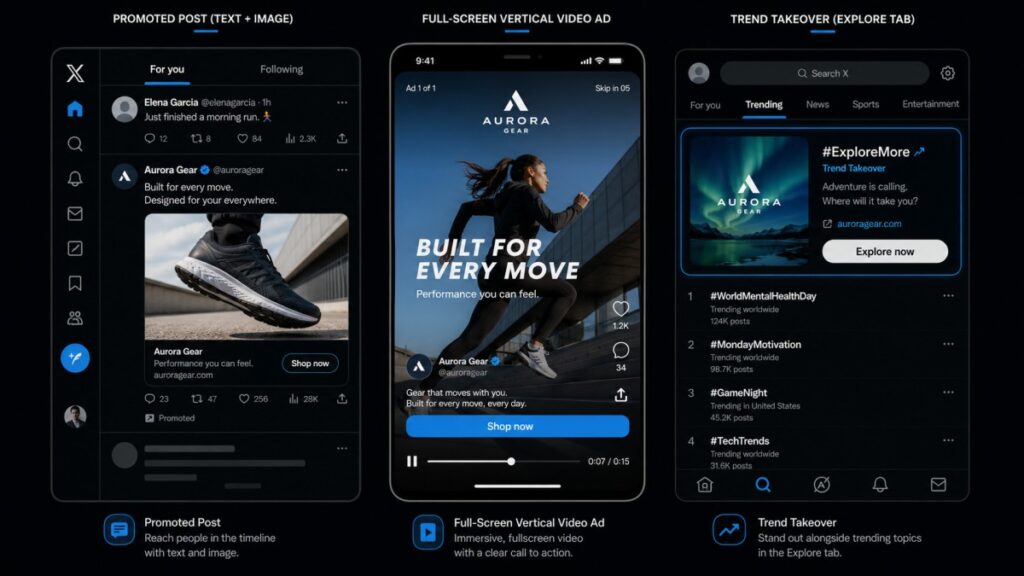
X ad formats
| Format | What it is | Best for |
|---|---|---|
| Promoted Ads | Image, video, carousel, or text posts amplified beyond your followers | Everyday reach and performance |
| Vertical Video Ads | Full-screen, sound-on video in X’s fastest-growing surface | Attention and consideration |
| Amplify | Pre-roll video before premium publisher content (200+ partners) | Brand-safe video adjacency |
| Takeovers | Timeline Takeover (first ad of the day) and Trend/Spotlight Takeover (Explore tab) | Mass-reach brand moments |
| Dynamic Product & Collection Ads | Catalog-driven and multi-product units | Ecommerce conversion |
| Conversational & Live Ads | Reply-driven engagement and livestream promotion | Interaction and real-time events |
In early 2026, X added 4:5 and 2:3 aspect ratios so advertisers can reuse their best-performing creative from other platforms without reformatting. Takeover placements are premium reservation buys, typically starting around $200,000 per day, and are reserved for launches and cultural moments.
How to optimize X campaigns
- Lead with sharp copy — on X, a strong text hook can outperform heavy production.
- Upload native video rather than linking out; native video earns roughly 10x the engagement of external links, and captions matter because most views are sound-off.
- Use X’s pay-for-action auction (clicks, views, follows, or conversions) to keep spend efficient.
- Reserve Takeovers for genuine moments; they amplify sentiment, positive or negative, so make sure your creative invites participation.
Snapchat Ads
Snapchat is the platform most Western marketers underrate and most Gulf marketers cannot ignore. It reaches over 400 million daily users globally, skews heavily toward Gen Z, and offers augmented-reality formats no other platform matches. Its dominance in Saudi Arabia is significant enough that I cover the regional angle separately below.
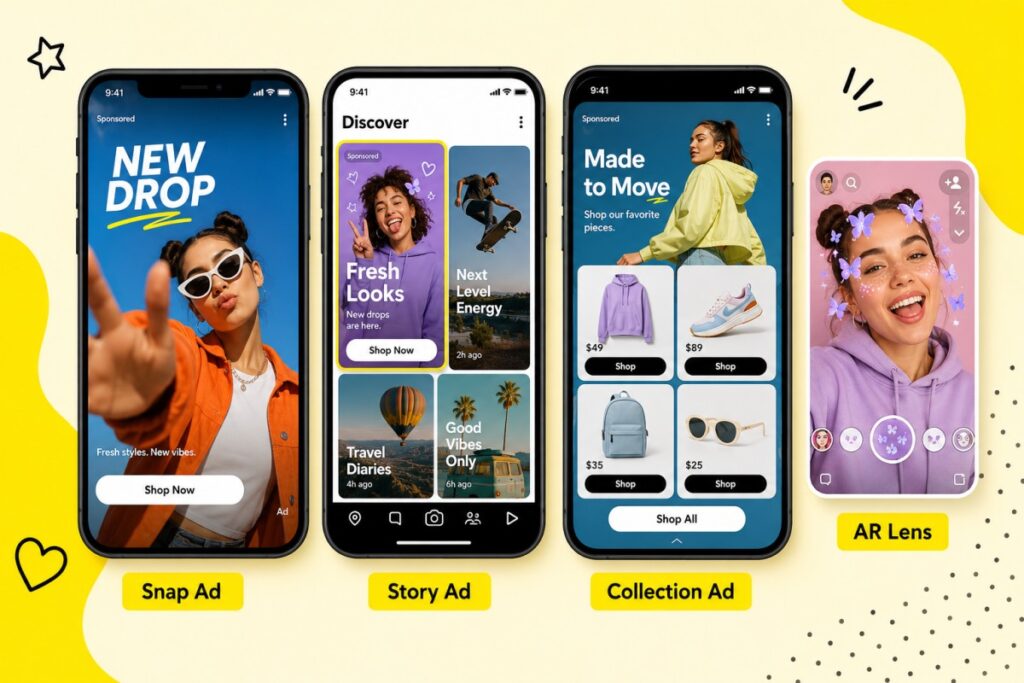
Snapchat ad formats
| Format | What it is | Best for |
|---|---|---|
| Single Image/Video Snap Ads | Full-screen vertical between Stories and in Spotlight | Versatile starting point |
| Story Ads | A tappable series of Snaps, or a branded tile in Discover | Storytelling and lookbooks |
| Collection Ads | Hero image or video above four shoppable product tiles | Product discovery and sales |
| Dynamic Ads | Auto-generated from your catalog, personalized per user | Retargeting and ecommerce scale |
| Commercials | Non-skippable video (Standard 3–6s; Extended Play up to 3 min) in curated content | Guaranteed-view awareness |
| AR Lenses | Interactive face, world, and try-on experiences | Highest engagement of any format (20–30s spent) |
| Filters | Location-based (geo) and audience-based overlays | Local and event activation |
| Sponsored Snaps | A newer format delivered straight into the Chat inbox | Direct, conversational reach |
AR Lenses are Snapchat’s signature differentiator: users actively play with them for 20–30 seconds and share the ones they love, turning paid placements into earned reach. Awareness CPMs on Snapchat also run 30–40% cheaper than Meta, which makes it a genuinely underpriced channel for the right audience.
How to optimize Snapchat campaigns
- Create vertical-first (9:16, 1080×1920); repurposed horizontal video looks cramped and underperforms.
- Keep Snap Ads under 10 seconds, make the call to action appear immediately, and lean into authentic, creator-style content.
- Install the Snap Pixel and define conversion events before spending so campaigns exit the learning phase faster.
- Use AR Lenses where they fit your category — beauty, fashion, entertainment, and consumer goods — for shareable, earned reach.
Pinterest Ads
Pinterest is a high-intent discovery engine that quietly became a serious performance channel. With more than 600 million monthly users who arrive to plan and buy — often weeks before purchase — Pinterest ads inspire rather than interrupt, which is why they suit considered and visual purchases so well.
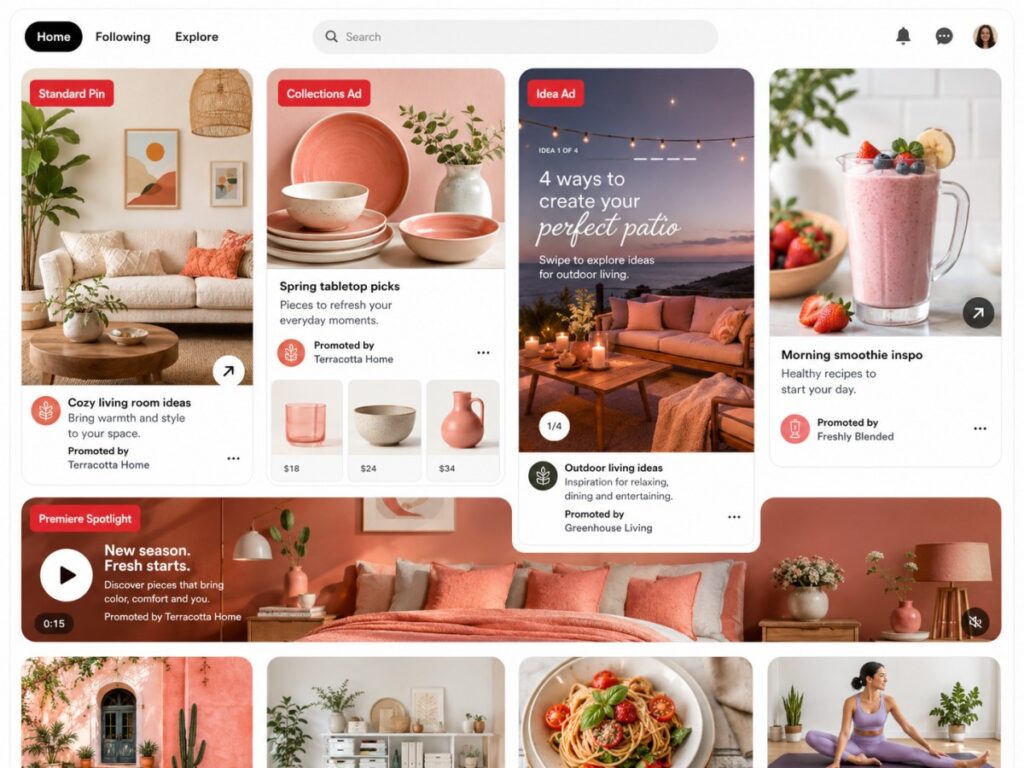
Pinterest ad formats
| Format | What it is | Best for |
|---|---|---|
| Standard Pins | Single vertical image (2:3) | Traffic and awareness |
| Video Pins | Standard and max-width auto-play video | Demos and storytelling |
| Carousel Ads | 2–5 swipeable images, each with its own link | Multiple products or angles |
| Collections Ads | Hero image or video with a product grid below (mobile) | Shoppable inspiration |
| Idea Ads | Multi-page, full-screen storytelling (now with direct links) | Tutorials and creator content |
| Showcase Ads | Multi-card, swipeable feature cards | Highlighting a product range |
| Quiz Ads | Interactive questions leading to personalized recommendations | Beauty, fashion, and home |
| Shopping Ads | Dynamic catalog pins with live pricing | Direct product sales |
| Premiere Spotlight | Premium max-width video in the home feed or search | Major launches |
Shopping pins deliver notably higher return on ad spend and conversion rates than plain creative because they carry buying intent. Pinterest’s 2026 acquisition of a connected-TV ad platform is also extending its first-party audiences onto the biggest screen in the home.
How to optimize Pinterest campaigns
- Design vertical (2:3, 1000×1500); vertical creative takes about 50% more screen than square.
- Treat Pinterest like search: use keywords in Pin titles, descriptions, and boards so ads surface for planning queries.
- Lead Shopping and Collections ads with lifestyle imagery, not plain product shots.
- Pair paid with organic — Pinterest is a long-game, evergreen platform where content keeps working for months.
Reddit Ads
Reddit gives you access to more than 100,000 tightly themed communities and around 1.7 billion monthly visits — an intent-rich, skeptical audience that rewards authenticity and punishes obvious selling. It has also become the most-cited domain in AI answer engines, which makes a well-run Reddit presence doubly valuable for both paid reach and AI visibility.
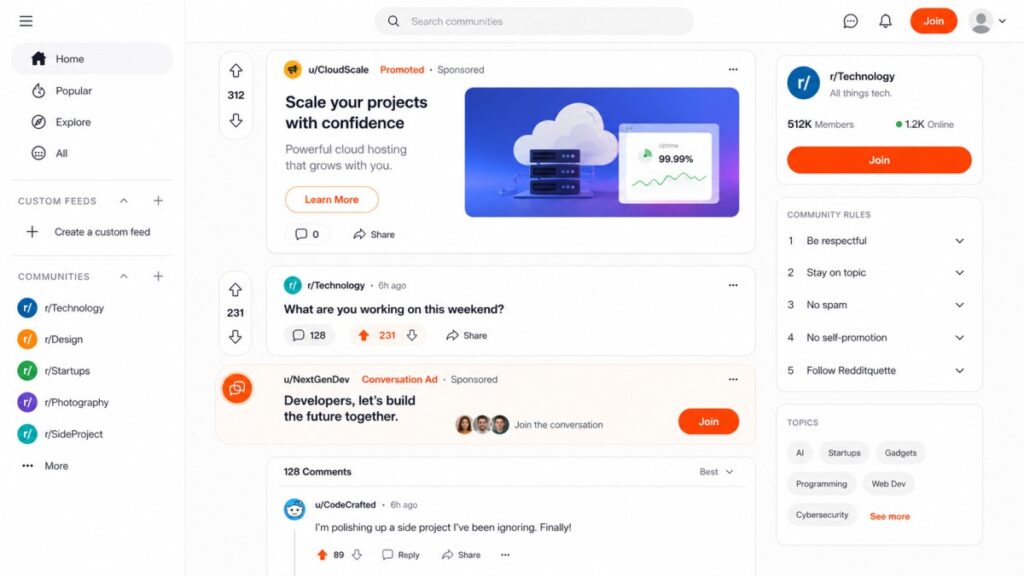
Reddit ad formats
| Format | What it is | Best for |
|---|---|---|
| Image Ads (Promoted Posts) | Native single-image posts with a “Promoted” label | Awareness and traffic |
| Video Ads | Auto-playing feed video (CPV bidding available) | Demonstrations |
| Carousel Ads | Swipeable multi-image units | Feature sets and comparisons |
| Free-form Ads | Rich posts mixing text, images, video, and lists | The most native, story-driven format |
| Product Ads | Shoppable catalog ads | Ecommerce |
| Conversation Ads | Placed between a post and its comments | Reaching users in research mode |
| AMA & Reminder Ads (Beta) | Promoted Ask-Me-Anything sessions and event reminders | Trust-building and launches |
Reddit’s placements split into Feed and Conversation, and running both together lifts action intent. Premium Takeover packages — full-platform, category, and trending — exist for major moments, and Reddit’s new AI-driven Max Campaigns automate the best combinations of creative, placement, and audience.
How to optimize Reddit campaigns
- Write like a Redditor: replace vague slogans with specific, supportable claims, because the community will challenge everything.
- Free-form and Conversation placements perform best when the ad reads like a helpful post, not a banner.
- Install the Reddit Pixel from day one, start with three to five relevant subreddits, and use CPV bidding for video.
- If you turn comments on, have a response plan — unanswered criticism sinks Reddit campaigns fast.
LinkedIn Ads
LinkedIn is the default platform for B2B paid media, offering targeting no consumer network matches — job title, seniority, company, industry, and skills. It costs more per click, but it puts you in front of decision-makers with real budget authority, which is exactly what high-value B2B deals require.
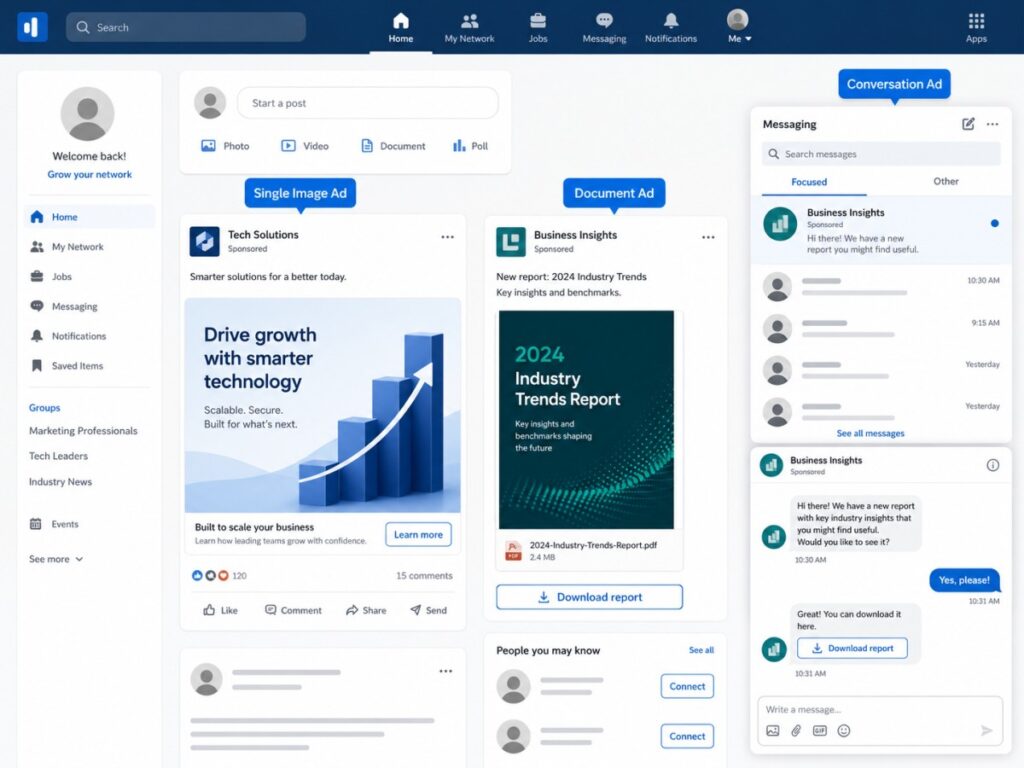
LinkedIn ad formats
| Format | What it is | Best for |
|---|---|---|
| Single Image & Carousel | Native feed ads | Awareness and content promotion |
| Video Ads | In-feed video (now with interactive polls and CTAs) | LinkedIn’s fastest-growing format |
| Document Ads | Downloadable whitepapers and reports in-feed | Highest lead efficiency (22%+ form completion) |
| Thought Leader Ads | Boost posts from employees’ personal profiles | Most cost-efficient (CPC ~$3 vs ~$13 for single image) |
| Event Ads | Promote LinkedIn Events | Webinars and registrations |
| Message & Conversation Ads | Direct and choose-your-path inbox messaging | Direct outreach (11–18% reply rates) |
| Lead Gen Forms | Pre-filled native forms | Frictionless lead capture |
| Dynamic & Text Ads | Personalized Follower/Spotlight and sidebar units | Awareness and traffic |
| Connected TV Ads | Video on streaming devices with B2B targeting | Upper-funnel reach |
Thought Leader Ads and Document Ads are the two standout performers in 2026 — the former because personal profiles feel more authentic and cost a fraction of company-page ads, the latter because the gated asset itself is the conversion driver. LinkedIn also rolled out Buying Group targeting to reach multiple stakeholders at a single target account.
How to optimize LinkedIn campaigns
- Layer job function with seniority rather than stacking many restrictive filters, which shrinks audiences and inflates cost.
- Exclude current customers, competitors, and your own employees to stop wasted spend.
- Cap Message and Conversation Ads at one to two sends per person every 30 days.
- Use real photography and specific offers — concrete value propositions can outperform generic messaging several times over.
Amazon Ads and Retail Media
Retail media is the fastest-growing slice of paid media, and Amazon owns roughly 80% of the US market. Its power comes from first-party purchase data and closed-loop measurement — ads reach shoppers at the exact point of purchase, where conversion rates run 8–15% versus 2–3% on the open web. If you sell products, this is a channel you cannot skip.
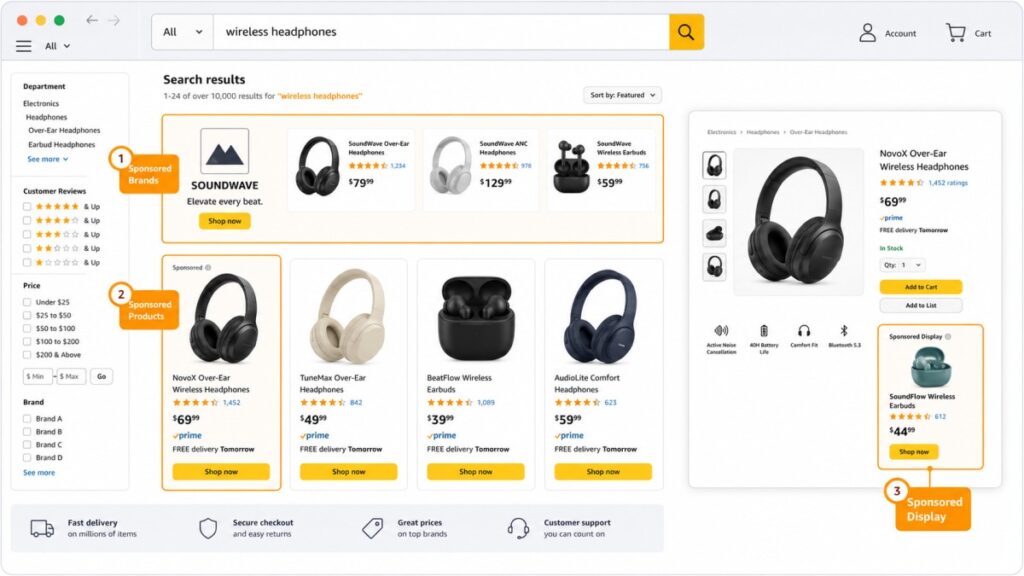
Amazon ad formats
| Format | What it is | Best for |
|---|---|---|
| Sponsored Products | CPC ads promoting individual listings in search and on product pages | The backbone; ~65% of Amazon ad spend |
| Sponsored Brands | Logo plus multi-product headline and carousel units | Brand awareness and portfolio |
| Sponsored Display | Audience-based retargeting on and off Amazon (including Twitch and IMDb) | Re-engaging shoppers |
| Sponsored TV | Self-service streaming ads on Fire TV and Prime Video | Top-funnel awareness |
| Amazon DSP | Programmatic display, video, audio, and streaming TV, with interactive video ads on CTV | Full-funnel reach and advanced audiences |
Amazon now operates as a full-funnel retail media platform, not just a search-bidding tool. In 2026 it unified its console and DSP into a single Campaign Manager and added AI creative tools. Beyond Amazon, retail media networks such as Walmart Connect, Target Roundel, and — in the MENA region — Noon offer similar sponsored placements against their own shopper data. This ties closely to how AI shopping agents are reshaping product discovery inside marketplaces.
How to optimize Amazon campaigns
- Start with Sponsored Products auto-targeting, let it run about two weeks, then migrate the winning search terms into manual campaigns.
- Layer in Sponsored Brands and Sponsored Display as you grow, and graduate to DSP once you want audiences beyond the storefront.
- Track ACoS and ROAS, but watch TACoS (total advertising cost of sale) most closely — a falling TACoS is the clearest sign paid spend is lifting your organic rank.
- Keep listings sharp with strong images, reviews, and pricing; Sponsored Products convert on the strength of the detail page. If you are building on a marketplace, my guide to starting an ecommerce business pairs well with this.
Microsoft Advertising
Microsoft Advertising (formerly Bing Ads) is the most underused high-value channel in paid media. It runs across Bing, Edge, Outlook, MSN, and now Copilot — and it is the only platform with LinkedIn’s professional targeting built directly into search campaigns, which is a real advantage for B2B.
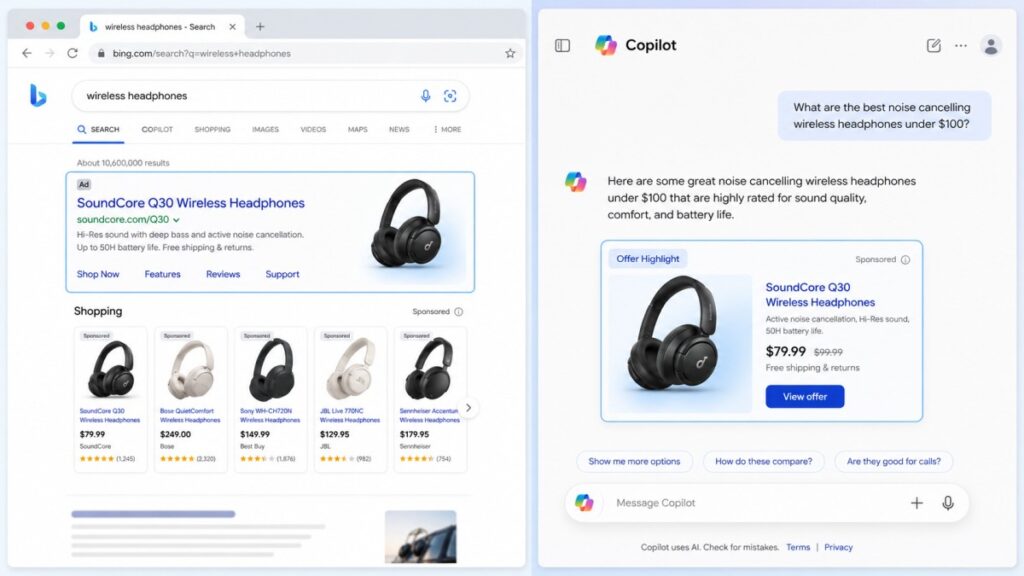
Microsoft ad types
| Ad type | What it is | Best for |
|---|---|---|
| Search Ads | Keyword-based text ads on Bing and partners | High-intent capture, often cheaper than Google |
| Shopping Ads | Product listings from Merchant Center | Ecommerce |
| Audience Ads | Native display across the Microsoft Audience Network | Consideration and reach |
| Performance Max | AI-run cross-channel campaigns across Microsoft inventory, including Copilot | Automated performance |
| AI Max for Search | Query matching beyond keywords, asset personalization, and URL routing | Conversational search coverage |
Microsoft’s 2026 push centers on AI-era discovery. Offer Highlights surface product details such as free shipping and returns directly inside Copilot chats, Audience Generation builds targeting from a plain-language prompt, and the Universal Commerce Protocol plus Copilot Checkout let brands transact inside AI conversations. As shoppers move toward AI assistants, showing up in these answers is becoming part of the same discipline as generative engine optimization.
How to optimize Microsoft campaigns
- Use Import Center to migrate proven Google (or Meta) campaigns, then trim for Microsoft’s audience rather than rebuilding from scratch.
- Add LinkedIn profile targeting (job title, seniority, company) to search campaigns for B2B — a genuine Microsoft-only advantage.
- Install Universal Event Tracking (UET) for conversion tracking, remarketing, and automated bidding.
- Expect lower CPCs than Google in many verticals, which makes Microsoft a cost-efficient way to extend your search reach.
Other Paid Media Platforms Worth Knowing
The platforms above cover the majority of budgets, but a complete paid media strategy often reaches beyond them. Depending on your audience and goals, these are worth having on your radar:
- YouTube (via Google): beyond Demand Gen, YouTube sells skippable and non-skippable in-stream ads, six-second bumpers, in-feed video, Shorts ads, and the premium Masthead. As the second-largest search engine, it is a top-funnel powerhouse.
- Spotify and audio: audio ads and podcast placements reach listeners in a low-competition, sound-on environment — strong for awareness and local targeting.
- Quora Ads: image, text, and promoted-answer units that reach people actively researching questions, useful for B2B and considered purchases.
- Programmatic and DSPs: platforms like Google’s Display & Video 360 and The Trade Desk buy display, video, audio, and CTV across the open web with granular audience control.
- Connected TV (CTV): streaming-TV ads (through Amazon, Pinterest, LinkedIn, and independent DSPs) bring TV-style reach with digital targeting and measurement — one of the fastest-growing formats in 2026.
- Apple Search Ads: promotes apps at the top of App Store results, essential for app-first businesses.
You do not need all of these. Pick the ones where your audience genuinely spends time and where you can measure a return, and leave the rest until you have a reason to expand.
Paid Media in Saudi Arabia and the MENA Region
If your customers are in the Kingdom, the platform priorities shift meaningfully from the Western default. Saudi Arabia has near-universal internet penetration (around 99%), roughly 94% social media engagement, and a population where about 70% are under 35 — one of the most advertising-receptive markets on earth. Getting your paid media mix right here starts with recognizing which platforms actually own attention.
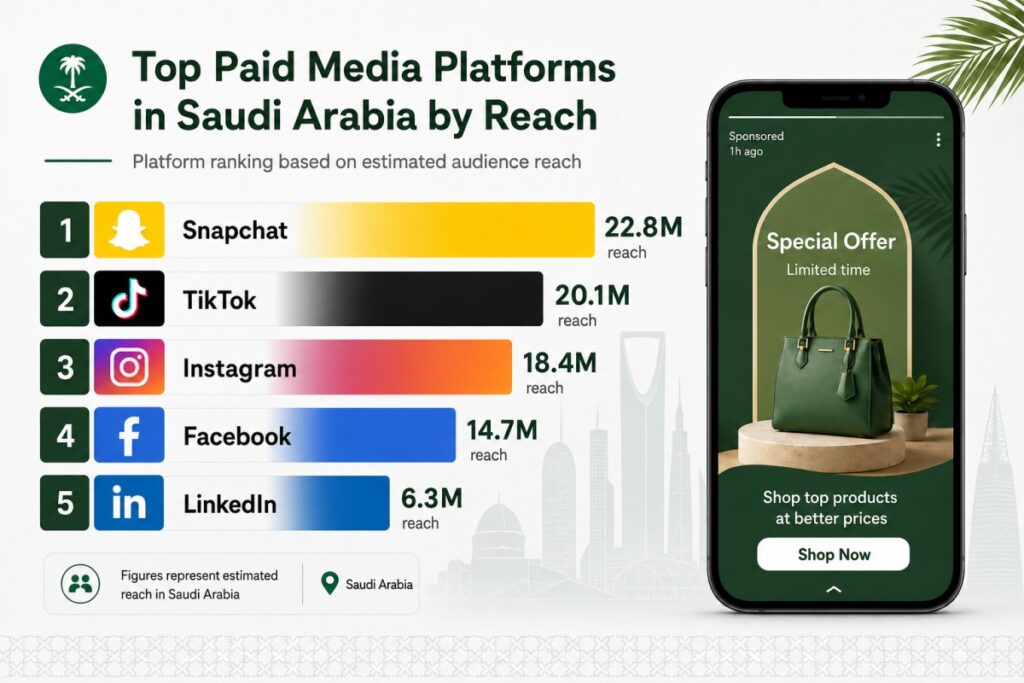
Which platforms matter most in Saudi Arabia
Snapchat is the standout: it reached about 25 million users in late 2025 — roughly 73% of the population, and close to 89% of adults — with women using it at rates comparable to men, a distinction from some other platforms.
TikTok is enormous too, with more than 38 million adult users, while Facebook and Instagram remain core for performance. For B2B, LinkedIn has around 12 million members in the Kingdom. In practice, a Saudi paid media plan usually leads with Snapchat and TikTok for reach among younger audiences, Meta for full-funnel performance, and Google plus Microsoft for intent capture. Snapchat’s Saudi-specific tools — city and neighborhood targeting, Arabic-language optimization, and local audience segments — are more developed than most competitors’, which is worth exploiting. My deeper dive into social media marketing in Saudi Arabia expands on the cultural and channel nuances.
Localization, data, and compliance
Three practical rules shape effective paid media across the region:
- Create Arabic-first, not translated. Gulf-facing and Egypt-facing audiences respond to different tone; luxury positioning in Saudi Arabia often calls for restraint and polish, while mass-market campaigns elsewhere reward warmth and directness. Ground your targeting in real digital consumer behavior, not assumptions.
- Respect the Personal Data Protection Law (PDPL). Saudi Arabia’s PDPL governs how you collect and use personal data for ad targeting; lean on consented first-party data, clear privacy notices, and platform tools that handle consent rather than unclear data sources.
- Optimize for local conversion. Payment preference matters — supporting local methods and wallets like those covered in my digital wallets in Saudi Arabia guide reduces the checkout friction that otherwise wastes ad spend.
Social commerce in the Kingdom is projected to keep growing at strong double-digit rates, so shoppable formats deserve increasing priority in your paid media budget. And keep all creative respectful of local culture and values — it is both the right thing to do and a practical requirement for ad approval and brand trust in the region.
Cross-Platform Optimization Principles
No matter which platforms you run, the fundamentals of high-performing paid media are the same. These are the principles I apply across every account, regardless of channel:
- Creative is the biggest lever. In 2026, your creative is the primary targeting signal every AI system reads. Produce more variations, refresh on a schedule, and design vertical-first with sound-off in mind. If creative volume is your bottleneck, an AI content strategy can help you scale production without losing quality.
- Feed the machines clean data. Every platform’s automation depends on accurate conversion tracking. Install server-side tracking (CAPI, UET, and the relevant pixel) and define real conversion events, not just clicks.
- Prioritize first-party data. As third-party cookies fade, your customer lists, site visitors, and CRM data become your most valuable targeting asset for lookalikes and retargeting.
- Let AI automate execution, not strategy. Advantage+, Performance Max, Smart+, Max Campaigns, and AI Max are excellent at tactical optimization — but you still own audience choice, creative direction, and brand positioning. AI can accelerate a bad decision just as easily as a good one.
- Test structurally, then scale. Start broad, validate messaging on a small budget, and increase spend on winners gradually so you do not reset the learning phase.
- Measure incrementally. Last-click attribution undervalues upper-funnel platforms. Use view-through and assisted conversions, and where budget allows, run holdout and lift tests to see what spend is truly incremental.
FAQ: Paid Media Advertising
What is the difference between paid, owned, and earned media?
Paid media is advertising you pay to place (search, social, retail, and programmatic). Owned media is what you control, such as your website, app, and email list. Earned media is exposure you do not pay for directly, like organic shares, press, and word of mouth. The strongest strategies use paid media to accelerate the other two.
Which paid media platform should I start with?
Start where your audience and intent align. For most ecommerce brands, that means Google Search or Amazon to capture demand, plus Meta to create it. B2B usually starts with LinkedIn and Google Search. In Saudi Arabia, Snapchat and TikTok are strong first choices for reach. Begin with one or two platforms, prove a return, then expand deliberately.
How much should I budget for paid media?
There is no fixed number — you set your own budget and, on most platforms, pay only for results. Self-serve platforms like TikTok, Snapchat, and Reddit start around $5 per day. The more useful question is your target cost per acquisition and your margin: high-value conversions justify expensive search clicks, while awareness goals suit cheaper CPM channels. Give any new campaign a two- to four-week learning window before judging it.
What are the newest ad formats in 2026?
The biggest 2026 additions are AI-native: Google’s AI Max for Search, Microsoft’s ads inside Copilot, TikTok’s Smart+, Reddit’s Max Campaigns, and Snapchat’s Sponsored Snaps. Across platforms, short vertical video, shoppable catalog ads, and Connected TV are the fastest-growing formats.
How is AI changing paid media advertising?
AI now runs targeting, bidding, and increasingly creative on every major platform. Campaign types like Performance Max and Advantage+ hand the machine your goals and assets and optimize automatically. Separately, AI answer engines such as Copilot, ChatGPT, and Google’s AI surfaces are becoming ad placements themselves, which is merging paid media with generative engine optimization.
Do I need different creative for each platform?
Ideally yes. While a 9:16 vertical video can run across TikTok, Reels, Snapchat, and Shorts, top performance comes from platform-native creative — creator-style content on TikTok, polished-but-authentic Snaps on Snapchat, and copy-first posts on X. At minimum, build 4:5, 9:16, and 1:1 versions so nothing gets cropped across placements.
What is retail media and is it worth it?
Retail media is advertising inside shopping platforms like Amazon, Walmart, and Noon, using their first-party purchase data. It is worth it if you sell products those marketplaces carry, because it reaches shoppers at the point of purchase with closed-loop measurement, and conversion rates far exceed the open web. It is now the fastest-growing paid media category.
Conclusion: Building Your Paid Media Stack
The paid media landscape in 2026 rewards advertisers who think in systems, not silos. The platforms are converging on the same formats and racing to automate with AI, which means your edge comes from three things the machines cannot do for you: choosing the right platform mix for your audience and funnel, producing creative that stops the scroll, and measuring what is genuinely incremental.
Start with one or two platforms where your customers already are, get conversion tracking and creative right, and let each platform’s AI handle the tactical optimization. Then expand deliberately — layering demand-creation channels like TikTok and Snapchat on top of demand-capture channels like Google and Amazon — so the interest you generate up-funnel gets captured down-funnel. That compounding effect, not any single “best” platform, is what turns paid media into a reliable growth engine.
Related reading:
- The Evolution and Impact of Social Media Marketing in Saudi Arabia
- Generative Engine Optimization: GEO vs. AEO vs. AIO
- AI Shopping Agents Ecommerce: The Complete Guide
- GA4 Ecommerce Tracking Saudi Arabia
- Ecommerce Trends 2026: 10 Technologies Reshaping Online Shopping
Sources: Google Ads Help, Meta Ads Guide, TikTok Ads Help Center, X Business Help, Snapchat for Business, Pinterest Business Help, Reddit Ads, LinkedIn Ads Guide, Amazon Ads, Microsoft Advertising, DataReportal Digital 2026 Saudi Arabia, and EMARKETER Retail Media 2026.

Husain Alhaboubi is Director of Digital Channels at Mobily, where he leads platform optimization, AI-powered customer engagement, and UI/UX strategy. With 20+ years of experience spanning eCommerce, IT infrastructure, and digital marketing, he previously drove a 225% revenue increase and 69% organic traffic growth as eCommerce Senior Manager at flyadeal, and managed enterprise IT operations — including data centers, ERP systems, and network security — as Group IT Manager at IPD Group.
Husain holds a BS in Information Systems from the University of Texas at Arlington and is certified in Google Ads, Google Analytics, and Semrush SEO. He writes from hands-on experience across both sides of digital business: the strategic (eCommerce, SEO, AI, digital transformation) and the technical (server administration, cloud computing, web development, networking, and security) — with a particular focus on the Saudi market and Vision 2030. Read his full resume →