
Arabic SEO for AI Search: The Complete 2026 Guide to Getting Cited in Arabic
As of September 15, 2026, Cloudflare applies new defaults to AI crawler traffic, and Cloudflare sites that chose to block AI training can now end up blocking multi-purpose crawlers such as Googlebot and Bingbot too. One setting can quietly remove your Arabic pages from classic results and AI answers at the same time. That is why Arabic SEO in the AI era is no longer only about keywords and backlinks. It is about whether AI search engines can reach, read, and trust your Arabic content.
Google now shows AI Overviews and AI Mode in Arabic, 45.2% of internet users in Saudi Arabia use AI tools, and ChatGPT is the most-downloaded AI app in the Kingdom. Yet most Arabic SEO advice still treats Arabic as translated English. In this guide, I walk you through how AI engines interpret Arabic queries, how to run Arabic keyword research for conversational search, the technical setup that keeps AI crawlers welcome, and how to measure the results. Everything is grounded in official documentation from Google, OpenAI, Anthropic, and W3C, plus lessons from running my own websites for Saudi and Gulf audiences.
Table of Contents
Why Arabic SEO Needs a Rethink for AI Search
Arabic is used daily by more than 400 million people, according to the United Nations. Yet W3Techs reports that Arabic is the content language of only 0.6% of the websites whose language it can identify. Saudi Arabia alone had 34.4 million internet users at the end of 2025, a 99.0% penetration rate, based on DataReportal’s Digital 2026 report. Demand is huge, and high-quality Arabic supply is thin. That gap is the opportunity Arabic SEO exists to capture.
AI search changes how Arabic SEO fills that gap. Google brought AI Overviews to the Middle East and North Africa in May 2025 with Arabic language support. The Google AI Mode Arabic rollout followed in October 2025, when Google expanded AI Mode to Modern Standard Arabic and 35 other languages. Google also reported that in markets where AI Mode is live, people type queries two to three times longer than traditional searches.
Query length matters for Arabic SEO because longer questions trigger AI answers more often. A Pew Research Center analysis found that 53% of searches with ten or more words produced an AI summary, compared with 8% of one- or two-word searches. When Arabic users type or speak full conversational questions, those queries land right in the zone where AI answers appear.
The Traffic Trade-Off
AI answers also change clicks. In the same Pew study of 900 U.S. adults, users clicked a traditional search result in 8% of visits when an AI summary appeared, versus 15% when none appeared. That data comes from U.S. users, so treat it as a direction rather than a Saudi benchmark. The practical lesson for Arabic SEO for AI search is simple: being the cited source inside the answer now matters as much as ranking in the links below it.
What Changed in 2026
Four developments this year reshaped the Arabic SEO playbook:
- Official guidance: On May 15, 2026, Google published Optimizing your website for generative AI features on Google Search, which states that optimizing for generative AI search is still SEO.
- New measurement and control: Search Console’s generative AI performance reports and the Search generative AI control reached all websites worldwide on August 31, 2026.
- Local adoption: Saudi Arabia’s Communications, Space and Technology Commission reported that AI tool use among Saudi internet users more than doubled in a year to 45.2%, as covered by Arabian Business. Deloitte’s 2026 KSA survey put active AI tool use at 66% of consumers aged 18 to 50.
- Crawler controls: Cloudflare split AI traffic into Search, Agent, and Training categories and scheduled new defaults for September 15, 2026.

How AI Search Engines Read Arabic Content
Google says its generative AI features are rooted in its core Search ranking and quality systems. They rely on two techniques. Retrieval-augmented generation grounds each answer in pages retrieved from the Search index. Query fan-out fires several related searches at once to gather more material. For Arabic SEO, fan-out means one Arabic question can bring your page into an answer through a sub-query you never targeted directly.
Picture a user asking كيف أفتح متجر إلكتروني في السعودية؟ (“How do I open an online store in Saudi Arabia?”). An AI engine could fan that out into sub-questions about commercial registration, ecommerce platforms, and payment gateways. Those sub-queries are my illustration, not a log of what Google actually runs, but they show why a page that thoroughly answers one piece of the journey can earn a citation for the broader question. I cover that whole journey in my guide on how to start an ecommerce business in Saudi Arabia.
Modern Standard Arabic vs. Saudi Dialect Queries
The Google AI Mode Arabic launch targeted Modern Standard Arabic (MSA), the formal written standard shared across the Arab world. Saudi users, however, often type and speak in dialect. A shopper in Riyadh may search وش أفضل (“what’s the best”) where MSA uses ما أفضل, and voice queries lean even further toward everyday speech.
For Arabic SEO, my recommendation is to write the body in clear MSA so it reads well across the region, then mirror the dialect phrasings your audience actually uses in FAQ questions, subheadings, and examples. You get content that feels professional and still matches the way people ask.
Spelling Variants and Morphology in Arabic SEO
Arabic spelling varies in ways English does not. The same word can appear with or without a hamza (أ versus ا), ending in ta marbuta or ha (ة versus ه), or ending in alif maqsura or ya (ى versus ي). Arabic also builds words from three-letter roots. The root ك ت ب produces كتاب (book), كاتب (writer), and مكتبة (library), while prefixes such as ال and و attach directly to words.
Google’s guide says its AI systems understand synonyms and general meaning, so you don’t need a separate page for every spelling. In fact, mass-producing near-duplicate pages for each variant, mainly to manipulate rankings or AI responses, would violate Google’s scaled content abuse policy. The better Arabic SEO approach is to use the most common spelling in your title and first heading, keep spelling consistent within the page, and let natural variation appear in the body.
Arabizi and Mixed Arabic-English Queries
Mixed scripts are a distinctly Arabic SEO challenge, because many Gulf users switch between Arabic and Latin characters. Arabizi writes Arabic with Latin letters and numerals, using “3” for ع and “7” for ح. Tech queries also blend Arabic with English product names, as in شرح GA4 (“GA4 explained”). Keep brand and product names in their official Latin form inside Arabic text, add an Arabic transliteration once where readers expect it, and mark up mixed-direction phrases so browsers display them in the right order. W3C’s article on inline markup and bidirectional text explains how.
Arabic Keyword Research for Conversational Queries
Good Arabic keyword research starts with how people ask, not with a translated English keyword list. Translation gives you words; it rarely gives you the phrasing real Saudi users type. Here is the four-step Arabic keyword research process I follow.
Step 1: Collect Real Questions Before Opening Tools
Open the Search Console Performance report, filter by country (Saudi Arabia), and review the Arabic queries your pages already receive. Then add questions from customer emails, WhatsApp chats, social comments, and Arabic autocomplete suggestions in Google. Social platforms are especially rich here, as I explain in my overview of social media marketing in Saudi Arabia. These sources give your Arabic keyword research the dialect and phrasing that tools and translations miss.
Step 2: Map Each Intent Across MSA, Dialect, and English
Group the questions by intent, then list how each intent is phrased in MSA, in Gulf dialect, and in mixed or English form. The examples below are illustrative, but the structure is what matters:
| Intent | MSA phrasing | Gulf dialect phrasing | Mixed or English phrasing |
|---|---|---|---|
| Find the best option | ما أفضل منصة للمتاجر الإلكترونية؟ | وش أفضل منصة متاجر؟ | best ecommerce platform KSA |
| Learn how to do something | كيف أنشئ متجرًا إلكترونيًا؟ | كيف أسوي متجر إلكتروني؟ | شرح إنشاء متجر WooCommerce |
| Check a price | كم تكلفة تصميم موقع إلكتروني؟ | بكم تصميم موقع؟ | website design cost Riyadh |
In Arabic SEO, one page should usually serve the whole row. The map tells you which phrasings belong in the title, which belong in subheadings and FAQ questions, and which only need to appear naturally in the text.
Step 3: Validate Demand With Keyword Tools
Use Google Keyword Planner with the location set to Saudi Arabia and the language set to Arabic, then cross-check in Ahrefs or Semrush. Expect keyword tools to show little or no volume for long dialect phrases. In Arabic SEO, treat those numbers as directional, and keep any phrase that matches a real question you collected in Step 1, even when the tool shows zero.
Step 4: Test Your Questions in AI Engines
Run your top 10 to 20 questions through Google AI Mode Arabic search, ChatGPT, and HUMAIN Chat. For each answer, record which sources are cited, which subtopics are covered, and where the answer is thin or generic. Those gaps become your content brief. This is the same answer-first thinking I describe in my AI content strategy playbook, applied to Arabic keyword research.
Technical Arabic SEO Foundations for AI Crawlers
Google is explicit about eligibility, and the rules apply to Arabic SEO exactly as they do to English. To appear in generative AI features, a page must be indexed and eligible to show with a snippet, and the site must be included in Search generative AI features through the control in Search Console. Once that is confirmed, technical Arabic SEO comes down to four areas.
Set Language and Direction Correctly
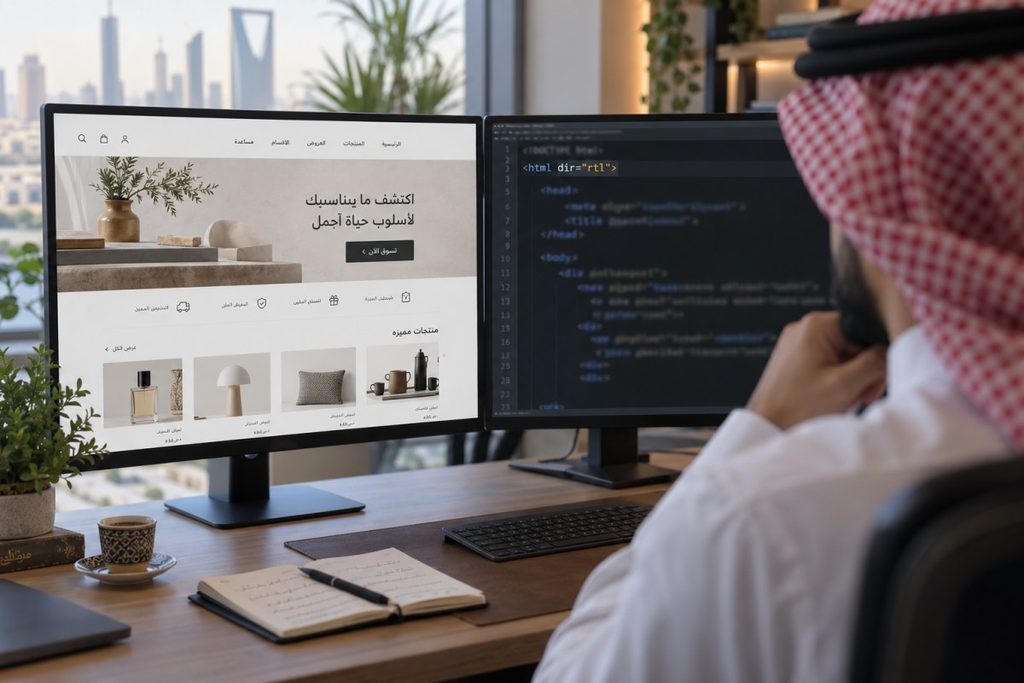
W3C’s guidance on structural markup and right-to-left text is clear: when a document reads right to left, set dir="rtl" on the html element, don’t use CSS to set the base direction, and use logical properties (start and end) for margins, padding, and alignment.
<!DOCTYPE html>
<html lang="ar" dir="rtl">
<head>
  <meta charset="utf-8">
  <title>دليل المتجر الإلكتروني</title>
</head>
.card {
  margin-inline-start: 1rem;   /* instead of margin-left */
  padding-inline-end: 1.5rem;  /* instead of padding-right */
  text-align: start;           /* instead of text-align: left */
}
One Arabic SEO nuance worth knowing: Google says it doesn’t use the lang attribute or hreflang to detect a page’s language, because its algorithms do that. Correct lang and dir values still matter for browsers, screen readers, and the rendered page that users and browser agents actually see.
Implement Hreflang for Bilingual SEO
If you publish Arabic and English versions of the same page, hreflang tells Google they are localized variants. According to Google’s documentation on localized versions of a page, translated pages are not treated as duplicates when the main content is actually translated. Annotations must be bidirectional, and x-default names the fallback page. That makes hreflang the backbone of bilingual SEO:
<!-- Place the same set on BOTH the Arabic and English versions -->
<link rel="alternate" hreflang="ar-SA" href="https://example.com/ar/guide/" />
<link rel="alternate" hreflang="ar" href="https://example.com/ar/guide/" />
<link rel="alternate" hreflang="en-SA" href="https://example.com/en/guide/" />
<link rel="alternate" hreflang="x-default" href="https://example.com/en/guide/" />
On WordPress, a bilingual SEO setup usually relies on a multilingual plugin to generate these tags. Check the rendered page source rather than trusting the settings screen, because a missing return link breaks the pair.
Choose Arabic or Transliterated URL Slugs
Google’s URL structure best practices recommend simple, descriptive words, preferably in the audience’s language, with UTF-8 encoding for non-ASCII characters. Arabic slugs are valid, but when people copy them, many apps paste a long percent-encoded string. For example, متجر-إلكتروني becomes %D9%85%D8%AA%D8%AC%D8%B1-%D8%A5%D9%84%D9%83%D8%AA%D8%B1%D9%88%D9%86%D9%8A.
| Slug option | Example | Strength | Trade-off |
|---|---|---|---|
| Arabic slug | /متجر-إلكتروني/ | Matches the audience’s language | Pastes as long encoded text in many apps |
| Transliterated slug | /matjar-electroni/ | Short and easy to share | Inconsistent spelling and weaker meaning |
| English slug | /ecommerce-store/ | Clean and familiar to bilingual users | Doesn’t reflect Arabic query wording |
My Arabic SEO rule of thumb: Arabic-first sites benefit from Arabic slugs because they match the audience’s language, which is exactly what Google recommends. For bilingual SEO, one consistent English slug on both language versions keeps maintenance simple.

Open the Door to AI Crawlers
Google’s AI features draw on its Search index, but other AI engines run their own crawlers, and each crawler has its own robots.txt token. OpenAI documents OAI-SearchBot for ChatGPT search and GPTBot for model training, with each setting independent of the other. Its publisher FAQ says your content can appear in ChatGPT summaries and snippets only if OAI-SearchBot isn’t blocked. Anthropic lists ClaudeBot for training, Claude-SearchBot for search indexing, and Claude-User for pages fetched when a user asks Claude a question.
A robots.txt setup that welcomes AI search while opting out of model training looks like this:
# Allow AI search indexing and user-requested fetches
User-agent: OAI-SearchBot
Allow: /

User-agent: ChatGPT-User
Allow: /

User-agent: Claude-SearchBot
Allow: /

User-agent: Claude-User
Allow: /

# Optional: opt out of model training
User-agent: GPTBot
Disallow: /

User-agent: ClaudeBot
Disallow: /

Sitemap: https://example.com/sitemap.xml
Whether to block training is a business decision, not an Arabic SEO ranking factor. The bigger Arabic SEO risk sits one layer below robots.txt, in your CDN. Cloudflare now groups AI traffic into Search, Agent, and Training. From September 15, 2026, new domains get Training and Agent bots blocked by default on pages that display ads, while Search stays allowed. Cloudflare also says that customers who chose to block Training will block multi-purpose crawlers such as Googlebot, Applebot, and Bingbot, because those crawlers are judged by all of their behaviors.
I have seen this layer bite in practice. On one of my own sites, robots.txt allowed an AI assistant’s fetcher, yet Cloudflare’s bot protection kept blocking it from the sitemap. robots.txt only states a preference, while a firewall rule is enforced silently. An allow rule in the WAF for that crawler fixed it. Review your Cloudflare Security settings, then confirm in your logs or the Cloudflare dashboard that the crawlers you want are actually getting through. If you already use Cloudflare for performance, my guide to caching WordPress using Cloudflare covers the dashboard basics.
Arabic Content Optimization That Earns AI Citations
Google’s guide says unique, non-commodity content will likely influence your presence in generative AI search more than anything else it recommends. It contrasts generic “tips” articles based on common knowledge with first-hand, expert takes that go further. For Arabic content optimization and Arabic SEO in general, that bar is often easier to clear than in English, simply because so little in-depth Arabic content exists.
Answer First in Clear Modern Standard Arabic
The first Arabic content optimization rule is structural: open each section with a direct answer in one or two sentences, then expand with steps, examples, and caveats. Google notes that readers appreciate pages organized into paragraphs and sections with clear headings, so let each heading state what the section answers. Keep sentences short, too. Long Arabic sentences chained with و are hard to scan for readers and for any system trying to pull out one clear statement.
Anchor Content in Verifiable Saudi Specifics
Strong Arabic SEO content names the regulator, the city, the platform, and the date. Quote prices in riyals, and use the official currency symbol where your stack supports it; my guide on using the new Saudi Riyal symbol shows how. Pick one numeral style, either Western (123) or Eastern Arabic (١٢٣), and use it consistently on the page. Original data, screenshots, and your own photos add the unique angle Google looks for, and its guide notes that AI features can surface relevant images and video as well.
Avoid Machine-Translated Mirrors
Translating an English site into Arabic at scale without review is a tempting Arabic SEO shortcut, but it produces exactly the commodity content Google warns against. AI tools can speed up drafting, and Google’s guidance on AI-generated content allows that as long as the result meets Search Essentials and spam policies. Have a fluent editor check terminology, tone, and cultural fit before anything goes live. Arabic content optimization is as much about editing as it is about writing.
When Arabic SEO Isn’t the First Priority
Arabic SEO isn’t always the right first investment. Developer, B2B, and technical audiences in the Gulf often search in English. If Search Console shows that English queries dominate your topic, strengthen your English pages first, then extend your Arabic SEO to the pages with the clearest Arabic demand. The goal is to match the language your audience actually searches in, not to translate everything by default.
Arabic SEO Myths: What Google Says You Can Stop Doing
Google’s 2026 guide includes a mythbusting section. For Google Search, including its generative AI features, you can ignore the following:
- llms.txt files and other special markup: Google Search doesn’t use them, so creating one neither helps nor harms your Google visibility.
- Chunking content into tiny pieces: Google’s systems can understand pages that cover several topics and show the relevant part.
- Rewriting content just for AI: AI systems understand synonyms, so you don’t need to capture every long-tail variation.
- Chasing inauthentic mentions: Generative features rely on the same quality and spam systems as core ranking.
- Overfocusing on structured data: No special schema is required for generative AI features, although structured data still helps with rich results.
If you have been following older Arabic SEO checklists, this is a good moment to prune. My list of SEO myths you should ignore covers more of the tactics that waste time. For earned mentions that do count, focus on genuine coverage, like the approaches in my guide to building free backlinks.
Where Other AI Engines Differ
Google’s guide covers Google Search only, and it notes that keeping an llms.txt file for other services is perfectly fine. ChatGPT and Claude run separate crawlers with their own rules, as shown above. A sound Arabic GEO strategy therefore plans for each engine your audience uses instead of assuming Google’s rules apply everywhere. For how GEO, AEO, and AIO relate to one another, see my guide to generative engine optimization, and for store owners, my playbook on generative engine optimization for ecommerce.
Arabic SEO Beyond Google: ChatGPT, HUMAIN Chat, and More
ChatGPT is the most-downloaded AI app in Saudi Arabia, ahead of Google Gemini and DeepSeek, according to the CST report. OpenAI says any public website can appear in ChatGPT search, which makes crawler access the first Arabic SEO box to tick for this engine.
Saudi Arabia also has its own Arabic-first assistant. HUMAIN Chat launched on August 25, 2025, powered by the ALLaM 34B Arabic language model. The Saudi Gazette reported that users can switch between Arabic and English mid-conversation and receive responses integrated with real-time search. I cover the company behind it in my guide to HUMAIN Saudi Arabia.
The wider field keeps growing. Microsoft and HUMAIN announced a collaboration to bring ALLaM to Microsoft Foundry and Copilot, while the UAE’s Jais and Falcon models and Qatar’s Fanar compete on Arabic benchmarks, as TechRevolt reported. None of these engines, to my knowledge, publishes a separate rulebook for Arabic content. The practical Arabic GEO playbook stays the same everywhere: be crawlable, be specific, and be the clearest Arabic answer on the topic.
How to Measure Arabic SEO Results in AI Search
You can’t improve Arabic SEO results you don’t track. I use three layers of measurement, from Google’s own data down to manual checks.
Search Console Generative AI Performance Report
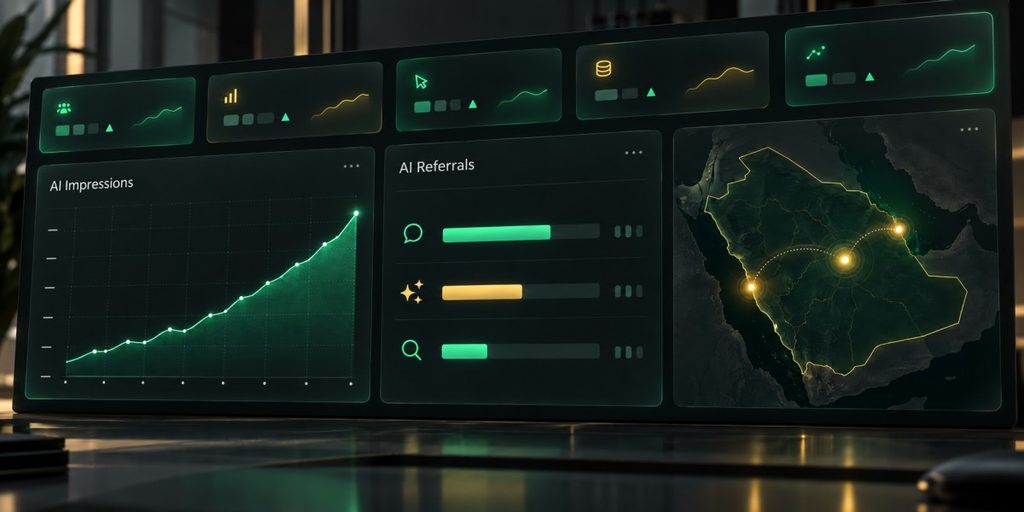
The generative AI performance report shows how often URLs from your site appeared in AI Overviews, AI Mode, and generative AI features in Discover. You can break the data down by pages, countries, devices (for Search), and dates. It doesn’t include clicks. Filter by Saudi Arabia, then compare the Arabic pages earning AI impressions with the Arabic queries they rank for in the standard Performance report. Pages that rank well but earn few AI impressions are your first Arabic SEO targets.
GA4 AI Referral Tracking
OpenAI adds utm_source=chatgpt.com to referral links from ChatGPT search, so those visits show up in GA4 traffic acquisition reports. Other assistants don’t always tag their links, so create a custom channel group that matches known AI referrers on session source with a regular expression like this one:
chatgpt\.com|chat\.openai\.com|perplexity\.ai|gemini\.google\.com|copilot\.microsoft\.com|claude\.ai
Then filter by your Arabic directory (for example, /ar/) to isolate Arabic pages. If you need a refresher on the setup itself, my guide to GA4 ecommerce tracking in Saudi Arabia walks through it step by step.
Manual Prompt Tracking in Arabic
The third Arabic SEO measurement layer is manual. Keep a monthly sheet of 20 to 30 prompts that mixes MSA, Gulf dialect, and mixed Arabic-English phrasings. For each engine, log whether your brand or page is cited, which competitors appear, and how accurate the answer is. AI answers vary from one run to the next, so judge trends across months rather than any single result.
Arabic SEO Checklist for AI Search
Use this Arabic SEO for AI search checklist to audit an existing site or plan a new one:
| Area | Action | Why it matters |
|---|---|---|
| Eligibility | Confirm your site is included in Search generative AI features in Search Console | Required to appear in AI Overviews and AI Mode |
| Crawler access | Allow Googlebot, OAI-SearchBot, and Claude-SearchBot in robots.txt | AI engines can’t cite pages they can’t fetch |
| CDN settings | Review Cloudflare AI traffic settings after September 15, 2026 | Training blocks can now catch multi-purpose crawlers |
| Markup | Set lang="ar" and dir="rtl", and use logical CSS | Correct rendering for users, screen readers, and agents |
| Bilingual pages | Add bidirectional hreflang with x-default | Serves the right language version |
| Keywords | Map each intent across MSA, dialect, and English | Matches how people actually ask |
| Content | Answer first and add verifiable Saudi detail | Non-commodity content earns citations |
| Quality | Have a fluent editor review AI-assisted or translated text | Protects quality and avoids scaled content abuse |
| Measurement | Track AI impressions, AI referrals, and prompt citations monthly | Shows what is working and where to focus |
FAQ: Arabic SEO for AI Search
What is Arabic SEO for AI search?
Arabic SEO for AI search is the practice of making Arabic web content easy for AI-powered engines, such as Google AI Overviews, AI Mode, ChatGPT, and HUMAIN Chat, to crawl, understand, and cite. It combines classic SEO fundamentals with Arabic-specific work: dialect-aware keyword research, right-to-left markup, hreflang for bilingual sites, and crawler access controls. In short, Arabic SEO now has to satisfy human readers and AI retrieval systems at the same time.
Is Google AI Mode available in Arabic?
Yes. The Google AI Mode Arabic rollout arrived in October 2025 and covers Modern Standard Arabic. Google had launched AI Mode in English across the Middle East and North Africa two months earlier, in August 2025. AI Overviews gained Arabic support earlier, in May 2025. Your Arabic pages need to be indexed and eligible for snippets to appear in either feature.
Should I write Arabic content in Modern Standard Arabic or Saudi dialect?
Write the main body in clear Modern Standard Arabic so it reads professionally across the Arab world. Then use the dialect phrasings your audience types, such as وش أفضل, in FAQ questions, subheadings, and examples. That balance works well for Arabic SEO because it matches real search behavior without making the whole page informal.
Do I need an llms.txt file to appear in AI answers?
Not for Google. Google’s May 2026 guide states that Google Search ignores llms.txt files, so they neither help nor harm your visibility there. Other services may read them, so keeping one is optional. Crawler access, indexing, and helpful content matter far more for Arabic SEO.
Should Arabic pages use Arabic or English URLs?
Both work for Arabic SEO. Google recommends descriptive words, preferably in the audience’s language, with UTF-8 encoding for non-ASCII characters. Arabic slugs suit Arabic-first sites, while bilingual SEO setups are often easier to manage with one consistent English slug. Just remember that Arabic slugs turn into long percent-encoded strings when people copy and share them.
How can I tell if my Arabic pages appear in AI Overviews?
Open the generative AI performance report in Search Console. It shows impressions from AI Overviews, AI Mode, and AI features in Discover, grouped by page, country, device, and date. Filter by Saudi Arabia and by your Arabic URLs to isolate your Arabic SEO performance. The report doesn’t show clicks, so pair it with GA4 referral data.
Can I block AI training without losing AI search visibility?
Yes, in robots.txt. OpenAI and Anthropic use separate tokens for training (GPTBot, ClaudeBot) and search (OAI-SearchBot, Claude-SearchBot). Be careful at the CDN level, though: Cloudflare says customers who block Training can also block multi-purpose crawlers such as Googlebot and Bingbot, so review those settings.
Is machine translation acceptable for Arabic content?
As a drafting aid, yes. Google allows AI-assisted content as long as it meets Search Essentials and spam policies. Publishing unreviewed translations at scale, however, creates commodity content and can fall under scaled content abuse. Always have a fluent Arabic editor review terminology, tone, and cultural fit.
Your Next Step: A 30-Minute Arabic SEO Audit
Start your Arabic SEO audit with the three settings that can silently remove you from AI answers: the Search generative AI control in Search Console, your Cloudflare AI traffic settings, and the robots.txt rules for OAI-SearchBot and Claude-SearchBot. Then pick five Arabic questions your customers actually ask, including at least one in Gulf dialect, and run them through Google AI Mode and ChatGPT.
Whoever gets cited today is your real competition in Arabic SEO. The gaps in those answers show you exactly which Arabic page to write or fix first this week.
Related reading:
- Generative Engine Optimization: GEO vs. AEO vs. AIO
- Generative Engine Optimization for Ecommerce
- HUMAIN Saudi Arabia: The Kingdom’s Sovereign AI Champion
- GA4 Ecommerce Tracking Saudi Arabia
- 15 SEO Myths You Should Ignore
Sources: United Nations, World Arabic Language Day; W3Techs, Usage Statistics of Arabic for Websites (September 2026); DataReportal, Digital 2026: Saudi Arabia (November 2025); Google, Bringing AI Overviews to MENA, and in Arabic globally (May 2025); Arab News, Google expands AI Mode to Arabic and 35 other languages (October 2025); Pew Research Center, Google users are less likely to click on links when an AI summary appears (July 2025); Google Search Central, Optimizing your website for generative AI features on Google Search (May 2026); Google Search Central Blog, Search generative AI performance reports (June 2026); Search Console Help, Search generative AI control and Generative AI performance report; Arabian Business, Saudi Arabia AI use more than doubles (August 2026); Communicate Online, Deloitte Digital Consumer Trends 2026, KSA Edition (May 2026); Cloudflare, New AI traffic options for all customers (July 2026); W3C, Structural markup and right-to-left text in HTML and Inline markup and bidirectional text in HTML; Google Search Central, Localized versions of your page, URL structure best practices, Spam policies, and Guidance on using generative AI content; OpenAI, Overview of OpenAI Crawlers and Publishers and Developers FAQ; Anthropic, Anthropic crawler documentation; HUMAIN, HUMAIN Chat launch (August 2025); Saudi Gazette, HUMAIN launches Arabic AI app (August 2025); TechRevolt, Microsoft to bring ALLaM to its global platform.
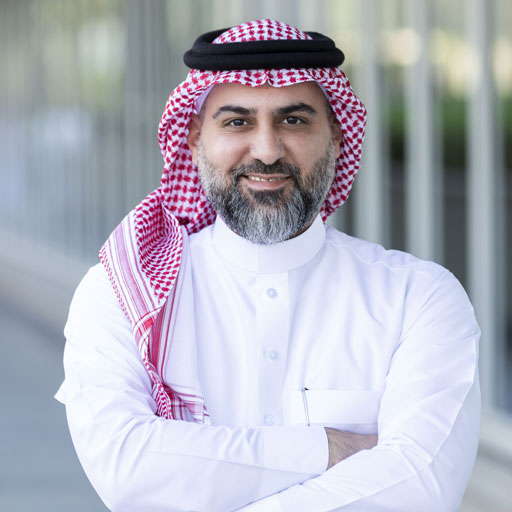
Husain Alhaboubi is Director of Digital Channels at Mobily, where he leads platform optimization, AI-powered customer engagement, and UI/UX strategy. With 20+ years of experience spanning eCommerce, IT infrastructure, and digital marketing, he previously drove a 225% revenue increase and 69% organic traffic growth as eCommerce Senior Manager at flyadeal, and managed enterprise IT operations — including data centers, ERP systems, and network security — as Group IT Manager at IPD Group.
Husain holds a BS in Information Systems from the University of Texas at Arlington and is certified in Google Ads, Google Analytics, and Semrush SEO. He writes from hands-on experience across both sides of digital business: the strategic (eCommerce, SEO, AI, digital transformation) and the technical (server administration, cloud computing, web development, networking, and security) — with a particular focus on the Saudi market and Vision 2030. Read his full resume →