HUMAIN Saudi Arabia: The Complete Guide to the Kingdom’s Sovereign AI Champion
HUMAIN Saudi Arabia is the most ambitious sovereign AI play I have seen come out of any single country in the last decade. Launched by the Public Investment Fund (PIF) in May 2025 and chaired by His Royal Highness Crown Prince Mohammed bin Salman, HUMAIN is building a full-stack AI operating company that covers compute infrastructure, cloud, Arabic-first foundation models, and enterprise applications.
In less than a year, the company has signed landmark deals with Nvidia, AMD, AWS, Qualcomm, Cisco, Groq, Turing, and xAI, launched its own agentic operating system, and set a clear target: to become the world’s third-largest AI provider behind the United States and China. If you work in technology, ecommerce, digital transformation, or investment in the Kingdom, this is the single company you cannot afford to ignore.
In this guide, I walk through everything you need to know about HUMAIN Saudi Arabia: what the company is, who leads it, how it fits into Vision 2030, the partnerships and infrastructure that power HUMAIN Saudi Arabia, its flagship products (HUMAIN ONE, ALLaM, HUMAIN Chat, Horizon Pro), the real business implications for Saudi enterprises, and the open questions that still surround HUMAIN Saudi Arabia. Expect numbers, sources, and a clear-eyed view rather than hype.
Table of Contents
What Is HUMAIN Saudi Arabia?
HUMAIN Saudi Arabia is a full-stack artificial intelligence company wholly owned by the Public Investment Fund (PIF) and chaired by HRH Prince Mohammed bin Salman, Crown Prince, Prime Minister, and Chairman of the Board of PIF. The company was officially launched on 12 May 2025, one day before President Donald Trump’s visit to Riyadh for the Saudi-U.S. Investment Forum, and was announced publicly through PIF with a mandate to position the Kingdom as a global AI powerhouse.
What makes HUMAIN Saudi Arabia different from other regional AI companies is its scope. Most firms play in one or two layers of the AI stack, picking either infrastructure, models, or applications. HUMAIN Saudi Arabia is deliberately building across all of them: AI data centers, AI cloud, proprietary frontier models (ALLaM), and enterprise applications (HUMAIN ONE, HUMAIN Chat, HUMAIN Horizon Pro). That vertical integration is unusual outside a handful of US and Chinese hyperscalers, which have had a decade or more to build similar stacks.
HUMAIN Saudi Arabia was not built on a blank sheet. It was formed by consolidating several existing national technology assets, including the Saudi Company for AI (SCAI), SDAIA’s AI model development team, and talent drawn from Aramco Digital and TONOMUS (NEOM). This merger gave HUMAIN Saudi Arabia an immediate foundation of research capability, government relationships, and Vision 2030 alignment that a pure startup could not match.
Leadership and Strategic Vision
HUMAIN Saudi Arabia is chaired by HRH Crown Prince Mohammed bin Salman, which signals the weight the Kingdom is placing on the venture. Day-to-day leadership of HUMAIN Saudi Arabia sits with CEO Tareq Amin, a Jordanian-American technologist appointed in May 2025. Amin is not a first-time operator. He previously launched Rakuten Symphony under the Rakuten Group in August 2021, where he led the convergence of IT and telecom networks and drove the company’s entry into the mobile market. Before joining HUMAIN Saudi Arabia, he served as CEO of Aramco Digital, leading digital transformation across the Saudi energy giant.
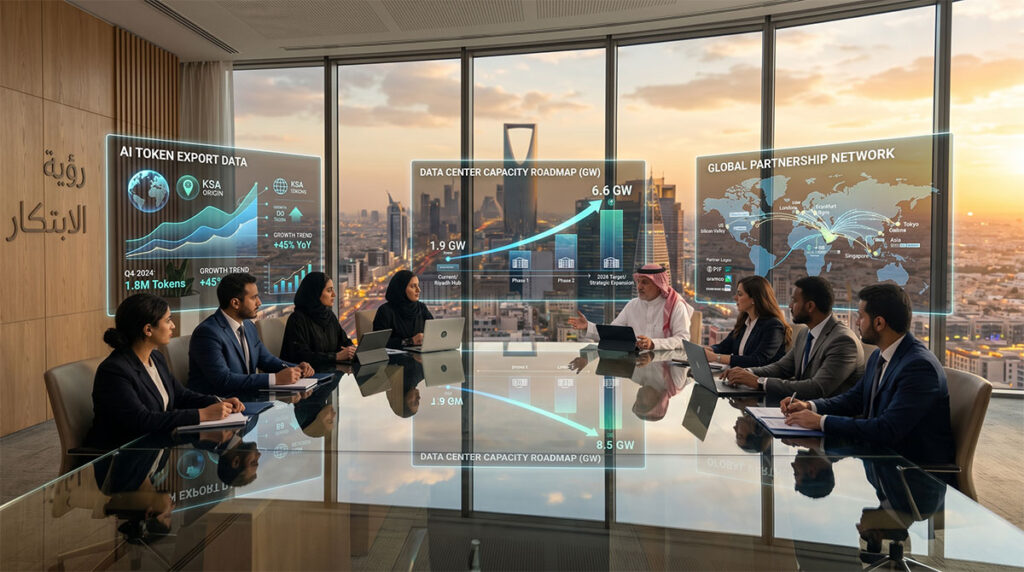
Amin’s stated ambition is unambiguous. Speaking to CNBC’s Access Middle East in August 2025, he said the goal of HUMAIN Saudi Arabia is to become the third-largest AI provider in the world, behind the United States and China. At the PIF Private Sector Forum in February 2026, he went further, declaring that Saudi Arabia intends to become the world’s largest exporter of AI tokens, leveraging the Kingdom’s abundant energy supply and geographic connectivity to the European, Asian, and African markets.
The strategic thinking here is straightforward. Saudi Arabia has something most AI superpowers lack in the quantities required for hyperscale compute: cheap, abundant energy. The Kingdom holds roughly 15.7 gigawatts of available energy capacity according to Amin’s comments at FII PRIORITY Miami 2026. Data centers are the new consumption engine for that energy, and AI tokens (the units of input and output processed by large language models) are the new export commodity. In the Kingdom’s framing, AI is the next oil, and HUMAIN Saudi Arabia is the refinery.
The Four Layers of HUMAIN’s AI Stack
HUMAIN Saudi Arabia describes its strategy as a full AI value chain organized across four integrated layers. Understanding these layers is the fastest way to grasp what HUMAIN Saudi Arabia actually does and where it is investing capital.
| Layer | What It Covers | Key Assets |
|---|---|---|
| AI Infrastructure | Data centers, power systems, networking, and cooling | HUMAIN Core data centers, stc joint venture, Infra partnership, Nvidia and AMD chip deployments |
| AI Cloud | GPU cloud services, model hosting, inference | AWS AI Zone, Groq inference clusters, HUMAIN Cloud platform |
| Data and Models | Sovereign foundation models, Arabic LLMs, training data | ALLaM 34B, HUMAIN Chat, xAI minority stake |
| Applications and Solutions | Enterprise platforms, AI agents, consumer products | HUMAIN ONE, HUMAIN Horizon Pro, HUMAIN Marketplace |
This layered approach is what investors and analysts mean when they say HUMAIN Saudi Arabia is a full-stack company. Each layer feeds the one above it: infrastructure hosts the cloud, the cloud trains and serves the models, the models power the applications, and the applications generate workloads that drive demand for more infrastructure. It is a self-reinforcing loop, similar in structure to how NVIDIA, Microsoft, or Alphabet operate, but engineered from the start around Saudi sovereignty and Arabic-first use cases.
Major Partnerships and Deals
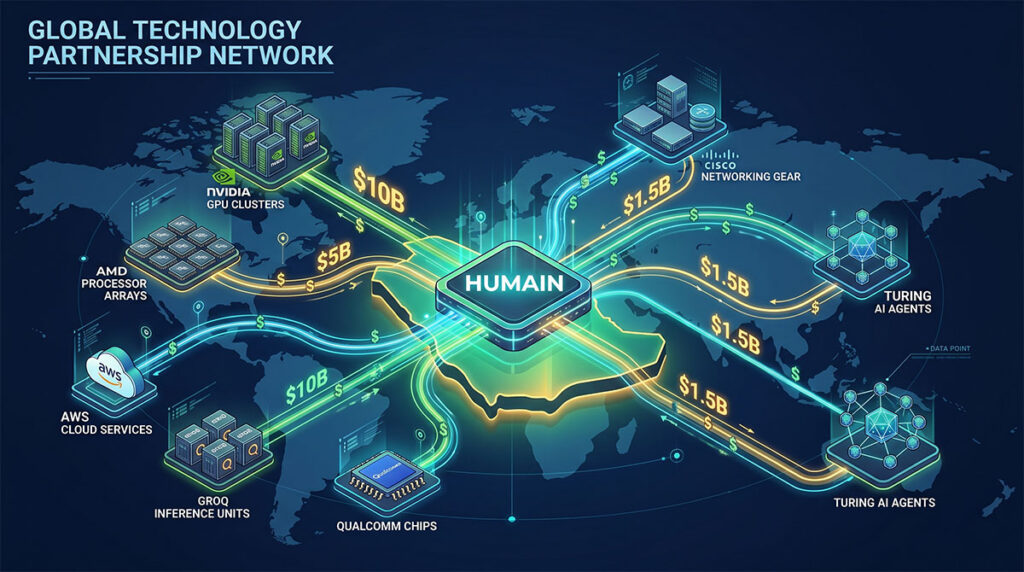
The partnership strategy of HUMAIN Saudi Arabia is where the scale of the ambition becomes concrete. The company has announced more than $23 billion in strategic technology partnerships and a separate $10 billion venture capital fund, HUMAIN Ventures, targeting AI startups in the US, Europe, and parts of Asia. Below are the most significant deals shaping HUMAIN Saudi Arabia today.
| Partner | Deal Value / Scope | Purpose |
|---|---|---|
| Nvidia | Up to 500 MW of compute, several hundred thousand GPUs over 5 years | AI factories powered by GB300 Grace Blackwell chips, starting with an 18,000-chip supercomputer |
| AMD | $10 billion joint investment, 500 MW of compute capacity | Data centers across Saudi Arabia and the United States |
| AWS (Amazon) | $5 billion+ investment | AI Zone in Riyadh with dedicated infrastructure, SageMaker, Bedrock, and Amazon Q |
| Groq | $1.5 billion commitment | Largest AI inference cluster in the region, 19,000 LPUs deployed in six days in Dammam |
| Cisco | Joint venture (with AMD) | Up to 1 GW of AI-optimized data centers, starting with 100 MW |
| Qualcomm | Product partnership | HUMAIN Horizon Pro AI PC built on Snapdragon silicon |
| xAI | Minority stake + 500 MW data center | Infrastructure for Elon Musk’s xAI in Saudi Arabia |
| Turing | Strategic partnership, first US customer of HUMAIN ONE | World’s first enterprise AI agent marketplace on HUMAIN ONE |
| EY | Strategic partnership | Embedding EY’s HR, tax, audit, and governance AI assets into HUMAIN ONE |
| Replit | Strategic partnership | First Arabic-first coding platform; “Nation of AI Coders” initiative |
| Blackstone / AirTrunk | $3 billion data center deal | Hyperscale data center capacity |
| Saudi Telecom Company (stc) | 51/49 joint venture | AI data center with up to 1 GW capacity, starting at 250 MW |
| Infra (National Infrastructure Fund) | Up to $1.2 billion financing framework | Up to 250 MW of additional AI data center capacity |
A few things stand out when you look at this list. First, HUMAIN Saudi Arabia is deliberately diversifying across chip suppliers. Relying solely on Nvidia would create a single point of failure and pricing dependency, so the AMD, Groq, and Qualcomm deals spread risk and unlock different performance profiles (training, inference, edge). Second, the partnerships are not one-way. Turing becoming the first US-based customer of HUMAIN ONE, and the $10 billion AMD deal spanning facilities in both Saudi Arabia and the United States, signal that HUMAIN Saudi Arabia wants to be an exporter of AI capacity, not just an importer of AI technology. Third, the partner list reaches across the Atlantic for compute and across the region for distribution, which aligns with the Kingdom’s broader strategy of sitting between the US and Asian AI ecosystems.
For a deeper view on how sovereign AI strategy shapes ecommerce and customer experience in the Kingdom, my guide on sovereign AI in Saudi Arabia walks through the commercial implications in detail.
HUMAIN ONE: The Agentic Operating System
HUMAIN ONE is the flagship enterprise product of HUMAIN Saudi Arabia and, in my view, the most interesting piece of what HUMAIN Saudi Arabia has shipped so far. It was unveiled on 28 October 2025 at the 9th edition of the Future Investment Initiative (FII9) in Riyadh, and positioned as an agentic AI operating system rather than a traditional application suite.
How HUMAIN ONE Works
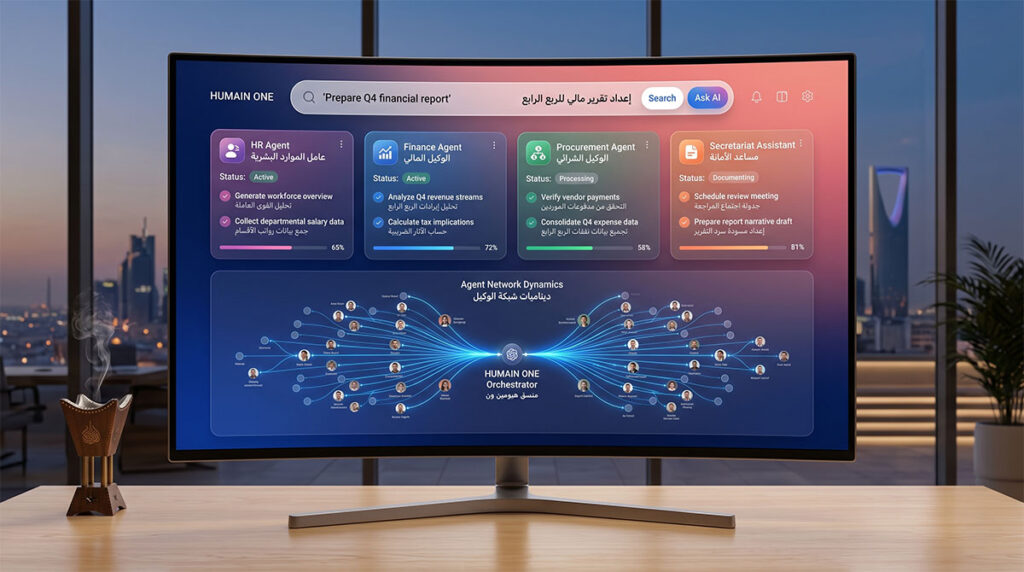
Instead of giving users a grid of application icons for HR, finance, procurement, and productivity, HUMAIN ONE exposes a single language-based interface. An employee expresses intent in plain Arabic or English, for example: “pull Q3 revenue by region and draft the variance commentary.” The system interprets the request, routes it across connected platforms and specialized AI agents, executes the underlying actions, and returns the result. Context switching between applications disappears.
Under the hood, HUMAIN ONE runs on the agentic orchestration engine developed by HUMAIN Saudi Arabia, powered by the ALLaM Arabic-first large language model. More than 150 AI agents are already managing corporate functions through the single HUMAIN ONE interface, according to disclosures from HUMAIN Saudi Arabia. Tareq Amin cited an early pilot in which a payroll preparation workflow that previously took 30 staff-hours across four employees was reduced to approximately 30 minutes with higher accuracy.
Core HUMAIN ONE Modules
- HUMAIN Secretariat — a proactive executive assistant managing meetings, calendars, tasks, and files.
- HUMAIN Search — a research tool that returns comprehensive insights in under three minutes.
- HUMAIN Connect — agentic video conferencing with live meeting summaries, action tracking, and context recall (Q4 2025).
- HUMAIN Workhub — an integrated office suite for documents, collaboration, and agentic workflows (Q1 2026).
- HUMAIN Code — a no-code and low-code environment where teams build custom agents from natural language prompts.
- HUMAIN Marketplace — an open platform where developers and enterprises publish, distribute, and monetize AI agents.
The marketplace piece is strategically important. Through a March 2026 partnership with Palo Alto-based Turing, HUMAIN Saudi Arabia is building what both companies describe as the world’s first enterprise AI agent marketplace. Turing is contributing model evaluation, fine-tuning, and reasoning expertise, while HUMAIN Saudi Arabia provides infrastructure, models, and orchestration. Third-party developers can publish and sell agents across HR, finance, legal, operations, and procurement, which turns HUMAIN ONE into a two-sided platform rather than a closed product. For the broader context on how agentic commerce is evolving, see my post on AI shopping agents and agentic commerce protocols.
ALLaM and HUMAIN Chat: Sovereign Arabic AI
ALLaM (Arabic Large Language Model) is the foundation model that powers HUMAIN ONE and the consumer-facing HUMAIN Chat application. Its history is worth understanding because it explains why HUMAIN Saudi Arabia has a credible technical foundation and not just press releases.
ALLaM development began in 2023 at the National Center for AI (NCAI) under the Saudi Data and AI Authority (SDAIA). Early versions (7B and 13B parameters) were released through IBM watsonx in May 2024, and ALLaM-2-7B landed on Microsoft Azure’s AI model catalog in September 2024. When HUMAIN Saudi Arabia was formed in May 2025, the company absorbed SDAIA’s model development team and took over the ALLaM roadmap.
The breakthrough release is ALLaM 34B, unveiled in August 2025 and launched alongside HUMAIN Chat on web, iOS, and Android. According to HUMAIN Saudi Arabia, ALLaM 34B was built from scratch rather than fine-tuned from an existing model, developed by a team of more than 120 AI specialists including 35 PhDs. Cohere, an independent evaluator, benchmarked it as the most advanced Arabic LLM developed in the Arab world on MMLU (Massive Multitask Language Understanding). A separate arXiv paper published in August 2025 by researcher Omer Nacar tested ALLaM 34B across modern standard Arabic, five regional dialects, reasoning, and safety prompts, and reported strong scores in generation and code-switching (4.92/5), MSA handling (4.74/5), reasoning (4.64/5), and safety (4.54/5).
What Makes HUMAIN Chat Different
- Arabic-first design. Handles Modern Standard Arabic, Najdi, Hijazi, Egyptian, Levantine, and Moroccan dialects, plus seamless Arabic-English code-switching within the same conversation.
- Sovereign hosting. The model runs end-to-end on HUMAIN infrastructure inside the Kingdom, fully compliant with Saudi Arabia’s Personal Data Protection Law (PDPL).
- Real-time web search. Returns current answers rather than relying only on training data.
- Multi-dialect speech input. Users can speak in their native dialect instead of typing.
- Groq-powered inference. HUMAIN Saudi Arabia deployed 19,000 Groq Language Processing Units (LPUs) in six days in Dammam, which the company says cuts inference cost by roughly 60% compared to alternatives elsewhere, and today serves users in 130 countries.
For Saudi and wider MENA enterprises, that combination is significant. Compliance with PDPL is not optional if you are processing customer data in the Kingdom. Running a frontier model on sovereign infrastructure with full data residency removes one of the largest blockers to AI adoption in regulated sectors like finance, healthcare, and government. If you want to understand the broader regulatory environment HUMAIN is operating inside, my guide to Saudi Arabia’s digital economy under Vision 2030 covers the policy backdrop.
Infrastructure: Data Centers, Chips, and Capacity
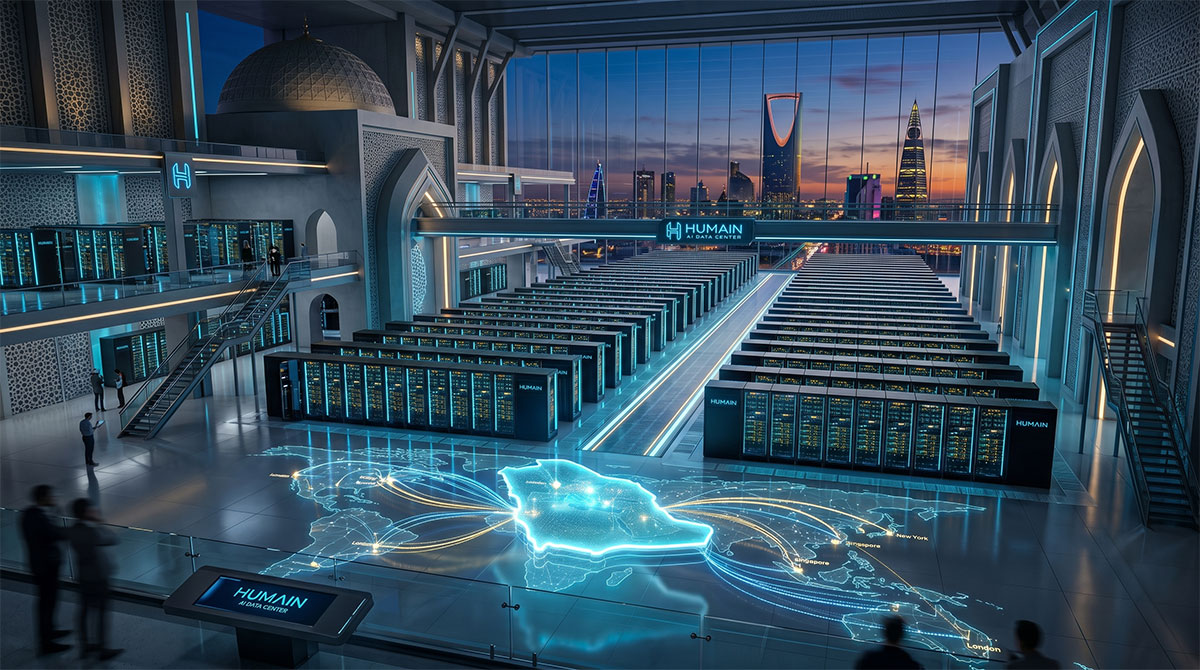
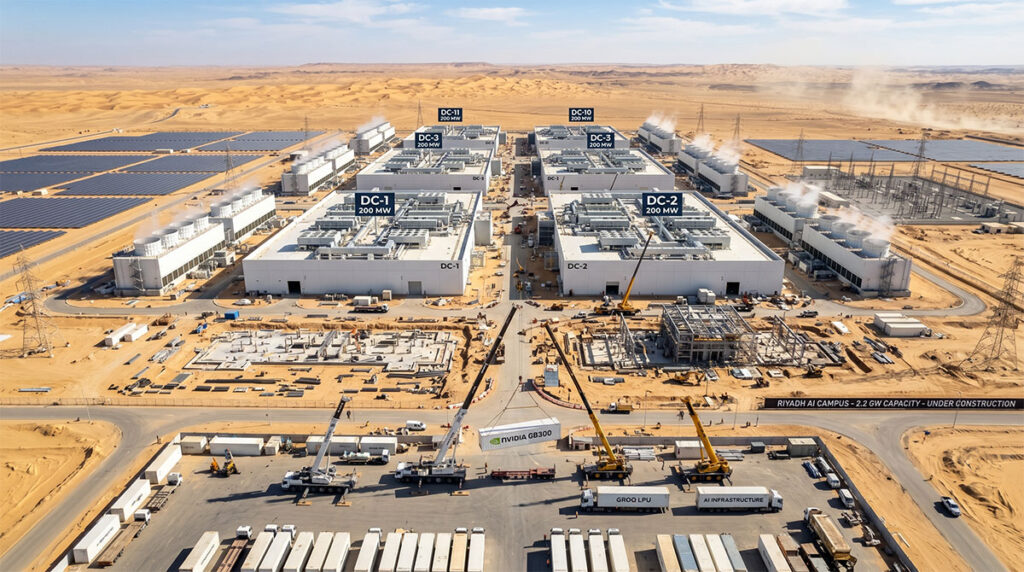
No sovereign AI strategy works without compute, and this is where HUMAIN Saudi Arabia has moved the fastest. HUMAIN Saudi Arabia has started construction on two large campuses made up of 11 data centers, each with 200-megawatt capacity according to reporting by CNBC. The initial target is 50 MW operational by the end of 2025, with an additional 50 MW added each quarter into 2026.
Capacity Roadmap
| Milestone | Capacity Target |
|---|---|
| Initial deployment (Phase 1) | 50 MW powered by 18,000 Nvidia GB300 chips |
| By 2030 | 1.9 GW of data center capacity |
| By 2034 | 6.6 GW (stated intent: 6% of global AI compute) |
| Future expansion | Up to 500 MW facility requiring ~180,000 chips |
| stc joint venture | 1 GW facility, starting at 250 MW |
| Infra framework | Up to 250 MW additional AI data center capacity |
The chip stack is deliberately diverse. For high-end training, HUMAIN Saudi Arabia is deploying Nvidia’s GB300 Grace Blackwell GPUs at scale, including an 18,000-chip supercomputer as the Phase 1 anchor. For more open and competitive economics, AMD’s Instinct accelerators fill the $10 billion joint venture footprint. For inference at scale, Groq’s Language Processing Units deliver the low-latency, high-throughput profile that chat and agent workloads need. And for edge and consumer AI, Qualcomm’s Snapdragon silicon powers the HUMAIN Horizon Pro AI PC, unveiled at the Snapdragon Summit in September 2025 as a flagship device purpose-built to run the AI-native OS from HUMAIN Saudi Arabia.
Energy is the hidden advantage. The Kingdom has roughly 15.7 GW of available energy capacity, which gives HUMAIN Saudi Arabia room to scale beyond 3 GW of AI compute by 2030 without the grid constraints now plaguing data center development in the United States and parts of Europe. That alone is a structural moat. For a broader look at the cloud and compute landscape these facilities sit inside, my guide to setting up AWS EC2 instances offers useful hands-on context on the underlying technologies.
HUMAIN’s Role in Vision 2030 and Sovereign AI
HUMAIN Saudi Arabia is best understood as the execution arm of the Kingdom’s national AI ambition under Vision 2030. The 2024 Global AI Index ranked Saudi Arabia as the world leader in government AI strategy, and SDAIA estimates AI will contribute $15.6 trillion to the global economy by 2030. The Saudi AI market itself is projected to grow from $79.9 million in 2024 to $800.6 million by 2030.
Inside that national context, HUMAIN Saudi Arabia sits alongside a broader ecosystem of Saudi AI institutions: SDAIA (national AI strategy and governance), KACST and KAUST (research), Alat (semiconductors and AI hardware), TONOMUS at NEOM (cognitive city infrastructure), Aramco Digital (industrial AI), Misk Foundation (AI literacy), and SVC and FII Institute (venture capital and thought leadership). The unique role of HUMAIN Saudi Arabia is to commercialize and export what the rest of the ecosystem researches and regulates.
The sovereignty angle is not purely symbolic. When Saudi data stays on Saudi infrastructure, governed by Saudi law, operating in Arabic by default, it removes a long list of practical barriers for public sector, financial services, and healthcare AI adoption. That is why HUMAIN Saudi Arabia is building its own data centers, training its own foundation model, and, according to Amin at the PIF Private Sector Forum in February 2026, preparing to launch its own commercial operating system, which would make Saudi Arabia the first country outside the US and China to commercialize one.
What HUMAIN Means for Saudi Businesses
If you run or advise a business in the Kingdom, here is where HUMAIN Saudi Arabia stops being an abstract policy story and starts affecting your roadmap.
For Enterprises and Government Entities
HUMAIN ONE offers a credible path to deploying agentic AI inside HR, finance, procurement, and operations without stitching together a dozen foreign SaaS tools. Because the underlying model is PDPL-compliant and hosted locally, enterprises in regulated sectors can move faster than they could on overseas platforms. EY’s integration of its HR, tax, audit, and governance AI assets into HUMAIN ONE means that the professional services layer on top of the platform is already forming. Expect large Saudi enterprises to start migrating back-office operations onto HUMAIN ONE through 2026 and 2027.
For SMEs and Ecommerce Operators
For smaller businesses, the more immediate benefit comes through ALLaM and HUMAIN Chat. An Arabic-native model with strong dialect handling changes what is possible for customer support automation, Arabic content generation, and voice-driven shopping experiences. Combined with the payments and logistics developments I cover in my guide on starting an ecommerce business in Saudi Arabia, this closes one of the remaining gaps holding back conversational commerce in the Kingdom. The HUMAIN Marketplace for AI agents also creates an opportunity for Saudi developers and agencies to build niche, industry-specific agents and monetize them regionally.
For Developers and AI Talent
HUMAIN’s partnership with Replit to create the first Arabic-first coding platform, alongside the “Nation of AI Coders” initiative, is aimed squarely at the talent pipeline. SDAIA and HUMAIN have committed to training more than 20,000 AI experts, and the Kingdom is already 14th globally in AI readiness (UNESCO 2024) with year-over-year AI hiring growth of 28.7%, the third-fastest in the world. For developers, the practical opportunity is to build on HUMAIN ONE’s no-code agent tooling, publish through the HUMAIN Marketplace, and participate in a builder economy that did not exist 18 months ago.
For Investors
HUMAIN Ventures, the $10 billion venture capital fund targeting AI startups in the US, Europe, and Asia, is one signal. PIF’s willingness to commit capital across infrastructure, models, and applications simultaneously is another. Saudi Arabia’s data center market alone is projected to grow from $1.33 billion in 2024 to $3.9 billion by 2030, and HUMAIN Saudi Arabia is positioned as the anchor player in that growth. The investment thesis is straightforward: if the Kingdom succeeds in becoming a net exporter of AI compute and tokens, HUMAIN Saudi Arabia captures the economic rent.
Challenges and Open Questions
An honest assessment needs to cover what could slow HUMAIN Saudi Arabia down, because the company is not operating in a vacuum.
Talent Gap
The Saudi Minister of Human Resources and Social Development, Ahmed Al-Rajhi, has publicly acknowledged a 50% hiring gap for AI-related roles in the Kingdom. HUMAIN Saudi Arabia is mitigating this with senior AI salaries averaging roughly $420,000 tax-free and with large-scale training programs, but building the middle layer of AI engineers, product managers, and ML operations staff is harder than writing a chip check. The UAE has a structural head start here through G42 and its ecosystem.
Geopolitical Balancing Act
Access to US chips for HUMAIN Saudi Arabia depends on a continued relaxation of export controls. The Trump administration’s rollback of the Biden-era AI diffusion rule opened the door for the initial Nvidia, AMD, and AWS deals, but any future tightening would put capacity plans at risk. Saudi Arabia also has to manage its largest trading partner, China, while building deeply with US technology suppliers, which constrains how it can source alternative hardware.
Execution Risk
Saudi Arabia has announced mega-projects before that remain in early stages years later. Moving from 50 MW of operational capacity to 6.6 GW in under a decade is an execution ask few organizations in history have pulled off. MIT research cited by Amin at the 2026 PIF Private Sector Forum estimates a 90% to 95% failure rate for enterprise AI pilots, and HUMAIN ONE’s value proposition depends on beating those odds at scale.
Environmental and Cost Pressure
Running and cooling gigawatt-scale data centers in a desert climate is expensive and carbon-intensive. The Kingdom has energy to spare, but water cooling and sustainability targets under Vision 2030 will require serious engineering and reporting rigor as capacity scales.
None of these challenges are fatal, but they are real. The difference between a $100 billion vision and a $100 billion business is in the operational details, and the next 24 months will tell us which way HUMAIN Saudi Arabia is going.
FAQ: HUMAIN Saudi Arabia
What is HUMAIN in Saudi Arabia?
HUMAIN Saudi Arabia is a full-stack artificial intelligence company wholly owned by Saudi Arabia’s Public Investment Fund (PIF) and chaired by HRH Crown Prince Mohammed bin Salman. It was launched on 12 May 2025 and covers AI infrastructure, AI cloud services, sovereign Arabic foundation models (ALLaM), and enterprise applications such as HUMAIN ONE and HUMAIN Chat.
Who owns HUMAIN?
HUMAIN Saudi Arabia is wholly owned by the Public Investment Fund (PIF), the Kingdom’s sovereign wealth fund with nearly $1 trillion in assets under management. HRH Crown Prince Mohammed bin Salman serves as Chairman of the Board, and Tareq Amin is the Chief Executive Officer.
When was HUMAIN founded?
HUMAIN Saudi Arabia was officially launched on 12 May 2025, one day before the Saudi-U.S. Investment Forum in Riyadh. It was formed by consolidating existing national AI assets, including the Saudi Company for AI (SCAI) and SDAIA’s model development team, with additional talent from Aramco Digital and TONOMUS.
What is the difference between HUMAIN ONE and ALLaM?
ALLaM is the Arabic-first large language model (the 34-billion-parameter version is the current flagship) developed by HUMAIN Saudi Arabia and SDAIA. HUMAIN ONE is the agentic enterprise operating system that runs on top of ALLaM, unifying HR, finance, procurement, and productivity into a single natural-language interface. Think of ALLaM as the engine and HUMAIN ONE as the vehicle it powers.
How does HUMAIN compare to the UAE’s G42?
G42 is the closest regional competitor to HUMAIN Saudi Arabia, operating under Abu Dhabi’s sovereign wealth funds with a similar full-stack approach. G42 has a head start (founded in 2018) in generative AI data center scale, but faced US national security concerns over China-linked activity. HUMAIN Saudi Arabia launched with clean US partnerships from day one, giving it preferred access to Nvidia, AMD, AWS, and Qualcomm technology, while G42 retains a lead in deployed capacity and partnerships such as the Stargate Campus in Abu Dhabi.
Can I use HUMAIN Chat outside Saudi Arabia?
At launch in August 2025, HUMAIN Chat was restricted to users inside Saudi Arabia. HUMAIN has publicly committed to expanding access across the wider Middle East and eventually globally, and Groq-powered inference infrastructure in Dammam is already serving users in 130 countries. Check chat.humain.ai for the current availability status in your region.
How many Nvidia chips does HUMAIN have?
Phase 1 of the Nvidia partnership includes 18,000 GB300 Grace Blackwell AI supercomputer chips in Riyadh. Over the next five years, Nvidia has committed to supplying several hundred thousand additional GPUs to HUMAIN Saudi Arabia, targeting up to 500 MW of compute capacity. A separate deal placed 150,000 Nvidia chips in a new AI Zone in Riyadh in partnership with Amazon.
Can external investors put money into HUMAIN?
HUMAIN Saudi Arabia itself is wholly owned by PIF and is not publicly traded. However, HUMAIN Ventures, the $10 billion venture capital fund, co-invests with external partners in global AI startups. The company has also explored an AI data center investment platform with the Infra national fund, structured to accept global and local institutional investor participation. For most investors, exposure today comes through partners (Nvidia, AMD, AWS, Groq, Qualcomm) or through Saudi-listed firms involved in the supply chain of HUMAIN Saudi Arabia.
Conclusion: Why HUMAIN Matters
HUMAIN Saudi Arabia is a serious, well-capitalized, deeply integrated bet on the idea that AI infrastructure, models, and applications should be built and owned sovereignly rather than rented from a small cluster of US and Chinese hyperscalers. The combination of PIF backing, Crown Prince sponsorship, experienced leadership, diversified chip partnerships, a credible Arabic-first model, and an agentic OS with a marketplace gives HUMAIN Saudi Arabia a genuine shot at becoming the third pole of the global AI economy. Whether it actually reaches 6% of global AI compute by 2034 is an open question, but the path is no longer hypothetical.
For businesses in the Kingdom, my practical recommendation is simple. Start evaluating HUMAIN ONE and ALLaM against your current stack now, not in 2027. The regulatory tailwinds (PDPL, Vision 2030, sovereign cloud mandates) combined with the performance and economics that HUMAIN Saudi Arabia is bringing online make it increasingly difficult to justify a pure foreign-SaaS strategy for Arabic-language, regulated, or government-adjacent workloads. Pilot early, negotiate hard, and make sure your team has at least one person tracking the releases from HUMAIN Saudi Arabia the way they track Google and Microsoft. This story is going to move fast.
Related reading:
- Sovereign AI Saudi Arabia & The “Saudi-First” Customer Experience
- Saudi Arabia’s Digital Economy: Vision 2030’s Tech-Driven Transformation
- Best AI Models and Agents: Hands-On Pricing, Pros, Cons, and Comparison
- The Ultimate Guide to Autonomous AI Agents
- AI Shopping Agents Ecommerce: The Complete Guide to Agentic Commerce
- The Spectacular Digital Transformation Journey of Saudi Arabia
Sources: Public Investment Fund (PIF) press release on HUMAIN launch; Nvidia Newsroom; AMD press release; AWS and Amazon partnership announcements; Arab News; CNBC; Fortune; Data Center Dynamics; Bloomberg; The National; PRNewswire; Middle East AI News; arXiv paper 2508.17378 (Nacar, 2025) “UI-Level Evaluation of ALLaM 34B”; SDAIA and National Center for AI documentation; Deloitte Middle East 2026 AI Trends Report; Mordor Intelligence Saudi Arabia Ecommerce Market Report (January 2026).
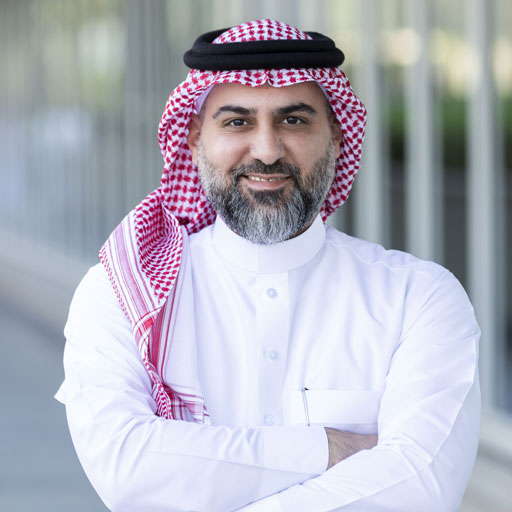
Husain Alhaboubi is Director of Digital Channels at Mobily, where he leads platform optimization, AI-powered customer engagement, and UI/UX strategy. With 20+ years of experience spanning eCommerce, IT infrastructure, and digital marketing, he previously drove a 225% revenue increase and 69% organic traffic growth as eCommerce Senior Manager at flyadeal, and managed enterprise IT operations — including data centers, ERP systems, and network security — as Group IT Manager at IPD Group.
Husain holds a BS in Information Systems from the University of Texas at Arlington and is certified in Google Ads, Google Analytics, and Semrush SEO. He writes from hands-on experience across both sides of digital business: the strategic (eCommerce, SEO, AI, digital transformation) and the technical (server administration, cloud computing, web development, networking, and security) — with a particular focus on the Saudi market and Vision 2030. Read his full resume →