
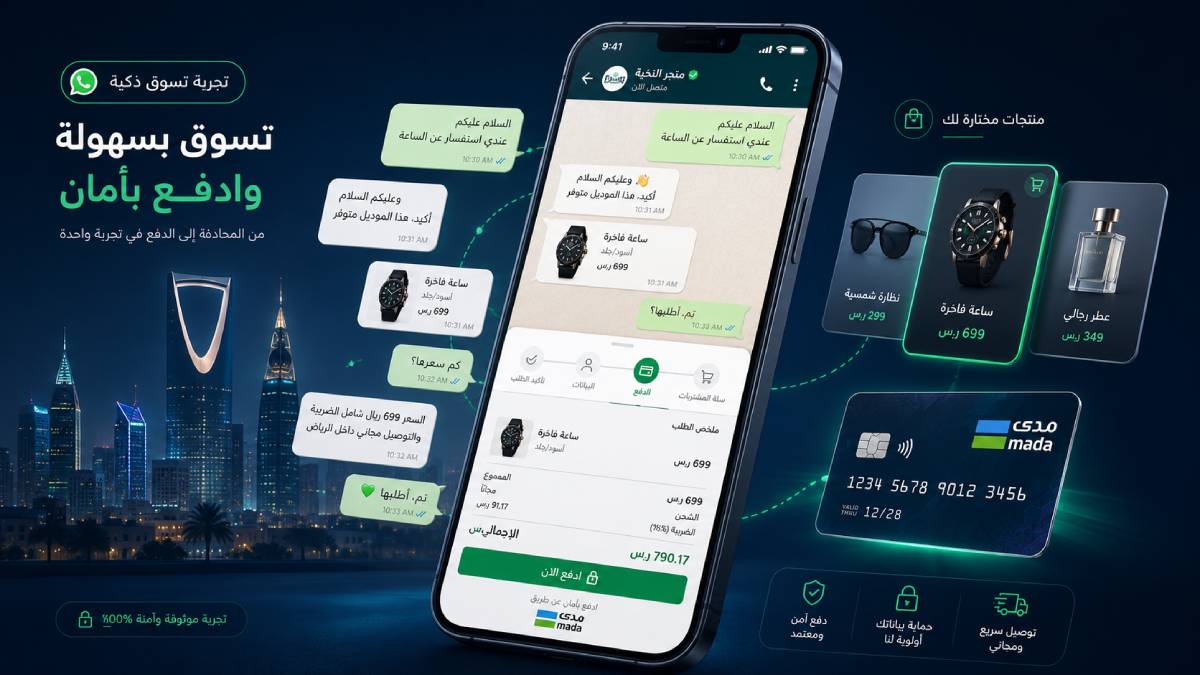
WhatsApp Commerce Saudi Arabia: The Complete Technical Guide for 2026
If you architect ecommerce systems for the Saudi market and you are still treating WhatsApp as a glorified support inbox, you are leaving the Kingdom’s highest-intent sales channel unbuilt. WhatsApp commerce Saudi Arabia has moved from a manual, copy-paste sales tactic into a fully programmable layer: a Cloud API, structured product catalogs, message templates, webhooks, and external payment rails that together turn a chat thread into a transactional checkout. With WhatsApp reaching roughly 80% penetration in the Kingdom and over 33 million active users, the question is no longer whether to build on it, but how to engineer it correctly. This guide is written for developers, CTOs, and solution architects who need the technical blueprint for WhatsApp commerce Saudi Arabia — the API model, the integration patterns with Salla and Zid, the payment flows that work locally, and the PDPL constraints that will get you fined if you ignore them.
Table of Contents
Why WhatsApp Is Saudi Arabia’s Highest-Intent Channel
Before writing a line of integration code, it helps to understand why WhatsApp commerce Saudi Arabia deserves a dedicated engineering investment rather than a third-party plugin you forget about. WhatsApp penetration in the Kingdom sits around 80% of the smartphone population, and business messaging interactions in Saudi Arabia grew 107% year-on-year, signalling a market shifting decisively toward conversational transactions. Across the GCC, 84% of ecommerce brands now treat conversational commerce as a strategic pillar rather than a side experiment.
The performance numbers explain the urgency. For a WhatsApp commerce Saudi Arabia strategy, the numbers are hard to ignore: brands deploying in-chat checkout report roughly 35% higher conversion rates than redirecting customers to a web storefront, and abandoned-cart recovery flows on WhatsApp routinely recover 25–40% of carts — figures no email sequence in the region comes close to matching. For a Saudi merchant whose customers already live inside WhatsApp, the friction of a separate website checkout is exactly where revenue leaks. A well-built WhatsApp commerce Saudi Arabia stack closes that gap by keeping discovery, support, and payment inside a single thread.
This consumer behavior is consistent with what I have covered before on how shoppers in the Kingdom move between channels. If you want the demand-side context behind these engineering decisions, my analysis of digital consumer behavior in Middle East ecommerce pairs well with the technical build described here.
The Architecture: Cloud API, BSPs, and Components
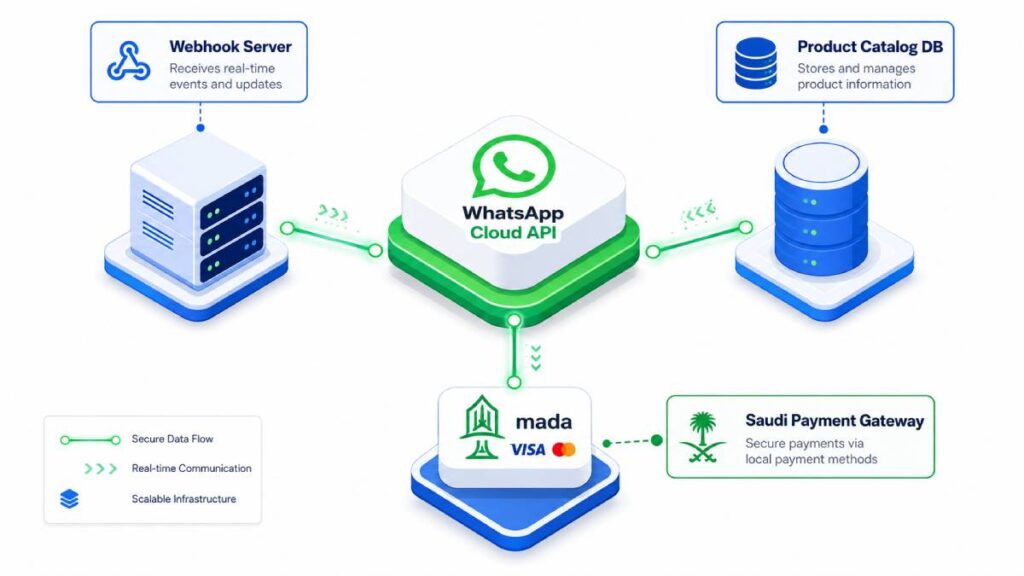
Every serious WhatsApp commerce Saudi Arabia implementation is built on the WhatsApp Business Platform, not the consumer app or the small-business mobile app. The Platform exposes two historical hosting models: the legacy On-Premises API, which Meta is sunsetting, and the Cloud API, which Meta hosts for free and which you should treat as the default for any new project. The Cloud API removes the burden of running your own messaging infrastructure and gives you the latest features first, which is why it underpins almost every production WhatsApp commerce Saudi Arabia build today.
Core components you will assemble
- WhatsApp Business Account (WABA): the top-level entity that holds your phone numbers, templates, and catalog.
- Business phone number: a dedicated number with a verified display name, separate from any number used on the consumer app.
- Cloud API endpoint: the Graph API surface you call to send and receive messages.
- Webhook receiver: your HTTPS endpoint that ingests inbound messages and delivery status events in real time.
- Product catalog: a Commerce Manager catalog linked to the WABA, holding up to 500 products.
- Payment layer: an external Saudi-licensed gateway, since native WhatsApp Pay is not available in the Kingdom.
You then choose between integrating directly with the Cloud API or working through a Business Solution Provider (BSP). Building directly gives you full control and the lowest per-message cost, but you own template management, number registration, and uptime. A BSP — locally, providers such as Unifonic, Deewan, Gabster, or LetsBot — abstracts much of that and ships native Salla and Zid connectors, at the cost of a markup. For most teams shipping WhatsApp commerce Saudi Arabia, the decision comes down to engineering capacity: if you have a backend team comfortable with webhooks and OAuth, go direct; if you need speed to market with prebuilt store integrations, a BSP earns its margin.
| Approach | Control | Per-message cost | Best for |
|---|---|---|---|
| Direct Cloud API | Full | Lowest (Meta rate only) | Teams with backend engineering capacity |
| BSP / aggregator | Partial | Meta rate + markup | Fast launch, native Salla/Zid connectors |
| No-code chatbot tool | Minimal | Highest (subscription + markup) | Non-technical merchants, simple flows |
Setup: WABA, System User Token, and Webhooks
The foundation of a direct integration is authentication and an event pipeline. For production, never authenticate with a personal user token. Instead, create a System User in Meta Business Suite and scope it to the whatsapp_business_messaging and whatsapp_business_management permissions. This produces a long-lived System User Access Token that survives staff changes and is the correct pattern for any WhatsApp commerce Saudi Arabia deployment that must stay online unattended.
With the token in hand, sending a message in your WhatsApp commerce Saudi Arabia backend is a single POST to the Graph API. Here is a minimal outbound text message in Node.js:
// Send a session (free-form) message inside the 24-hour service window
const sendMessage = async (to, body) => {
  const res = await fetch(
    `https://graph.facebook.com/v21.0/${PHONE_NUMBER_ID}/messages`,
    {
      method: "POST",
      headers: {
        Authorization: `Bearer ${SYSTEM_USER_TOKEN}`,
        "Content-Type": "application/json",
      },
      body: JSON.stringify({
        messaging_product: "whatsapp",
        to,                       // E.164 format, e.g. 9665XXXXXXXX
        type: "text",
        text: { body },
      }),
    }
  );
  return res.json();
};
The other half of the pipeline is the webhook. Without webhooks there is no automation: you cannot detect inbound questions, delivery failures, read receipts, or button clicks, and therefore cannot drive any commerce flow. You configure the webhook in the Meta App dashboard by supplying an HTTPS callback URL and a verification token, then subscribing to the messages field. Meta first sends a GET request to verify ownership:
// Webhook verification (GET) + event ingestion (POST)
app.get("/webhook", (req, res) => {
  const mode = req.query["hub.mode"];
  const token = req.query["hub.verify_token"];
  const challenge = req.query["hub.challenge"];
  if (mode === "subscribe" && token === VERIFY_TOKEN) {
    return res.status(200).send(challenge);
  }
  return res.sendStatus(403);
});

app.post("/webhook", (req, res) => {
  const entry = req.body.entry?.[0]?.changes?.[0]?.value;
  const message = entry?.messages?.[0];
  if (message) {
    // Route by type: text, interactive (button/list), order, etc.
    handleInbound(message, entry.contacts?.[0]);
  }
  res.sendStatus(200); // Always 200 quickly; process async
});
Two production notes that save you pain later: always return 200 immediately and process the payload on a queue, because Meta retries on slow responses and will duplicate events; and validate the X-Hub-Signature-256 header against your app secret so no one can forge order events into your WhatsApp commerce Saudi Arabia pipeline.
Message Templates, Categories, and the Pricing Model
Outside the 24-hour customer service window, you cannot send free-form messages — you must use a pre-approved message template. Templates have a strict structure (header, body, footer, and buttons), support variable placeholders, and must pass Meta’s review. Critically, every template is assigned a category, and the category determines both deliverability and cost. Getting categories right is the single biggest lever on the economics of WhatsApp commerce Saudi Arabia.
- Marketing: promotions, offers, re-engagement. The most expensive category and the one PDPL regulates most tightly.
- Utility: order confirmations, shipping updates, payment receipts tied to an existing transaction.
- Authentication: one-time passwords and login codes.
- Service: any non-template message inside the open 24-hour window — these are free.
If you submit a promotional template under the Utility category to dodge cost, Meta’s review will reject it with an INCORRECT_CATEGORY reason delivered to your webhook. Build template management so a rejection is surfaced and re-categorized, not silently retried.
The pricing model changed materially on 1 July 2025. Meta replaced conversation-based pricing with a per-message model: you are now charged per delivered template message rather than once per 24-hour conversation. Service messages within an open window remain free, and utility templates delivered inside an open service window are also free. For Saudi Arabia specifically, the October 2025 update lowered utility and authentication rates, which is good news for transactional WhatsApp commerce Saudi Arabia flows that lean heavily on order and shipping notifications.
| Template category | Typical use | Cost behavior |
|---|---|---|
| Marketing | Offers, launches, win-back | Charged per delivered message; highest rate |
| Utility | Order/shipping/payment updates | Free inside open service window; otherwise charged (lowered for KSA, Oct 2025) |
| Authentication | OTP, login | Charged; volume discounts apply |
| Service | Replies within 24h window | Free |
The architectural takeaway: design your flows to maximize utility and service messages and to trigger marketing templates only against an opted-in, segmented audience. A sending template via the API looks like this:
// Send an approved UTILITY template: order confirmation
const sendOrderConfirmation = (to, orderId, total) =>
  fetch(`https://graph.facebook.com/v21.0/${PHONE_NUMBER_ID}/messages`, {
    method: "POST",
    headers: {
      Authorization: `Bearer ${SYSTEM_USER_TOKEN}`,
      "Content-Type": "application/json",
    },
    body: JSON.stringify({
      messaging_product: "whatsapp",
      to,
      type: "template",
      template: {
        name: "order_confirmation_ar",
        language: { code: "ar" },
        components: [
          {
            type: "body",
            parameters: [
              { type: "text", text: orderId },
              { type: "text", text: `${total} SAR` },
            ],
          },
        ],
      },
    }),
  });
Catalog and Commerce: Product Messages and Flows

The catalog is what makes WhatsApp commerce Saudi Arabia truly transactional rather than conversational. It is the bridge between a chat and a checkout, and getting it right is what separates a real WhatsApp commerce Saudi Arabia storefront from a glorified contact form. You create a catalog in Commerce Manager, link it to your WABA, and reference products by their retailer IDs. Two constraints to design around: a catalog supports up to 500 products, and a WABA can have only one linked catalog. Large Saudi retailers therefore curate a WhatsApp-specific subset rather than syncing an entire Salla or Zid inventory.
Inside chat, you surface products through two interactive message types: the Single Product Message (SPM), which shows one item with a details view, and the Multi-Product Message (MPM), which presents a mini-catalog of sections the customer can browse and add to a cart — all without leaving WhatsApp. Here is an MPM payload:
// Multi-Product Message: show a curated catalog section in chat
const sendCatalog = (to) =>
  fetch(`https://graph.facebook.com/v21.0/${PHONE_NUMBER_ID}/messages`, {
    method: "POST",
    headers: {
      Authorization: `Bearer ${SYSTEM_USER_TOKEN}`,
      "Content-Type": "application/json",
    },
    body: JSON.stringify({
      messaging_product: "whatsapp",
      to,
      type: "interactive",
      interactive: {
        type: "product_list",
        header: { type: "text", text: "New Arrivals" },
        body: { text: "Tap to browse and add to your cart." },
        action: {
          catalog_id: CATALOG_ID,
          sections: [
            {
              title: "Abayas",
              product_items: [
                { product_retailer_id: "ABA-001" },
                { product_retailer_id: "ABA-002" },
              ],
            },
          ],
        },
      },
    }),
  });
When the customer adds items and sends the cart, your webhook receives an order message containing the product IDs, quantities, and an item-level price snapshot. That event is the trigger for your checkout flow. The five flows every WhatsApp commerce Saudi Arabia build should implement are abandoned-cart recovery (fired 30–60 minutes after an incomplete order), order confirmations, shipping updates, catalog browsing, and re-engagement campaigns. The abandoned-cart flow alone tends to deliver the highest return on engineering effort.
In-Chat Checkout and Payments in Saudi Arabia
This is where global tutorials mislead Saudi builders. Native WhatsApp Pay — the fully in-app payment experience — is only live in a handful of markets such as India, Brazil, and Singapore. It is not available in Saudi Arabia. Any WhatsApp commerce Saudi Arabia checkout therefore completes through an external, SAMA-licensed payment gateway, surfaced as a secure payment link inside the thread. The customer never has to install anything new; they tap a link, pay, and return to the conversation where your webhook confirms the transaction.
For local coverage, the gateways that matter are Moyasar — Saudi-built and SAMA-licensed, supporting MADA, Apple Pay, and stc pay with T+1 settlement — and Tap Payments, which additionally fronts the major BNPL providers. Because MADA dominates Saudi card payments, MADA support is non-negotiable. The payment options you expose mirror the broader Kingdom landscape I detailed in my guide to digital wallets in Saudi Arabia.
Buy now, pay later is now table stakes for Saudi conversion. Tamara and Tabby both expose hosted checkout that you can trigger with a payment link, letting customers split a purchase into interest-free instalments directly from the WhatsApp thread. If you are weighing which BNPL rails to integrate, my breakdown of buy now pay later in Saudi Arabia covers the merchant economics. A typical link-based checkout step looks like this:
// Create a Moyasar payment link, then send it as a WhatsApp CTA
const sendPaymentLink = async (to, orderId, amountHalalas) => {
  const invoice = await fetch("https://api.moyasar.com/v1/invoices", {
    method: "POST",
    headers: {
      Authorization: "Basic " + btoa(MOYASAR_SECRET_KEY + ":"),
      "Content-Type": "application/json",
    },
    body: JSON.stringify({
      amount: amountHalalas,          // SAR amount in halalas
      currency: "SAR",
      description: `Order ${orderId}`,
      callback_url: `https://store.example.sa/wa/callback/${orderId}`,
    }),
  }).then((r) => r.json());

  return sendMessage(to, `Complete your payment here: ${invoice.url}`);
};
The gateway’s own webhook confirms payment status back to your server; you then fire the utility template that confirms the order in the chat. Keep the payment confirmation and the WhatsApp confirmation on separate, idempotent handlers so a retried gateway webhook never double-sends to the customer.
Integrating with Salla and Zid
Most Saudi merchants already run on Salla or Zid, so your WhatsApp commerce Saudi Arabia layer rarely lives in isolation — it has to stay in sync with an existing storefront. There are two integration patterns.
The first is event-driven sync via the platform’s own webhooks and REST API. Both Salla and Zid emit events — order created, status changed, abandoned cart — that you subscribe to, then translate into the matching WhatsApp utility template. This keeps a single source of truth (the store) and uses WhatsApp purely as a messaging surface:
// Salla webhook -> WhatsApp utility template bridge
app.post("/salla/webhook", async (req, res) => {
  const { event, data } = req.body;
  if (event === "order.created") {
    const phone = data.customer.mobile;   // already E.164 from Salla
    await sendOrderConfirmation(phone, data.id, data.amounts.total.amount);
  }
  if (event === "abandoned.cart") {
    await sendCatalog(data.customer.mobile); // re-engage with products
  }
  res.sendStatus(200);
});
The second pattern is to adopt a BSP that ships a certified Salla or Zid app — LetsBot is an official partner on both, and Unifonic and Gabster offer native connectors with Arabic-first interfaces and local support. These handle order-status notifications, abandoned-cart recovery, OTP, and broadcast campaigns out of the box, with some Salla stores reporting cart-recovery rates up to 40% through personalized WhatsApp reminders carrying product images and discounts. The trade-off is the same as always: faster to ship, less control, a per-message markup. For a deeper view of how automated agents fit this stack, see my guide to AI agents for ecommerce.
AI Chatbot and Automation Architecture
A modern WhatsApp commerce Saudi Arabia deployment is increasingly fronted by an AI agent rather than a rigid decision tree. This is the layer where a WhatsApp commerce Saudi Arabia stack starts to feel less like messaging and more like a salesperson. The architecture is straightforward: the webhook receives an inbound message, a natural-language layer classifies intent (product query, order status, complaint, payment issue), and a routing layer decides whether to answer from a knowledge base, call your commerce API, or escalate to a human. Arabic-language handling — including Saudi dialect — is the differentiator, which is why locally trained models and Arabic-first BSPs matter here.
// Intent routing skeleton for an AI-fronted chat agent
async function handleInbound(message, contact) {
  const text = message.text?.body ?? "";
  const intent = await classifyIntent(text); // LLM or NLU service

  switch (intent.type) {
    case "product_query":
      return sendCatalog(message.from);
    case "order_status":
      return replyOrderStatus(message.from, intent.orderId);
    case "checkout":
      return sendPaymentLink(message.from, intent.orderId, intent.amount);
    default:
      return escalateToAgent(message.from, contact); // human handoff
  }
}
The automation that pays for itself fastest is abandoned-cart recovery, followed by proactive order and shipping updates that deflect “where is my order” tickets. Layer personalization on top — product recommendations based on prior purchases — and the channel starts behaving like a one-to-one storefront. The same personalization principles I described for AI ecommerce personalization apply directly to how you segment and target WhatsApp audiences.
PDPL Compliance for Broadcast Messaging
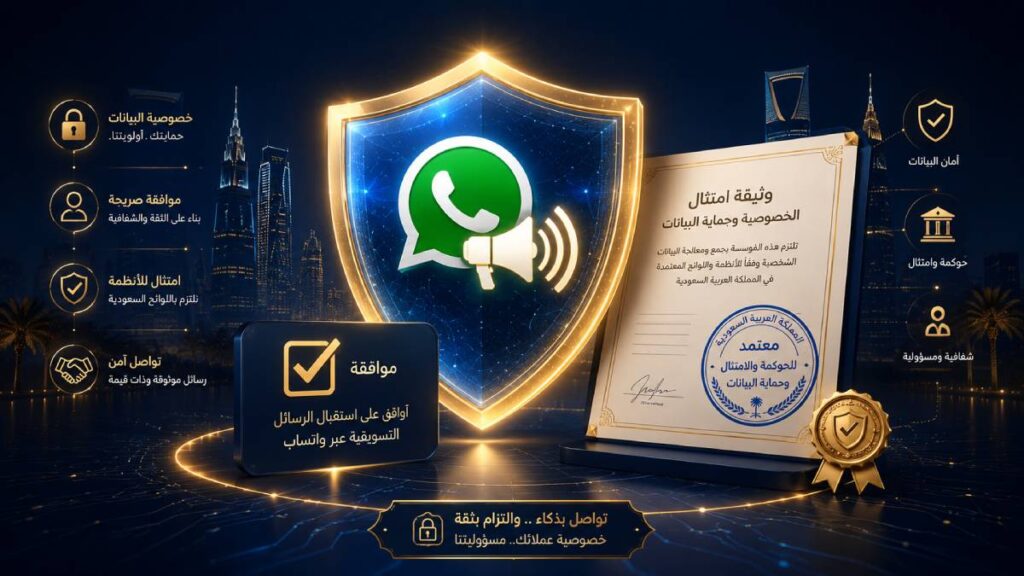
🚨 This is the section that protects your business. Every marketing broadcast you send through a WhatsApp commerce Saudi Arabia system is governed by Saudi Arabia’s Personal Data Protection Law (PDPL), enforced by SDAIA. Article 25 of the PDPL restricts direct marketing: you must obtain explicit, prior opt-in consent from a recipient before sending any promotional or awareness material through a personal channel like WhatsApp. Consent must be specific to marketing, documented, time-stamped, and revocable at any time.
This is not a theoretical risk. In 2025–2026, SDAIA’s enforcement committees issued 48 decisions confirming PDPL violations, and a notable share involved exactly this failure — sending marketing messages without prior consent, with retail among the most cited sectors. Penalties reach up to SAR 5,000,000 per breach, and repeat offences can double. For a channel as broadcast-friendly as WhatsApp, an unconsented campaign blast is one of the easiest ways to trigger a fine.
- Capture consent explicitly: a checkbox at checkout or a WhatsApp opt-in keyword, never pre-ticked, with the marketing purpose stated.
- Store proof: persist the consent event with a timestamp, source, and the exact wording the customer agreed to.
- Separate purposes: consent for transactional utility messages is distinct from consent for marketing — do not conflate them.
- Honor withdrawal instantly: a “stop” or unsubscribe must suppress future marketing within your system immediately.
- Mind data residency: SDAIA and CST rules push toward keeping Saudi personal data in the Kingdom, so check where your BSP and CRM store records.
Engineer consent as a first-class field in your customer model, not an afterthought, and gate every marketing-category template send behind it. Done properly, PDPL compliance also improves deliverability, because an opted-in audience reports fewer blocks — and WhatsApp quality ratings, which throttle your sending limits, depend directly on how recipients react to your messages.
FAQ: WhatsApp Commerce Saudi Arabia
Is native WhatsApp Pay available in Saudi Arabia?
No. Native in-app WhatsApp Pay is live only in select markets such as India, Brazil, Mexico, and Singapore. In the Kingdom, WhatsApp commerce Saudi Arabia checkout completes through an external SAMA-licensed gateway — typically Moyasar or Tap Payments — surfaced as a secure payment link inside the chat thread, with MADA, Apple Pay, stc pay, and BNPL options.
Should I build on the Cloud API directly or use a BSP?
For a WhatsApp commerce Saudi Arabia project, build directly on the Cloud API if you have backend engineers comfortable with webhooks, OAuth, and template management — you get the lowest per-message cost and full control. Use a Business Solution Provider such as Unifonic, LetsBot, or Gabster if you need fast launch with prebuilt Salla and Zid connectors and Arabic-first support, accepting a per-message markup.
How does WhatsApp pricing work after the 2025 change?
This is central to WhatsApp commerce Saudi Arabia economics. Since 1 July 2025, Meta charges per delivered template message instead of per 24-hour conversation. Service messages within an open window are free, and utility templates inside an open service window are also free. Saudi Arabia saw utility and authentication rates lowered in October 2025, which favors transactional flows like order and shipping notifications.
What consent do I need before sending WhatsApp marketing in Saudi Arabia?
Under PDPL Article 25, you need explicit, prior opt-in consent specific to marketing before broadcasting promotional messages. The consent must be documented, time-stamped, and revocable. Transactional utility messages tied to an existing order are treated differently from marketing, but you should still keep clear records of the lawful basis for every message type.
How many products can a WhatsApp catalog hold?
A single catalog supports up to 500 products, and a WhatsApp Business Account can link only one catalog. Most WhatsApp commerce Saudi Arabia retailers therefore curate a WhatsApp-specific subset of their Salla or Zid inventory rather than syncing the full catalog, prioritizing best-sellers and new arrivals.
Can I connect WhatsApp commerce to Salla and Zid?
Yes, and most WhatsApp commerce Saudi Arabia builds do exactly that. You can connect via each platform’s webhooks and REST API to bridge store events into WhatsApp templates, or adopt a certified BSP app. LetsBot is an official partner on both Salla and Zid, and Unifonic and Gabster offer native connectors covering order notifications, abandoned-cart recovery, OTP, and broadcasts.
What results can abandoned-cart recovery deliver on WhatsApp?
In a well-built WhatsApp commerce Saudi Arabia setup, abandoned-cart flows commonly recover 25–40% of carts, far above email benchmarks, and in-chat checkout has been associated with roughly 35% higher conversion. The strongest results come from personalized reminders sent 30–60 minutes after abandonment, carrying the product image and a time-bound incentive — always to an opted-in recipient.
Conclusion: Engineering for the Chat-First Buyer
The Saudi shopper already lives inside WhatsApp, and the platform now exposes everything you need to meet them there programmatically: a free Cloud API, structured catalogs, interactive product messages, a per-message pricing model that rewards transactional flows, and a mature local payment ecosystem to close the sale. Building WhatsApp commerce Saudi Arabia well is less about any single feature and more about assembling these pieces into reliable, idempotent, consent-aware flows. Start with the webhook pipeline and utility messaging, layer in the catalog and external checkout, connect it to your Salla or Zid source of truth, and only then turn on marketing broadcasts — behind documented PDPL consent. Engineer it in that order and WhatsApp stops being a support channel and becomes your highest-converting storefront in the Kingdom.
Related reading:
- AI Agents for eCommerce: Automate Inventory, Customer Service, and Pricing
- AI Ecommerce Personalization: The Complete Guide to Boosting Revenue
- Digital Wallets Saudi Arabia: Cashless Payment Guide
- Buy Now Pay Later in Saudi Arabia: Complete Guide to BNPL Services
- Start an Ecommerce Business in Saudi Arabia: The Complete Guide
- Digital Consumer Behavior in Middle East E-commerce
Sources: Meta for Developers — WhatsApp Cloud API and Pricing documentation; Unifonic and Campaign Middle East on Saudi conversational commerce adoption; SDAIA / PDPL Article 25 enforcement reporting (IAPP, A&O Shearman); Moyasar and Tap Payments documentation; Salla and Zid integration partners (LetsBot, Gabster).

Husain Alhaboubi is Director of Digital Channels at Mobily, where he leads platform optimization, AI-powered customer engagement, and UI/UX strategy. With 20+ years of experience spanning eCommerce, IT infrastructure, and digital marketing, he previously drove a 225% revenue increase and 69% organic traffic growth as eCommerce Senior Manager at flyadeal, and managed enterprise IT operations — including data centers, ERP systems, and network security — as Group IT Manager at IPD Group.
Husain holds a BS in Information Systems from the University of Texas at Arlington and is certified in Google Ads, Google Analytics, and Semrush SEO. He writes from hands-on experience across both sides of digital business: the strategic (eCommerce, SEO, AI, digital transformation) and the technical (server administration, cloud computing, web development, networking, and security) — with a particular focus on the Saudi market and Vision 2030. Read his full resume →